

Introduction
One of the first specifications you’ll notice when shopping for a power bank is its battery capacity, usually displayed as 5,000mAh, 10,000mAh, 20,000mAh, or even higher.
Many people assume that a higher number automatically means better performance. While battery capacity is an important factor, it doesn’t tell the whole story.
Questions such as “What does mAh actually mean?”, “Why doesn’t my 10,000mAh power bank charge my 5,000mAh phone twice?”, and “How much capacity do I really need?” are among the most common questions buyers ask.
Understanding these concepts will help you compare different models, estimate real charging performance, and choose a power bank that matches your daily needs.
Quick Answer
Power bank capacity refers to the amount of electrical energy a power bank can store, usually measured in milliampere-hours (mAh). A higher mAh rating generally means more stored energy, but the actual usable capacity is lower because some energy is naturally lost during voltage conversion and the charging process.
For a complete overview of portable chargers, read our Power Banks and Portable Charging guide, which explains battery technology, charging methods, safety features, and buying considerations.
In this article, we’ll explain what battery capacity really means, how mAh is measured, why usable capacity differs from advertised capacity, and how to choose the right capacity for your devices.
What Does Power Bank Capacity Mean?
Power bank capacity describes how much electrical energy a power bank can store inside its rechargeable battery cells.

In simple terms, it tells you how much power is available to charge your electronic devices before the power bank itself needs to be recharged.
Generally speaking:
- Higher capacity = More stored energy
- More stored energy = More potential charging time
However, battery capacity should not be confused with charging speed.
A larger battery stores more energy, but it doesn’t necessarily charge your devices faster.
Charging speed depends on factors such as output power, charging protocol, and device compatibility.
What Is mAh?
The term mAh stands for milliampere-hour, a unit used to describe battery capacity.
It indicates how much electrical charge a battery can store over time.
For example:
- 5,000mAh means the battery stores approximately 5,000 milliampere-hours of electrical charge.
- 10,000mAh stores roughly twice as much energy as a 5,000mAh battery under similar conditions.
- 20,000mAh stores even more energy, making it suitable for charging multiple devices or providing several phone recharges.
The higher the mAh rating, the greater the amount of energy available for portable charging.
However, actual charging performance depends on several additional factors, which we’ll discuss later in this guide.
How Is Power Bank Capacity Measured?
Manufacturers measure battery capacity using standardized testing procedures based on the rechargeable battery cells inside the power bank.
The capacity printed on the product refers to the combined capacity of the internal battery cells rather than the amount of energy that reaches your phone.
During charging, electricity passes through several electronic components, including voltage converters and protection circuits.
Because of this energy conversion process, a small percentage of stored energy is naturally lost before it reaches your device.
This is why the usable charging capacity is always lower than the advertised battery capacity.
To learn how energy moves through a power bank and why voltage conversion is necessary, read our detailed guide on How Power Bank Works.
Does a Higher mAh Always Mean a Better Power Bank?
Not necessarily.
Although higher-capacity power banks can store more energy, they also tend to be:
- Larger
- Heavier
- More expensive
- Slower to recharge
For someone who only needs emergency backup during the day, a compact 10,000mAh model may be a better choice than a bulky 30,000mAh power bank.
On the other hand, travelers, photographers, campers, and professionals who carry multiple devices may benefit from larger-capacity models.
Choosing the right power bank is about balancing battery capacity, portability, charging speed, and your everyday charging requirements.
Common Power Bank Capacity Options
Most power banks fall into one of these capacity ranges:
5,000mAh Power Banks
Best for:
- Emergency charging
- Light daily use
- Compact portability
Ideal for users who want a lightweight backup charger that easily fits into a pocket or small bag.
10,000mAh Power Banks
Best for:
- Everyday users
- Students
- Office workers
- Daily commuting
This capacity offers a balance between portability and charging capability, making it one of the most popular choices.
20,000mAh Power Banks
Best for:
- Frequent travellers
- Business professionals
- Charging multiple devices
- Long trips
These models provide significantly more backup power but are generally larger and heavier than lower-capacity options.
Real Capacity vs Advertised Capacity
One of the biggest misconceptions about power banks is that the advertised battery capacity is the exact amount of energy your devices will receive.

In reality, this isn’t how power banks work.
The capacity printed on the product—such as 10,000mAh or 20,000mAh—refers to the internal battery cells under specific testing conditions.
Before that stored energy reaches your smartphone or tablet, it passes through electronic components that regulate and convert the voltage.
During this process, some energy is naturally lost.
As a result, the usable capacity is always lower than the advertised capacity.
This is completely normal and applies to virtually all modern power banks.
Why Is Energy Lost During Charging?
Energy loss occurs because no electrical system is 100% efficient.
When a power bank transfers energy to your device, part of that energy is used by its internal electronics, while another portion is released as heat.
Some common causes of energy loss include:

- Voltage conversion
- Heat generation
- Battery chemistry
- Charging controller operation
- Cable resistance
- Device charging efficiency
These small losses add up, which is why the full advertised capacity never reaches your device.
Our How Power Bank Works guide explains how voltage converters and charging controllers regulate this process.
What Is Charging Efficiency?
Charging efficiency describes how much of the stored energy actually reaches your device.
For example, if a power bank stores 10,000mAh of energy, only a portion of that energy becomes usable after accounting for conversion losses.
Higher-quality power banks generally provide better charging efficiency because they use more efficient voltage converters, higher-quality battery cells, and improved internal electronics.
This is one reason premium power banks often deliver better real-world performance than cheaper alternatives with similar advertised capacities.
Why Doesn’t a 10,000mAh Power Bank Charge a 5,000mAh Phone Twice?
This is one of the most common questions buyers ask.
At first glance, it seems logical that a 10,000mAh power bank should recharge a 5,000mAh phone exactly two times.
However, real-world charging involves energy conversion, battery management, cable losses, and heat generation.
Because of these unavoidable losses, the actual number of full charges is usually lower than the simple mathematical calculation.
Example
Suppose you have:
- Power bank capacity: 10,000mAh
- Smartphone battery: 5,000mAh
A simple calculation suggests two full charges.
In practice, however, the usable energy is lower due to charging efficiency.
As a result, you might get approximately 1.5 to 1.8 full charges, depending on:
- Power bank quality
- Charging efficiency
- Cable quality
- Phone battery condition
- Ambient temperature
This is normal and should not be considered a defect.
How Much Capacity Do You Really Need?
The ideal capacity depends on how and where you use your devices.
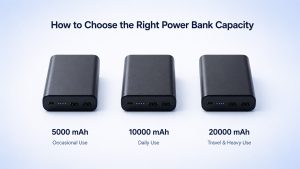
5,000mAh
Suitable for:
- Emergency backup
- Occasional use
- Short trips
10,000mAh
Recommended for:
- Daily commuting
- Students
- Office workers
- One smartphone with occasional recharging
This is often the best balance between portability and battery life.
20,000mAh
A good choice for:
- Frequent travelers
- Remote workers
- Charging multiple devices
- Long outdoor trips
These power banks provide more backup power but are generally larger and heavier.
30,000mAh and Above
Designed for users with demanding power needs, such as:
- Content creators
- Photographers
- Campers
- Professionals carrying multiple devices
Before purchasing a very high-capacity power bank, consider whether the additional weight and size fit your daily routine.
Capacity Is Only One Part of the Buying Decision
Many buyers focus only on battery capacity, but other specifications are equally important.
When comparing power banks, also consider:
- Charging speed
- USB Power Delivery (PD) support
- Qualcomm Quick Charge (QC) compatibility
- Number of output ports
- USB-C support
- Safety certifications
- Overall build quality
Choosing a well-balanced power bank often provides a better user experience than selecting the highest mAh rating alone.
If you’re still learning the basics, our What Is a Power Bank guide explains the key features and types of portable chargers.
Common Myths About Power Bank Capacity
Battery capacity is one of the most misunderstood aspects of portable charging. Let’s clear up some common myths.
Myth 1: Higher mAh Always Means a Better Power Bank
Fact: A higher mAh rating means the power bank can store more energy, but it doesn’t automatically make it the best choice.
A larger capacity usually means:
- More weight
- Longer recharge time
- Higher cost
For many users, a compact 10,000mAh power bank is more practical than a larger 30,000mAh model.
Myth 2: A 20,000mAh Power Bank Delivers 20,000mAh to Your Phone
Fact: The advertised capacity refers to the internal battery cells.
Some energy is naturally lost during voltage conversion, heat generation, and power transfer, so the usable capacity is always lower.
This is normal and applies to nearly every modern power bank.
Myth 3: Battery Capacity Determines Charging Speed
Fact: Capacity and charging speed are two different specifications.
Charging speed depends on factors such as:
- Output wattage
- USB Power Delivery (PD)
- Qualcomm Quick Charge (QC)
- Device compatibility
- Charging cable quality
A smaller power bank with fast-charging support may recharge a phone faster than a larger power bank without it.
Myth 4: Bigger Is Always Better
Fact: The best power bank is the one that matches your needs.
A traveler carrying multiple devices may benefit from a 20,000mAh model, while someone who only needs occasional backup power may find a 10,000mAh model more convenient.
Choosing based on your daily usage is more important than choosing the highest capacity available.
Frequently Asked Questions (FAQs)
What does mAh mean on a power bank?
mAh stands for milliampere-hour, a unit that measures how much electrical charge a battery can store. In general, a higher mAh rating means the power bank can provide more backup power before it needs to be recharged.
How much power bank capacity do I need?
The right capacity depends on your usage.
- Around 5,000mAh is suitable for light emergency use.
- Around 10,000mAh is a popular choice for everyday smartphone users.
- Around 20,000mAh or more is better for travel, multiple devices, or extended use away from power outlets.
Why is the usable capacity lower than the advertised capacity?
Power banks lose a small amount of energy during voltage conversion, internal circuit operation, and heat generation.
Because of these normal losses, the amount of energy delivered to your device is lower than the printed battery capacity.
Does a larger power bank charge faster?
No.
A larger battery stores more energy, but charging speed depends on the power bank’s output power and supported charging technologies, not its capacity alone.
Is a higher-capacity power bank worth buying?
If you frequently travel, charge multiple devices, or spend long periods away from electrical outlets, a higher-capacity power bank can be a worthwhile investment.
However, for everyday use, a smaller model may provide a better balance between portability and convenience.
Conclusion
Understanding power bank capacity helps you make smarter buying decisions and set realistic expectations for charging performance.
While a higher mAh rating means the power bank can store more energy, the actual usable capacity depends on charging efficiency, voltage conversion, battery quality, and other technical factors.
Instead of choosing a power bank based only on the largest number printed on the box, consider your daily charging habits, the devices you own, portability, and charging features such as USB Power Delivery and Quick Charge support.
By selecting the right capacity for your needs, you’ll enjoy more reliable portable charging, better battery performance, and a more satisfying user experience.