

Introduction
Power banks and portable charging have become essential for keeping smartphones, tablets, wireless earbuds, smartwatches, and other portable devices powered throughout the day. Running out of battery while traveling, working, or studying can be frustrating, especially when you don’t have access to a wall outlet.
A power bank is a portable battery that stores electrical energy and allows you to recharge compatible devices without needing a wall outlet. Over the years, power banks have become more powerful, faster, and more efficient, making them one of the most useful accessories for modern electronics.
However, choosing and using a power bank isn’t just about buying the largest battery capacity. Understanding how power banks work, how capacity is measured, how to charge them correctly, and what safety features to look for can help you get better performance and extend the lifespan of both your power bank and your devices.
Quick Answer
A power bank is a rechargeable portable battery that stores electrical energy and delivers it to compatible devices through USB or USB-C ports. Modern power banks include safety features, fast charging support, and multiple output options, making them a reliable portable charging solution for smartphones, tablets, earbuds, cameras, and other USB-powered devices.
In this complete guide, you’ll learn everything you need to know about power banks and portable charging—from how they work to charging methods, battery capacity, safety, maintenance, and tips for choosing the right model.
What Are Power Banks?
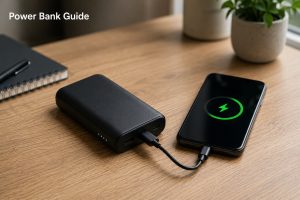
A power bank is a portable rechargeable battery designed to store electrical energy and recharge other electronic devices when a wall outlet isn’t available.
Inside every power bank are rechargeable battery cells, a charging control circuit, safety components, and one or more output ports that deliver power to connected devices.
Most modern power banks can charge:
- Smartphones
- Tablets
- Wireless earbuds
- Smartwatches
- Bluetooth speakers
- Portable gaming devices
- Cameras
- USB-powered accessories
Instead of relying on a fixed power source, a power bank lets you carry stored energy wherever you go, making it an ideal companion for travel, commuting, outdoor activities, and emergencies.
Want a deeper explanation? Read our complete guide on What Is a Power Bank to learn about its components, types, and everyday uses.
Power Banks and Portable Charging Explained
Portable charging refers to any method of charging electronic devices using a portable power source instead of a traditional wall outlet.
Although power banks are the most common portable charging solution, the term also includes products such as:
- Solar chargers
- Portable power stations
- Battery cases
- Wireless power banks
- Car charging solutions
For most users, however, portable charging simply means using a power bank to recharge devices while away from home or the office.
As smartphones and other electronics become more powerful, portable charging has become an essential part of daily life for students, professionals, travelers, and remote workers.
Why Are Power Banks So Popular?
Power banks have become increasingly popular because modern devices consume more power than ever before.
Streaming videos, using GPS navigation, gaming, video calls, and mobile photography all drain battery life quickly.
A reliable power bank solves this problem by providing backup power whenever you need it.
Some of the biggest reasons people use power banks include:
- Charging devices while traveling
- Staying connected during long commutes
- Backup power during emergencies
- Charging multiple devices on the go
- Working remotely without worrying about battery life
- Keeping essential devices powered during power outages
With fast charging technologies and larger battery capacities becoming more common, today’s power banks offer much more than simple emergency charging.
How Do Power Banks Work?
Portable charging follows a straightforward process.
First, the power bank is charged using a compatible charger and cable.
The electrical energy is stored inside rechargeable lithium-ion or lithium-polymer battery cells.
When you connect a device, the power bank’s internal control circuit manages the flow of electricity, delivering the correct voltage and current required by the connected device.
Throughout the charging process, built-in safety systems monitor temperature, voltage, current, and battery status to ensure safe and efficient operation.
If you’d like to understand the technology behind this process, read our detailed guide on How Power Bank Works.
Main Components of Power Banks
Although power banks come in different sizes and designs, most models contain the same essential components.
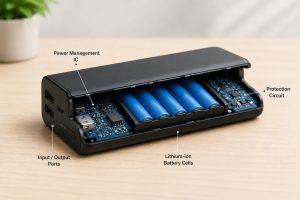
Rechargeable Battery Cells
The battery cells store electrical energy until it is needed.
Most modern power banks use either lithium-ion (Li-ion) or lithium-polymer (Li-Po) batteries because they provide high energy density, long cycle life, and reliable performance.
Charging Controller
The charging controller manages both charging and discharging.
It regulates voltage and current, protects the battery, and helps maximize charging efficiency.
Input Ports
Input ports allow the power bank itself to be recharged.
Common options include:
- USB-C
- Micro-USB (older models)
- Lightning (some models)
Output Ports
Output ports deliver power to your devices.
Many modern power banks include:
- USB-A
- USB-C
- Multiple output ports for charging several devices simultaneously
Safety Protection Circuit
Every quality power bank includes built-in protection systems designed to reduce the risk of damage.
These safety features often include:
- Overcharge protection
- Over-discharge protection
- Over-current protection
- Short-circuit protection
- Temperature monitoring
- Over-voltage protection
These components work together to provide reliable and safe portable charging.
Different Types of Power Banks
Power banks are available in various types, each designed for different charging needs. Understanding these options can help you choose the right portable charger for your lifestyle.
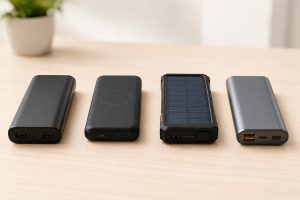
Standard Power Banks
Standard power banks are the most common type. They use USB-A or USB-C ports to charge smartphones, tablets, earbuds, and other USB-powered devices.
These models are suitable for everyday use and are available in a wide range of battery capacities.
Fast Charging Power Banks
Fast charging power banks support technologies such as USB Power Delivery (PD) and Qualcomm Quick Charge (QC).
They can recharge compatible devices much faster than standard power banks, making them ideal for users who need quick charging while traveling or working.
Wireless Power Banks
Wireless power banks allow compatible devices to charge without connecting a cable.
Simply place a Qi-compatible smartphone on the charging surface to begin charging.
Although convenient, wireless charging is generally slower than wired charging.
Solar Power Banks
Solar power banks include small solar panels that can generate electricity from sunlight.
While solar charging can be useful in emergencies or outdoor activities, most models still rely on USB charging as their primary charging method because solar charging is relatively slow.
High-Capacity Power Banks
These models typically offer capacities of 20,000mAh or more.
They are designed for users who need to charge multiple devices or require backup power during long trips or power outages.
Understanding Power Bank Capacity
One of the most important specifications of any power bank is its battery capacity.
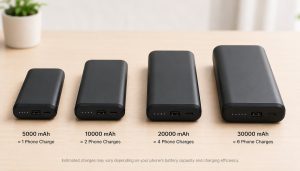
Capacity indicates how much electrical energy the power bank can store and is usually measured in milliampere-hours (mAh).
In general:
- 5,000mAh – Light everyday use
- 10,000mAh – One to two smartphone charges
- 20,000mAh – Multiple device charges
- 30,000mAh and above – Heavy users and travel
However, the advertised capacity is not the exact amount of usable energy delivered to your devices.
Some energy is naturally lost during voltage conversion and power transfer.
As a result, the actual charging capacity is usually lower than the printed capacity.
For a complete explanation of mAh, watt-hours (Wh), charging efficiency, and real-world battery capacity, read our detailed guide on Power Bank Capacity Explained.
Fast Charging Technologies for Power Banks
Modern power banks support several fast charging technologies that significantly reduce charging time.
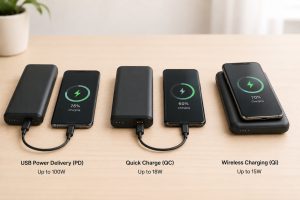
The most common standards include:
USB Power Delivery (USB PD)
USB Power Delivery is one of the most widely used fast charging standards.
It automatically adjusts voltage and current to safely deliver higher charging speeds to compatible devices.
USB PD is commonly used for:
- Smartphones
- Tablets
- Laptops
- Gaming devices
- USB-C accessories
Qualcomm Quick Charge (QC)
Quick Charge is another popular fast charging technology found on many Android devices.
Compatible power banks can negotiate higher charging speeds with supported smartphones, allowing batteries to recharge more quickly.
Adaptive Fast Charging
Some manufacturers use proprietary charging technologies designed specifically for their own devices.
While these technologies may offer excellent charging performance, compatibility can vary between brands.
When choosing a power bank, always check whether it supports the fast charging standard used by your device.
How to Choose the Right Power Bank
With so many models available, selecting the right power bank depends on your charging needs rather than simply buying the largest battery.
Consider the following factors before making a purchase.
Power Bank Battery Capacity
Choose a capacity that matches how often you need backup power.
Occasional users may only need 10,000mAh, while frequent travelers may benefit from 20,000mAh or higher.
Power Bank Charging Speed
Look for support for fast charging standards such as USB Power Delivery (PD) or Quick Charge (QC) if your devices support them.
Number of Output Ports
If you regularly charge multiple devices, choose a power bank with two or more output ports.
Port Types
Modern USB-C ports offer faster charging and greater versatility than older Micro-USB ports.
A power bank with USB-C input and output is generally a better long-term investment.
Power Bank Safety Features
Always choose a power bank with built-in protection against:
- Overcharging
- Short circuits
- Overheating
- Over-current
- Over-voltage
Certified products from reputable manufacturers usually provide the highest level of safety.
How to Charge a Power Bank Correctly
Charging a power bank properly helps maximize its lifespan and maintain reliable performance.
Some best practices include:
- Use the recommended charging adapter.
- Use a high-quality charging cable.
- Avoid exposing the power bank to extreme temperatures.
- Disconnect the charger once fully charged if recommended by the manufacturer.
- Store the power bank with some charge if it won’t be used for an extended period.
For detailed instructions, charging times, and maintenance tips, read our complete guide on How to Charge a Power Bank.
Power Bank Safety Tips
Power banks are designed with multiple safety features, but using them correctly is equally important. Following a few simple practices can improve safety, maintain battery performance, and extend the lifespan of your portable charger.
Here are some essential safety tips:
- Use the original or a certified charging cable and adapter.
- Avoid exposing the power bank to extreme heat or direct sunlight.
- Do not leave a power bank in a hot car for extended periods.
- Keep the power bank away from water and moisture.
- Avoid dropping or puncturing the device.
- Stop using the power bank if it becomes swollen, overheats, or shows signs of physical damage.
- Purchase power banks from reputable brands that include built-in safety certifications.
Proper handling reduces the risk of battery damage and helps ensure reliable performance over time.
Common Power Bank Mistakes to Avoid
Many users unknowingly reduce the lifespan of their power banks by following poor charging habits.
Avoid these common mistakes:
- Using low-quality or damaged charging cables.
- Frequently allowing the power bank to completely discharge before recharging.
- Charging in extremely hot or cold environments.
- Covering the power bank while it is charging, which can trap heat.
- Buying counterfeit or uncertified power banks.
- Ignoring the manufacturer’s charging recommendations.
Developing good charging habits helps maintain both battery health and charging efficiency.
How Long Do Power Banks Last?
The lifespan of a power bank depends on battery quality, usage habits, and charging frequency.
Most quality lithium-ion and lithium-polymer power banks are designed to last approximately 300 to 1,000 charge cycles before noticeable capacity loss occurs.
Several factors affect longevity, including:
- Battery cell quality
- Charging temperature
- Charging frequency
- Storage conditions
- Overall usage habits
Proper maintenance can significantly extend the usable life of your power bank.
Frequently Asked Questions (FAQs)
What is a power bank used for?
A power bank is used to store electrical energy and recharge portable electronic devices such as smartphones, tablets, wireless earbuds, smartwatches, cameras, and other USB-powered devices when a wall outlet is unavailable.
Learn more in our detailed guide on What Is a Power Bank.
How does a power bank work?
A power bank stores electrical energy inside rechargeable battery cells and delivers that energy to connected devices through its output ports. An internal control circuit regulates voltage, current, and safety throughout the charging process.
For a step-by-step explanation, read How Power Bank Works.
How many times can a power bank charge a phone?
It depends on the power bank’s usable capacity and your phone’s battery size.
For example, a 10,000mAh power bank may fully charge many modern smartphones around two times under typical real-world conditions, though the exact number varies due to energy conversion losses and device efficiency.
Our Power Bank Capacity Explained guide shows how to estimate real charging performance.
Can I use my phone while it is charging from a power bank?
Yes. Most modern power banks allow you to use your device while it is charging.
However, intensive activities such as gaming or video editing may increase heat generation and slow the charging process.
How should I charge my power bank?
Use a compatible charger and a high-quality cable, avoid extreme temperatures, and follow the manufacturer’s instructions for the best performance.
Read our complete guide on How to Charge a Power Bank for step-by-step instructions and maintenance tips.
Conclusion
Power banks have become an essential part of modern life, offering a convenient way to keep smartphones, tablets, earbuds, and other portable devices powered wherever you go.
Understanding how power banks work, how battery capacity is measured, how to charge them correctly, and which safety features to look for allows you to choose the right portable charger with confidence.
Whether you’re a student, traveller, remote worker, or simply someone who relies on mobile devices throughout the day, investing in a reliable power bank can provide peace of mind and uninterrupted productivity.
As portable charging technology continues to evolve with faster charging standards and improved battery efficiency, power banks will remain one of the most practical accessories for everyday use.