


Introduction
How power bank works is a common question for anyone who relies on portable charging every day. Power banks have become one of the most useful accessories for smartphones, tablets, wireless earbuds, and other portable devices. They provide backup power when you’re away from a wall outlet, making them essential for travel, work, and everyday use.
Although a power bank looks simple from the outside, it contains rechargeable battery cells, electronic control circuits, voltage converters, and multiple safety systems that work together to store energy and safely charge your devices.
Understanding how a power bank works not only helps you use it more effectively but also explains why features such as fast charging, battery capacity, and safety protection are so important.
Quick Answer
A power bank works by storing electrical energy inside rechargeable lithium-ion or lithium-polymer battery cells. When you connect a device, an internal controller converts and regulates the stored energy into the correct voltage and current, allowing your phone or other USB-powered device to charge safely and efficiently.
If you’re new to portable chargers, start with our complete guide on Power Banks and Portable Charging, where you’ll learn about different types of power banks, charging methods, and how to choose the right model.
In this guide, we’ll explain the complete charging process, the main components inside a power bank, how electricity is stored, and how modern safety systems protect both your power bank and your devices.
What Is a Power Bank?
A power bank is a portable rechargeable battery that stores electrical energy and supplies it to compatible electronic devices when an external power source isn’t available.
Unlike a standard charger, which only transfers electricity from a wall outlet to your device, a power bank first stores energy inside its own battery cells. That stored energy can then be used later to charge smartphones, tablets, wireless earbuds, cameras, smartwatches, and many other USB-powered devices.
Most modern power banks include:
- Rechargeable battery cells
- Charging controller
- Voltage conversion circuit
- USB output ports
- USB-C input/output ports
- Built-in safety protection
These components work together to deliver safe and reliable portable charging.
For a broader introduction, read our guide on What Is a Power Bank.
How Does a Power Bank Store Electricity?
Before a power bank can charge another device, it must first store electrical energy.
When you plug the power bank into a charger, electricity flows through the input port into its internal charging circuit.
The charging controller carefully manages this incoming power by regulating voltage and current before sending energy to the rechargeable battery cells.
Rather than storing electricity directly, the battery cells convert electrical energy into chemical energy through rechargeable electrochemical reactions.
When you later connect your smartphone or another device, this chemical energy is converted back into electrical energy, allowing the power bank to supply power safely.
This charging and discharging cycle can be repeated hundreds of times during the lifespan of a quality power bank.
Main Components Inside a Power Bank
Although power banks come in different sizes and capacities, most models share the same core components.
Understanding these parts makes it much easier to understand how the entire charging process works.

Rechargeable Battery Cells
Battery cells are the heart of every power bank.
They store the energy that will later be used to charge your devices.
Most power banks use one of two battery types:
- Lithium-ion (Li-ion)
- Lithium-polymer (Li-Po)
Both technologies offer high energy density, long battery life, and reliable charging performance.
Charging Controller
The charging controller acts as the brain of the power bank.
Its responsibilities include:
- Managing charging input
- Regulating charging output
- Preventing overcharging
- Monitoring battery status
- Controlling charging efficiency
Without this controller, safe charging would not be possible.
Voltage Converter
Battery cells do not naturally output the exact voltage required by USB-powered devices.
A voltage conversion circuit adjusts the stored battery voltage into a stable output suitable for smartphones, tablets, and other electronics.
This ensures that connected devices receive consistent and safe power throughout the charging process.
USB Input and Output Ports
Every power bank includes ports for both charging itself and charging other devices.
Common ports include:
- USB-C
- USB-A
- Micro-USB (older models)
Many modern power banks also support USB-C for both input and output, allowing faster charging and greater compatibility.
Safety Protection Circuit
Safety is one of the most important aspects of a modern power bank.
The protection circuit continuously monitors battery conditions and helps prevent damage caused by electrical faults.
Common protection features include:
- Overcharge protection
- Over-discharge protection
- Over-current protection
- Short-circuit protection
- Temperature monitoring
- Over-voltage protection
These systems help protect both the power bank and the connected device during every charging session.
Why Understanding How a Power Bank Works Matters
Knowing how a power bank works helps you make smarter purchasing decisions and use your portable charger more effectively.
For example, understanding battery cells, voltage conversion, charging controllers, and safety systems makes it easier to compare different models and identify high-quality products.
It also helps explain why factors such as battery capacity, charging speed, and charging efficiency can vary between power banks, even if they appear similar on the outside.
By understanding the technology behind portable charging, you’ll be better equipped to choose a power bank that matches your devices and daily charging needs.
How a Power Bank Works: Step-by-Step
Although using a power bank is simple, the technology inside it is surprisingly sophisticated. Every time you charge or use a power bank, several electronic components work together to store, regulate, and deliver energy safely.
Here’s how the process works from start to finish.
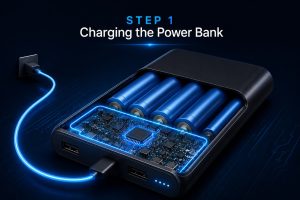
Step 1: Charging the Power Bank
The process begins when you connect the power bank to a wall charger using a compatible charging cable.
Electricity enters the power bank through its input port, usually USB-C or Micro-USB on older models.
Before reaching the battery cells, the incoming power passes through the charging controller.
The controller carefully regulates the voltage and current to ensure the battery charges safely without overheating or becoming overcharged.
This controlled charging process helps maximize battery lifespan while maintaining safe operating conditions.
Step 2: Storing Energy Inside the Battery Cells
Once the charging controller has regulated the incoming electricity, the energy is stored inside the rechargeable battery cells.
Most power banks use Lithium-ion (Li-ion) or Lithium-polymer (Li-Po) batteries because they offer:
- High energy density
- Lightweight construction
- Long cycle life
- Stable charging performance
Instead of storing electricity directly, these batteries convert electrical energy into chemical energy.
This chemical energy remains stored until you connect a device that needs charging.
Step 3: Detecting a Connected Device
When you connect a smartphone, tablet, or another USB-powered device, the power bank automatically detects the connection.
Modern power banks contain intelligent control circuits that recognize when a device has been plugged in.
Some advanced models can even identify the charging protocol supported by the connected device, allowing them to optimize charging performance.
This automatic detection helps improve compatibility while preventing unnecessary power consumption.
Step 4: Converting Stored Energy Into Usable Power
The voltage inside a rechargeable battery is different from the voltage required by most USB-powered devices.
To solve this, the power bank uses a built-in DC-DC voltage converter.
This electronic circuit converts the battery’s stored voltage into a stable output that matches USB charging standards.
The result is a safe and consistent power supply that protects connected devices from unstable voltage fluctuations.
Step 5: Delivering Power to Your Device
After voltage conversion, electricity flows through the output port to your device.
During this stage, the charging controller continuously monitors:
- Output voltage
- Output current
- Battery temperature
- Charging status
- Remaining battery capacity
If charging conditions change, the controller automatically adjusts the power output to maintain safe and efficient charging.
This real-time regulation is one reason modern power banks are both reliable and safe.
Battery Management System (BMS)
A Battery Management System (BMS) is one of the most important safety features inside a modern power bank.
The BMS constantly monitors the condition of the battery cells and ensures they operate within safe limits.

Its responsibilities include:
- Preventing overcharging
- Preventing over-discharging
- Monitoring battery temperature
- Balancing battery cells
- Detecting abnormal electrical conditions
- Protecting against short circuits
Without a Battery Management System, rechargeable batteries could become unstable or suffer permanent damage.
How Fast Charging Works in a Power Bank
Many modern power banks support fast charging technologies such as USB Power Delivery (PD) and Qualcomm Quick Charge (QC).
Unlike standard charging, fast charging uses intelligent communication between the power bank and the connected device.
Before increasing charging speed, both devices exchange information about supported voltage and current levels.
Only after this negotiation is complete does the power bank deliver higher charging power.
This communication helps maximize charging speed while protecting the battery from excessive heat or electrical stress.

What Affects Charging Efficiency?
Not all of the stored energy inside a power bank reaches your device.
A small amount of energy is naturally lost during voltage conversion, heat generation, and power transfer.
Several factors influence charging efficiency, including:
- Battery quality
- Voltage conversion efficiency
- Cable quality
- Charging protocol
- Device compatibility
- Ambient temperature
Using high-quality accessories and certified chargers can improve overall charging performance.
To understand why usable capacity is lower than the advertised mAh rating, read our guide on Power Bank Capacity Explained.
Why Different Power Banks Charge at Different Speeds
Charging speed depends on more than just battery capacity.
Several factors determine how quickly a power bank can recharge a device, including:
- Maximum output wattage
- USB Power Delivery (PD) support
- Quick Charge (QC) compatibility
- Cable quality
- Smartphone charging capability
- Battery temperature
For example, a 20,000mAh power bank without fast charging support may charge a phone more slowly than a 10,000mAh model equipped with USB Power Delivery.
This is why charging technology is often more important than battery size alone.
To get the best charging performance, read our guide on How to Charge a Power Bank, which explains proper charging methods and best practices.
Is It Safe to Use a Power Bank?
Yes. A high-quality power bank is generally safe to use when it includes built-in protection systems and is used according to the manufacturer’s instructions.
Modern power banks are designed with multiple safety mechanisms that monitor voltage, current, temperature, and battery status during both charging and discharging.
Common safety features include:
- Overcharge protection
- Over-discharge protection
- Short-circuit protection
- Over-current protection
- Over-voltage protection
- Temperature monitoring
To maximize safety, always use certified charging cables and adapters, avoid exposing the power bank to extreme temperatures, and replace it if you notice swelling, physical damage, or unusual overheating.
Common Myths About How Power Banks Work
Many misconceptions about power banks continue to circulate online. Understanding the facts can help you use your portable charger more effectively.
Myth 1: A Higher mAh Rating Always Means Faster Charging
Fact: Battery capacity and charging speed are different.
A higher-capacity power bank stores more energy, but charging speed depends on its output power, charging protocol, and your device’s compatibility.
Myth 2: A Power Bank Delivers 100% of Its Advertised Capacity
Fact: No power bank can deliver its full rated capacity.
Some energy is naturally lost during voltage conversion and power transfer, so the usable capacity is always lower than the printed mAh value.
Learn why this happens in our guide on Power Bank Capacity Explained.
Myth 3: Leaving a Device Connected Will Always Damage the Battery
Fact: Most modern power banks automatically stop or significantly reduce power output once the connected device reaches a full charge.
Likewise, modern smartphones include battery management systems that help protect the battery during charging.
Tips to Improve Power Bank Performance
Following a few simple habits can improve charging efficiency and extend the lifespan of your power bank.
- Recharge the power bank before it becomes completely empty whenever possible.
- Use high-quality USB or USB-C cables.
- Keep the power bank clean and dry.
- Store it in a cool, well-ventilated place.
- Avoid dropping or exposing it to excessive heat.
- Use chargers that meet the manufacturer’s recommended specifications.
Consistent maintenance helps ensure reliable performance over hundreds of charging cycles.
Frequently Asked Questions (FAQs)
How does a power bank charge a phone?
A power bank stores energy inside rechargeable battery cells. When you connect a phone, an internal controller converts and regulates the stored energy before delivering the correct voltage and current through the output port.
What type of battery is used inside a power bank?
Most modern power banks use either Lithium-ion (Li-ion) or Lithium-polymer (Li-Po) battery cells because they provide high energy density, long cycle life, and reliable performance.
Why does a power bank become warm while charging?
A small amount of heat is normal because some energy is lost during voltage conversion and charging.
However, excessive heat may indicate poor ventilation, a faulty cable, or a damaged power bank.
Can a power bank overcharge my phone?
No. Modern smartphones and quality power banks include intelligent charging circuits that regulate power delivery and help prevent overcharging under normal operating conditions.
How many years does a power bank last?
A quality power bank can often last several years, depending on battery quality, charging habits, usage frequency, and storage conditions. Most lithium-based power banks are rated for hundreds of charge cycles before their capacity gradually declines.
Conclusion
Power banks work by storing electrical energy inside rechargeable battery cells and delivering that energy safely through intelligent charging circuits when needed. Behind their simple design is a combination of battery technology, voltage conversion, power regulation, and advanced safety systems that ensure reliable portable charging.
By understanding how a power bank stores energy, detects connected devices, converts voltage, and manages charging, you can make better purchasing decisions and use your portable charger more effectively.
Whether you’re charging a smartphone, tablet, wireless earbuds, or another USB-powered device, choosing a quality power bank with the right capacity and safety features will provide dependable backup power whenever you need it.