
Introduction
If you’re trying to decide between a Mini Projector vs Regular Projector, you’re not alone. Choosing the right projector can be challenging because both options offer unique advantages. Mini projectors are compact and portable, while regular projectors deliver higher brightness, better image quality, and superior performance for home theaters, gaming, and business presentations. In this guide, we’ll compare Mini Projector vs Regular Projector to help you choose the best option for your needs.
Mini projectors are popular because they’re compact, portable, and easy to set up. Regular projectors, on the other hand, are built to deliver higher brightness, better image quality, and superior performance for larger spaces.
Choosing the right option depends on several factors, including where you’ll use it, the type of content you watch, your budget, and how important portability is to you.
In this guide, we’ll compare mini projectors and regular projectors side by side to help you understand their strengths, limitations, and ideal use cases.
Quick Answer
Mini projectors are best for portability, travel, casual entertainment, and small spaces, while regular projectors are better for home theatres, business presentations, classrooms, and situations that require higher brightness, larger screens, and better overall image quality. The right choice depends on your viewing environment, budget, and intended use.
If you’re new to projector technology, start with our Projectors and Display Technology guide to understand the different projector types, display technologies, and key specifications.
What Is a Mini Projectors?
A mini projector is a compact and portable projector designed for convenience and flexibility.
Most models use LED light sources and support wireless features such as Wi-Fi, Bluetooth, and screen mirroring. Some even include built-in batteries, making them ideal for travel and outdoor entertainment.
Mini projectors are commonly used for:
- Home entertainment
- Outdoor movie nights
- Travel
- Student presentations
- Casual gaming
- Small business meetings
Their biggest advantage is portability, allowing users to enjoy a large-screen experience almost anywhere.
For a complete explanation of features, benefits, and buying considerations, read our detailed What Is a Mini Projector guide.
What Is a Regular Projector?
A regular projector is a full-size projection system designed to deliver higher performance than portable models.
These projectors typically include:
- More powerful light sources
- Larger optical systems
- Higher brightness
- Better cooling systems
- Superior image quality
- More installation flexibility
Regular projectors are widely used in:
- Home theatres
- Conference rooms
- Schools
- Universities
- Business presentations
- Large meeting spaces
Although they are less portable, they generally provide a more immersive and professional viewing experience.
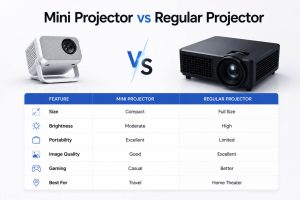
Mini Projectors vs Regular Projectors: Quick Comparison
| Feature | Mini Projector | Regular Projector |
| Size | Compact and lightweight | Larger and heavier |
| Portability | Excellent | Limited |
| Brightness | Moderate | High |
| Image Quality | Good for casual viewing | Better overall quality |
| Screen Size | Medium to large | Large to very large |
| Battery Option | Available on some models | Rare |
| Built-in Smart Features | Common | Depends on the model |
| Best For | Travel, entertainment, portability | Home theater, business, education |
| Installation | Simple and portable | Often permanent or semi-permanent |
This quick overview highlights the biggest practical differences, but your ideal choice depends on how and where you plan to use the projector.
Key Differences Between Mini Projectors and Regular Projectors
Although both devices perform the same basic function, they differ in several important ways.
Size and Portability
Mini projectors are specifically designed to be portable.
Many models are small enough to fit inside a backpack or travel bag, making them easy to carry between locations.
Regular projectors are considerably larger because they contain more powerful light sources, larger cooling systems, and more advanced optical components.
If portability is your top priority, mini projectors clearly have the advantage.
Installation Requirements
Mini projectors usually require very little setup.
Many support:
- Auto focus
- Automatic keystone correction
- Wireless casting
- Built-in speakers
Regular projectors often require:
- Ceiling mounting
- Dedicated projection screens
- Fixed power connections
- Longer HDMI cable runs
This makes regular projectors more suitable for permanent installations.
Intended Use
Mini projectors are designed for flexibility.
They perform well for:
- Portable entertainment
- Family movie nights
- Dorm rooms
- Travel
- Temporary presentations
Regular projectors are built for:
- Dedicated home theatres
- Conference rooms
- Classrooms
- Professional presentations
- Large audiences
Choosing the right projector depends more on your intended use than on the specifications alone.
Want to understand why different projector types perform differently? Read our How Projector Works guide to learn how projection technology affects image quality and overall performance.
Picture Quality Comparison
Picture quality is one of the biggest differences between mini projectors and regular projectors.
Regular projectors generally deliver better image quality because they use larger optical systems, more powerful light sources, and advanced image processing technologies.
Mini projectors have improved significantly over the years, but many models still prioritize portability over maximum visual performance.
Mini Projectors
Typical strengths include:
- Sharp images in dark environments
- Good colour reproduction for casual viewing
- Suitable for movies, streaming, and family entertainment
- Compact optical design
Potential limitations include:
- Lower brightness
- Reduced detail in bright rooms
- Performance varies between models
Regular Projector
Regular projectors often provide:
- Higher native resolution
- Better contrast ratios
- Greater colour accuracy
- Improved HDR performance (supported models)
- More consistent image quality across larger screen sizes
For dedicated home theatres or professional presentations, regular projectors usually produce a more cinematic viewing experience.
Brightness Comparison
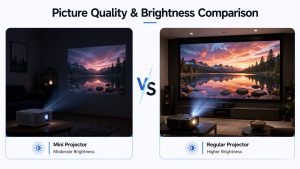
Brightness determines how well a projector performs under different lighting conditions.
Mini projectors generally produce lower ANSI lumens because of their compact size and energy-efficient light sources.
Regular projectors often generate much higher brightness, making them more suitable for:
- Daytime presentations
- Conference rooms
- Classrooms
- Larger living rooms
- Outdoor events with ambient lighting
If you frequently use a projector in bright environments, brightness should be one of your highest priorities.
Portability Comparison
Portability is where mini projectors clearly stand out.
Mini Projectors
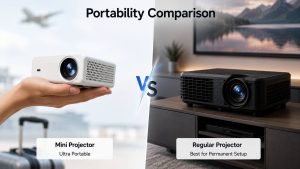
Advantages include:
- Lightweight construction
- Easy transportation
- Battery-powered options
- Quick setup
- Ideal for travel
Many users can simply place the projector on a table, connect a smartphone, and begin streaming within minutes.
Regular Projector
Regular projectors prioritize performance rather than mobility.
They usually require:
- Dedicated storage
- Larger carrying cases
- External power
- More installation space
For permanent setups, these limitations are rarely a concern.
Sound Quality Comparison
Audio performance also differs between the two categories.
Mini projectors often include built-in speakers for convenience.
While these speakers work well for personal viewing, they may not provide enough volume or bass for larger audiences.
Regular projectors are commonly paired with:
- External speakers
- Soundbars
- AV receivers
- Home theatre systems
This setup typically delivers a much richer audio experience.
Connectivity Comparison
Modern projectors support a variety of wired and wireless connections.
Mini Projectors
Many portable models include:
- Wi-Fi
- Bluetooth
- Screen Mirroring
- USB-C
- HDMI
These features make connecting smartphones and tablets simple.
Need help connecting your phone? Follow our complete How to Connect Mini Projector to Phone guide for Android and iPhone.
Regular Projectors
Regular projectors often provide:
- Multiple HDMI ports
- USB
- VGA
- Ethernet (some models)
- RS-232 (professional models)
- Audio outputs
They are designed to support a wider range of professional equipment.
Gaming Performance
For gamers, several specifications influence the overall experience.
Mini Projectors
Best suited for:
- Casual gaming
- Portable gaming sessions
- Nintendo Switch
- Family entertainment
Performance depends heavily on:
- Input lag
- Refresh rate
- Resolution
- Brightness
Regular Projector
Dedicated gaming projectors generally provide:
- Lower input lag
- Higher refresh rates
- Better motion handling
- Higher brightness
- Improved HDR support
Competitive gamers often prefer regular projectors for smoother gameplay and faster response times.
Home Theatre Performance
If your goal is to create a cinematic experience at home, regular projectors generally have the advantage.
They typically offer:
- Larger screen support
- Better black levels
- Higher contrast
- More accurate colours
- Greater brightness consistency
Mini projectors remain a great choice for casual movie nights, apartments, and flexible entertainment spaces where portability matters.
Business Presentation Performance
Business users often have different priorities than home entertainment users.
Mini projectors work well for:
- Traveling professionals
- Quick client meetings
- Small conference rooms
Regular projectors are better suited for:
- Large presentations
- Training centers
- Universities
- Corporate meeting rooms
- Bright office environments
Their higher brightness and sharper text improve readability for larger audiences.
Which Offers Better Overall Value?
The better value depends on how you plan to use the projector.
A mini projector offers excellent value if you prioritize:
- Portability
- Convenience
- Travel
- Casual entertainment
- Wireless features
A regular projector offers better value if you prioritize:
- Premium image quality
- Home theater performance
- Brightness
- Professional presentations
- Long-term dedicated installation
Rather than asking which projector is universally better, it’s more helpful to ask which one best matches your specific needs and viewing environment.
Still exploring portable models? Read our What Is a Mini Projector guide to understand their features, strengths, and ideal use cases.
Want to know why image quality differs between projector types? Our How Projector Works guide explains the technology behind modern projection systems.
Which One Should You Buy?
There isn’t a single projector that’s perfect for everyone. The right choice depends on where you’ll use it, what you’ll watch, and how important portability is to you.
If you want a projector for occasional entertainment, travel, or flexible use, a mini projector is often the better option. On the other hand, if you’re building a dedicated home theater or need a projector for professional presentations, a regular projector is usually the smarter long-term investment.
Before making a purchase, consider:
- Your viewing environment
- Room lighting conditions
- Screen size requirements
- Budget
- Portability needs
- Connectivity options
- Frequency of use
Matching the projector to your actual needs will provide a better experience than simply choosing the model with the highest specifications.
Best Use Cases
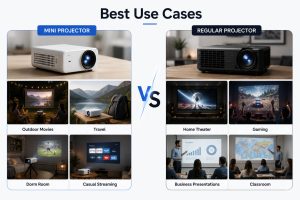
The table below summarizes which type of projector is generally the better choice for common situations.
| Use Case | Better Choice | Why |
| Travel | Mini Projector | Lightweight and portable |
| Outdoor Movie Nights | Mini Projector | Easy to transport and quick to set up |
| Dorm Rooms | Mini Projector | Compact design fits limited spaces |
| Casual Streaming | Mini Projector | Convenient wireless features |
| Home Theater | Regular Projector | Better brightness, contrast, and image quality |
| Gaming | Regular Projector | Lower input lag and stronger performance |
| Business Presentations | Regular Projector | Brighter images and sharper text |
| Classrooms | Regular Projector | Better visibility for larger audiences |
This comparison shows that the “best” projector depends on the intended use rather than the product category alone.
Common Buying Mistakes to Avoid
Choosing a projector based only on price or marketing claims can lead to disappointment.
Avoid these common mistakes:
Buying Based Only on Brightness
A projector with higher ANSI lumens isn’t automatically the best choice.
Image quality also depends on:
- Native resolution
- Contrast ratio
- Colour accuracy
- Lens quality
- Image processing
Ignoring Room Conditions
A projector that performs well in a dark bedroom may struggle in a bright living room.
Always consider your viewing environment before purchasing.
Overlooking Connectivity
Check whether the projector supports the devices you plan to connect.
Look for features such as:
- HDMI
- USB-C
- Wi-Fi
- Bluetooth
- Screen Mirroring
Forgetting Future Needs
If you expect your needs to change, choose a projector that offers enough flexibility for future upgrades and different use cases.
Frequently Asked Questions (FAQs)
Is a mini projectors good enough for watching movies?
Yes.
A mini projector is an excellent choice for casual movie nights, especially in darker environments.
For a dedicated home theater with the highest picture quality, a regular projector is usually the better option.
Which projector is better for gaming?
Regular projectors generally provide lower input lag, higher brightness, and smoother performance.
Mini projectors remain suitable for casual gaming and portable gaming sessions.
Can a mini projectors replace a regular projectors?
It depends on your needs.
Mini projectors can replace regular projectors for many portable and casual applications. But they may not provide the brightness or performance required for larger rooms or professional installations.
Which projector is easier to carry?
Mini projectors are significantly lighter and easier to transport.
Many models are designed specifically for travel and mobile entertainment.
Which projector offers better long-term value?
If portability is your priority, a mini projector often provides excellent value.
If your priority is premium image quality and long-term home theatre performance, a regular projector is typically the better investment.
Conclusion
Both mini projectors and regular projectors have their own strengths, and neither is universally better than the other.
Mini projectors excel in portability, convenience, and flexible everyday use, making them an excellent choice for travellers, students, families, and casual entertainment.
Regular projectors, meanwhile, deliver superior brightness, larger image support, better picture quality, and stronger overall performance, making them ideal for dedicated home theatres, classrooms, and professional presentations.
The best decision comes from understanding your own viewing habits, environment, and expectations. By comparing features such as brightness, portability, image quality, connectivity, and intended use, you can confidently choose the projector that best fits your lifestyle.