
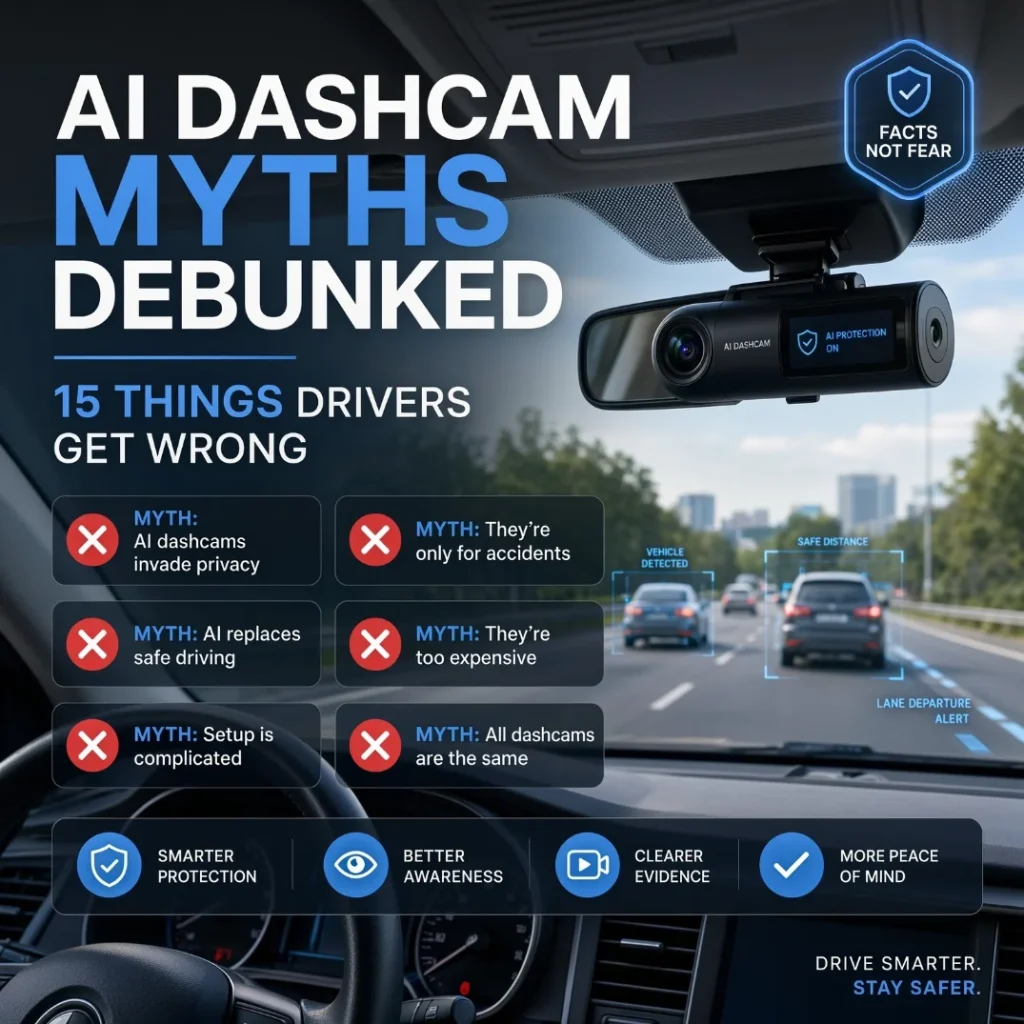
Quick Answer
Here are these AI dashcam myths debunked in one short paragraph, before the full list below. An AI dashcam doesn’t drive the car. It doesn’t secretly upload footage to the cloud by default. It can’t issue you a ticket, and it doesn’t reliably call the police on its own. That last feature exists on a handful of subscription models, and it works less consistently than the marketing suggests. Most AI dashcam myths trace back to confusing the device with either self-driving tech or a factory-installed emergency system. It’s really neither.
Most “myths debunked” articles are strawmen with extra steps: invent a belief nobody actually holds, then feel very smart for correcting it. We’re going to try to avoid that here by sticking to the misconceptions people genuinely bring up in reviews, forums, and comment sections, including a couple where the honest answer is more “it’s complicated” than a clean myth-or-fact verdict. If you want the deep version of any of these, we’ve linked the dedicated article each time rather than repeating it.
AI Dashcam Myth:
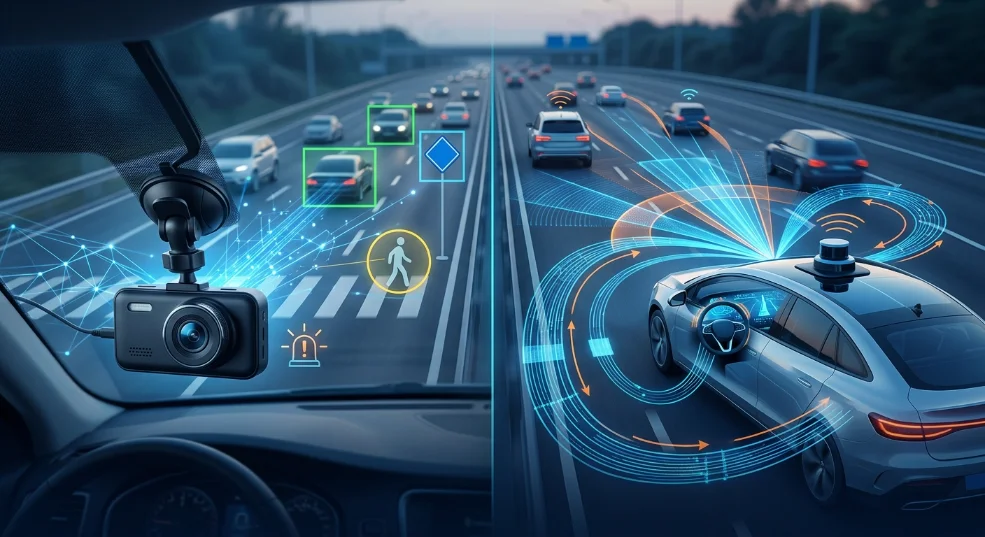
AI Dashcams Are Basically Self-Driving Cars
An AI dashcam shares a research lineage with self-driving cars, not a capability. Both rely on computer vision and neural networks to recognize objects in a video feed. That shared foundation is exactly why the confusion happens. But a self-driving system closes the loop: it decides, then it acts, steering and braking on its own. An AI dashcam only ever reaches the “decide” step before handing control straight back to the driver. Think of the difference between a smoke detector and a fire sprinkler. One notices, the other intervenes, and no amount of better AI turns a dashcam into the second thing. Our technical breakdown covers the actual mechanics.
AI Dashcams Spy on me and Upload Everything to the Cloud
The honest answer depends on the specific product. That’s less satisfying than a flat no, but it’s more accurate. Most consumer AI dashcams process video locally, on the device’s own chip, and keep footage on the memory card. Nothing leaves the device unless you personally export or share a clip. Cloud upload exists as an optional tier on many models, built for backup or remote viewing, not as a silent default.
The concern has more teeth with driver-facing cameras. Even there, most systems track motion and geometry, like blink speed and head angle, rather than storing continuous video of your face. Our driver monitoring guide breaks down exactly what gets recorded, model by model.
An AI Dashcam Can Predict Accidents Before They Happen
This is closer to very fast recognition than actual prediction. The system calculates risk from things already visible in the footage: closing speed, lane drift, a lingering glance away from the road. It typically looks one to three seconds ahead. That’s genuinely useful, and it’s genuinely not foresight. A tire blowing out on the car ahead, or a driver having a medical event, leaves no earlier visible pattern. The system catches nothing sooner than you eventually would yourself. Our piece on how the technology actually works goes deeper on why.
It automatically calls the police after a crash
This myth deserves more than a yes-or-no verdict. A handful of models really do offer something like this. Nextbase’s Emergency SOS is the best-known example: if the system detects a severe impact and the driver doesn’t respond within a set window, it can alert emergency contacts, or in some configurations, emergency services with the vehicle’s location. That feature is real, not vaporware.
Where the marketing oversells it
The gap shows up in how seamlessly the feature actually works. It’s typically a paid subscription add-on, not a standard AI dashcam capability. Independent testing by reviewers and forum users has turned up a consistent pattern: failed confirmation texts, notifications that never arrive, error screens instead of an active alert.
How it compares to a factory system
A factory-installed automatic crash notification system typically connects to a live, trained response operator. It doesn’t just fire off an automated text. Next to that, the dashcam version looks like what it actually is: a scaled-down, DIY approximation of a feature cars have offered for years. Treat it as a backup layer, not your only one.
The footage can get you a ticket
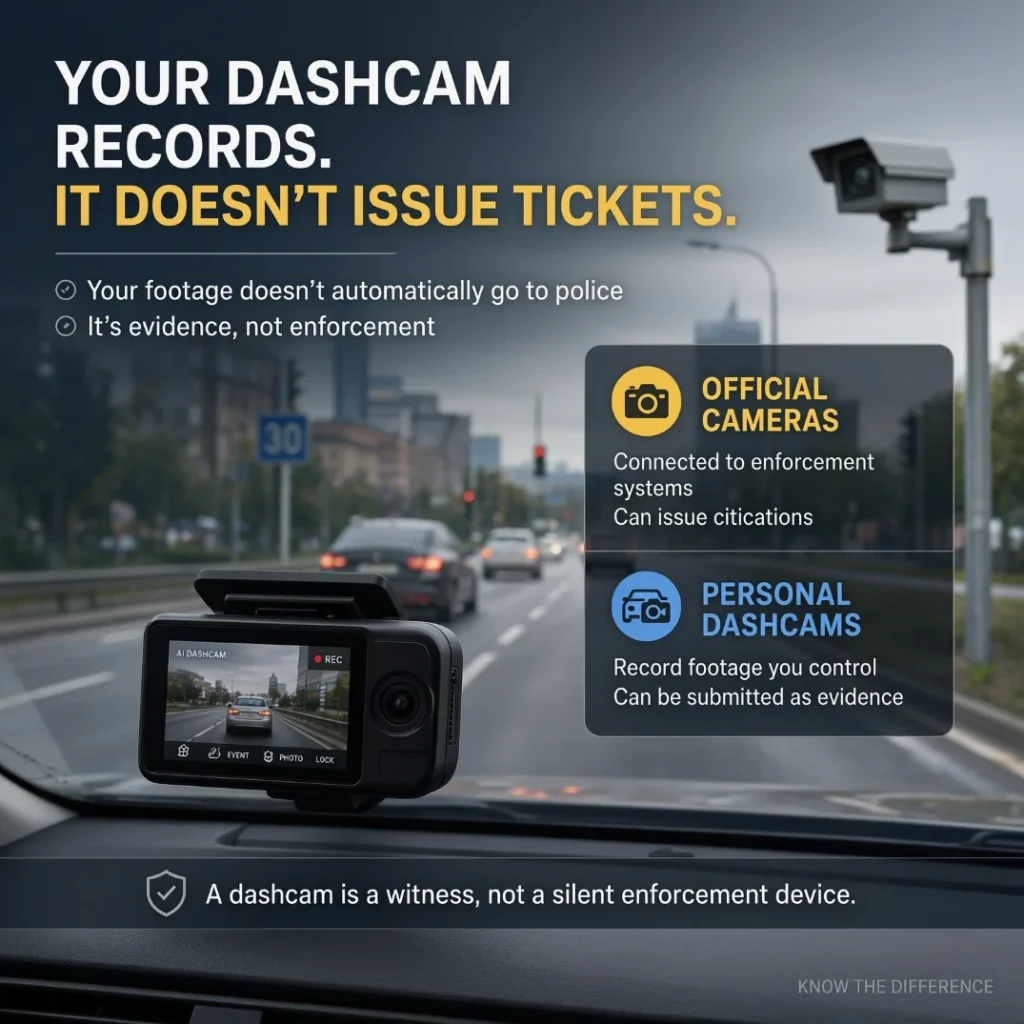
Not on its own, and the confusion here is understandable. Government-operated speed cameras and red-light cameras run on a completely different system. They’re purpose-built, connected directly to enforcement infrastructure, and capable of generating a citation without a human in the loop. A personal AI dashcam has none of that connectivity or legal standing. Your own footage showing you speeding doesn’t transmit anywhere or trigger anything by itself.
There’s one nuance worth flagging. In some places, most notably the UK’s dashcam submission portals covered in our beginner’s guide, a person can voluntarily submit footage of someone else’s dangerous driving to police. An officer then decides whether to act on it. That’s a human choosing to report evidence, not a camera issuing anything automatically. Your dashcam is a witness you control, not a silent enforcement device working against you.
That’s five AI dashcam myths debunked so far, mostly about what the technology can’t do. The next batch covers what the hardware and marketing actually mean.
More Megapixels Means Smarter AI
These are two separate specs, and people mix them up constantly. Resolution and sensor quality determine how sharp the footage looks. Detection accuracy comes from the chip’s neural processing unit and the model running on it, a completely different part of the hardware. A dashcam can film gorgeous 4K video and still run a mediocre, bargain-bin detection model. The reverse happens too. Check both specs independently; the “AI-powered” badge tells you almost nothing about which one you’re getting. Our full comparison covers this in more detail.
AI Dashcam Alerts Are Basically Always Right
No safety system in this category is, and treating one as infallible is arguably riskier than having no dashcam at all. That trust invites the exact complacency covered in myth eight. Research on comparable factory-installed collision warning systems has found that a large share of triggered alerts get judged afterward as unnecessary noise rather than genuine warnings. Mount vibration, poor lighting, and faded lane markings all degrade accuracy in specific, well-understood ways. None of that makes the alerts useless. “Usually right, in predictable conditions” is the honest standard, not “always right.” Our limitations guide and troubleshooting guide go deep on where and why.
Having One Means You Can Pay Less Attention
This is less a myth than a documented risk, which somehow makes it worse. Researchers studying driver-assistance systems have found a real behavioral pattern called risk compensation. Some drivers relax their own attention specifically because a system is now watching for them. They follow closer, or check their phone slightly more often than they would unassisted. The technology doesn’t cause this on purpose, and it doesn’t happen to everyone, but real driving data has documented it. Our limitations article covers the research behind it. Short version: the dashcam is a backup system, not a reason to loosen your grip on being the primary one.
All AI Dashcams Are Basically the Same
This is the opposite myth, and it’s just as common. “AI dashcam” is a label covering everything from a genuinely capable multi-sensor system with a dedicated processor to a basic motion sensor with a machine-learning sticker on the box. Two products can wear the identical badge and perform nothing alike. The chip, the mount quality, and which specific features are actually included vary enormously underneath that one shared word. Assuming they’re interchangeable is how people end up disappointed by a bargain unit that never had the hardware to do what the listing implied. It’s one of the more common AI dashcam myths debunked simply by reading the spec sheet closely.
Once It's Installed, You're Done
Mostly true, with one recurring exception: the mount. A dashcam that shifts even slightly feeds every motion-based feature bad data. It’s the single most common cause of the false alerts that make people give up on the technology within the first month. Beyond that, periodic firmware updates and an occasional lens wipe are really the entire maintenance list. It’s low, just not quite zero.
Ten AI dashcam myths debunked, five left to go. The rest cover conditions, subscriptions, and hardware, the questions people ask right before they buy.
AI Dashcams Work Just as Well at Night and in Bad Weather
Detection accuracy drops after dark, in heavy rain, and in fog, the same way human eyesight does, just with different failure points. Low light gives the camera less contrast to work with, so lane markings and vehicle edges blur together sooner than they would in daylight. Rain on the lens scatters light and confuses edge detection. Fog does something similar at a larger scale, hiding the very objects the system needs to see. Better sensors and infrared assistance narrow the gap, but they don’t close it. Budget for slightly later warnings after dark, not identical ones, and don’t treat night footage as equivalent evidence to daylight footage.
The AI Recognizes Your Face and Tracks Your Identity
Driver-facing cameras monitor behavior, not identity, in nearly every consumer model on the market. The system watches for closed eyes, a tilted head, or a gaze that drifts off the road for too long. It flags a pattern, not a person. Facial recognition, the kind that matches an identity against a stored profile, is a separate technology with its own hardware and legal requirements, and it isn’t what ships in a typical AI dashcam. A handful of fleet-management systems do add driver ID features for logging purposes, but that’s a business tool bolted on top, not something built into the core AI safety features people buy a dashcam for.
You Need a Subscription for the AI Features to Work at All
Core safety features run entirely on-device, with no subscription required. Collision warnings, lane departure alerts, and following-distance monitoring all happen on the dashcam’s own chip in real time, offline, the moment you turn the key. A subscription typically unlocks something else: cloud video backup, live remote viewing from your phone, or the emergency SOS feature covered in myth four. Skipping the subscription doesn’t cripple the AI; it just means you keep everything local, on the memory card, the way most people already use the device. Of all the AI dashcam myths debunked here, this one costs shoppers real money if they believe it.
An AI Dashcam Drains Your Car's Battery
It can, but only in one specific mode, and only if it’s set up carelessly. Normal recording while the engine runs draws power the same way any other accessory does, and it’s not meaningful. The real risk is parking mode, which keeps the camera watching for impacts while the car sits off for hours. Left unmanaged, that can pull a battery down over a long weekend. A proper hardwire kit with a low-voltage cutoff solves this by disconnecting the dashcam before it touches the battery reserve the car needs to start. Skip the hardwire kit and run parking mode off a cheap battery pack instead, and drain simply isn’t a factor.
One Camera Covers Everything: Front, Rear, and Cabin
A single-channel dashcam only sees what’s in front of the car. It can’t capture a rear-end collision, a hit-and-run in a parking lot, or anything happening inside the cabin. Dual-channel models add a rear-facing lens; three-channel models add an interior lens for rideshare drivers or cabin monitoring. Each additional channel costs more, uses more storage, and complicates the mount. None of that makes a single front-facing camera the wrong choice. It just means the “one camera, fully covered” assumption is worth checking against what actually gets recorded before you buy.
Key Takeaways
Here’s what all fifteen AI dashcam myths debunked above add up to, in short.
- Most AI dashcam myths trace back to one confusion: mixing up the device with either a self-driving system or a factory emergency-call system, when it’s structurally neither.
- Automatic emergency calling is real but limited — a paid feature on specific models, not a universal capability, and less reliable in practice than the marketing implies.
- A dashcam can’t issue you a ticket. Only government-operated enforcement cameras have that connectivity; a personal dashcam has none of it.
- “AI-powered” says nothing about video quality, and nothing guarantees two AI dashcams perform alike. Check resolution and detection hardware separately.
- Night, rain, and fog all reduce accuracy. Expect slower warnings in poor conditions, not identical performance to daylight.
- Core AI safety features don’t require a subscription. Paid tiers usually unlock cloud backup, remote viewing, or emergency SOS.
- Overreliance isn’t a hypothetical myth to dismiss — it’s a documented behavioral pattern worth taking seriously precisely because it’s real.
- The one genuine maintenance item is the mount. Almost everything else about “set and forget” turns out to be true.
Frequently Asked Questions
Does an AI dashcam drive the car?
No. It shares underlying computer vision technology with self-driving systems, but it only detects and warns; it has no connection to the steering, brakes, or throttle. Every decision after an alert is still the driver’s.
Does an AI dashcam spy on drivers?
Generally, no, by default. Most process footage locally and keep it on the memory card unless you choose to share or upload it. Driver-facing cameras track alertness signals like blink rate and head angle rather than storing continuous identifiable video, though specifics vary by model.
Is an AI dashcam the same as a self-driving car?
No. They share a family of underlying technology, computer vision and neural networks, but a self-driving system acts on what it sees, while a dashcam only detects and alerts. It’s a meaningful difference in capability, not just scale.
Does an AI dashcam call the police automatically?
Rarely, and only on specific subscription-based models with an emergency SOS feature, which alert a contact or emergency services if a severe crash is detected and the driver is unresponsive. It’s a real but limited feature, and independent testing has found it doesn’t always work as smoothly as advertised.
Can an AI dashcam give you a ticket?
No. Personal dashcams aren’t connected to any enforcement system. Only official government traffic cameras can generate an automatic citation. Footage can sometimes be voluntarily submitted to police, but a human decides whether to act on it, not the camera.
Are AI dashcam alerts 100 percent accurate?
No, and no comparable safety system is. Accuracy depends heavily on mount stability, lighting, and hardware quality. Research on similar factory-installed systems has found a large share of triggered alerts get judged afterward as unnecessary rather than genuine warnings.
Can an AI dashcam replace human attention?
No, and treating it that way is genuinely risky. Research on driver-assistance technology has documented some drivers becoming less attentive once they trust a system to watch for them, a real behavioral pattern called risk compensation, not just a theoretical warning.
Does an AI dashcam work as well at night?
No, not quite. Low light, rain, and fog all reduce detection accuracy compared with daylight conditions. Infrared assistance and better sensors help, but they narrow the gap rather than closing it entirely.
Do you need a subscription for an AI dashcam to work?
No. Core safety features like collision warnings and lane departure alerts run on-device, offline, with no subscription. Paid tiers typically add cloud backup, remote live viewing, or emergency SOS, not the core detection itself.
Will an AI dashcam drain my car battery?
Only if parking mode is set up without a proper hardwire kit. Normal driving use draws negligible power. A hardwire kit with a low-voltage cutoff prevents parking mode from pulling the battery down.
A Note on Sources
Every one of these AI dashcam myths debunked above traces back to a specific source, listed here rather than buried in a footnote. The emergency-SOS reliability claims come from independent reviewer testing and real user reports on forums like DashCamTalk, not manufacturer marketing pages. The comparison to factory-installed Automatic Crash Notification systems reflects how automakers and independent automotive research document those systems. Where a myth’s correction relies on research covered more fully elsewhere on this site, we’ve linked the source article rather than re-summarizing it secondhand.
These AI dashcam myths debunked reflect general industry patterns. Specific features and their reliability vary by manufacturer and model.