
Introduction
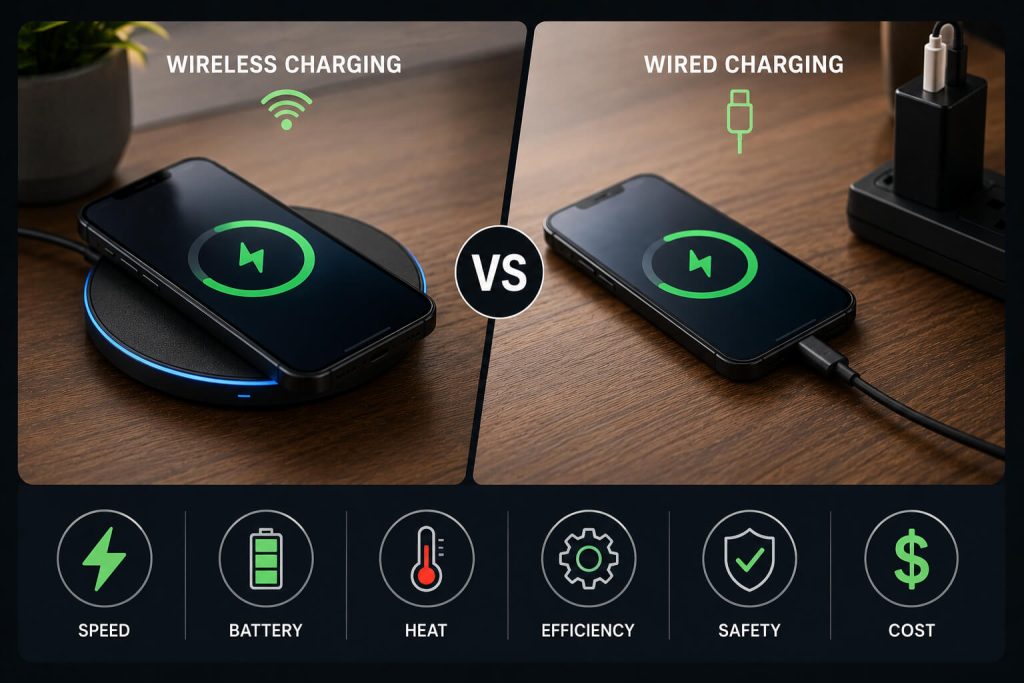
Wireless charging vs wired charging has become one of the biggest debates among smartphone users. As modern devices support both charging methods, choosing the right one depends on factors such as charging speed, battery health, efficiency, convenience, safety, and cost. This guide compares both options to help you decide which charging method best fits your needs.
The answer isn’t as simple as choosing one over the other. Each charging method has its own strengths and weaknesses. Wired charging generally offers faster charging speeds and higher energy efficiency, while wireless charging provides greater convenience and reduces wear on charging ports.
Quick Answer
If you prioritize speed and maximum efficiency, wired charging is usually the better choice. If you value convenience, a cable-free setup, and easier day-to-day charging, wireless charging is an excellent option.
The best choice ultimately depends on how you use your device.
If you’re new to this topic, start with our complete guide on Wireless Charging Technology, where you’ll learn how wireless charging works, its different types, and why it has become so popular.
In this comparison guide, we’ll examine both charging methods based on speed, efficiency, battery health, safety, convenience, cost, and overall user experience to help you decide which option best fits your needs.
What Is Wireless Charging?
Wireless charging is a method of transferring electrical energy from a charging pad to a compatible device without using a physical charging cable.
Instead of relying on a wired connection, wireless charging uses electromagnetic induction to transfer energy between a transmitter coil inside the charger and a receiver coil inside the device.
This technology has become common in smartphones, wireless earbuds, smartwatches, and other portable electronics because it offers a cleaner and more convenient charging experience.
For a complete explanation of how this technology works, read our guide on What Is Wireless Charging.
What Is Wired Charging?
Wired charging is the traditional method of charging electronic devices using a physical cable connected between a power adapter and the device.
Electricity flows directly through the charging cable into the battery, making it one of the fastest and most energy-efficient charging methods available today.
Modern wired charging technologies now support incredibly fast charging speeds, with some smartphones capable of reaching significant battery levels in a short amount of time.
Although wired charging requires carrying cables and adapters, it remains the preferred choice for users who need maximum charging performance.
Wireless Charging vs Wired Charging: Key Differences
Before comparing specific features, let’s look at the major differences between these two charging methods.
| Feature | Wireless Charging | Wired Charging |
| Charging Method | Electromagnetic induction | Physical cable connection |
| Charging Speed | Moderate | Fast |
| Convenience | Excellent | Good |
| Charging Efficiency | Lower | Higher |
| Port Wear | No physical wear | Charging port wears over time |
| Cable Required | No | Yes |
| Heat Generation | Slightly Higher | Lower |
| Best For | Everyday convenience | Fast charging |
This table provides a quick overview, but each factor deserves a closer look.
Charging Speed Comparison
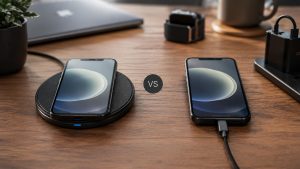
One of the biggest differences between wireless and wired charging is speed.
In general, wired charging delivers electricity directly to the battery through a cable, resulting in faster charging times and lower energy loss.
Wireless charging, on the other hand, transfers energy through a magnetic field. While modern Qi chargers have become much faster than earlier generations, they are still generally slower than high-speed wired chargers.
For users who frequently need a quick battery boost before leaving home, wired charging remains the better option.
However, for overnight charging or office use, the speed difference is often less noticeable because convenience becomes the priority.
How Charging Efficiency Compares
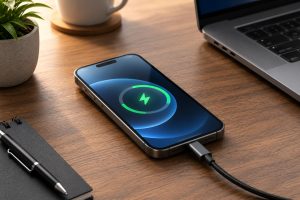
Charging efficiency refers to how much of the electrical energy actually reaches your battery.
Wired charging is generally more efficient because electricity flows directly through the charging cable with minimal energy loss.
Wireless charging loses a small percentage of energy during magnetic power transfer, making it slightly less efficient overall.
Although this difference exists, improvements in wireless charging technology continue to reduce energy loss with each new generation of chargers.
To understand why energy loss occurs during wireless charging, read our detailed guide on How Wireless Charging Works.
Battery Health: Which Charging Method Is Better?
One of the most common concerns among smartphone users is whether their charging method affects battery health.
The good news is that both wireless charging and wired charging are generally safe when you use certified chargers and follow the manufacturer’s recommendations.
Modern smartphones include advanced Battery Management Systems (BMS) that monitor charging speed, voltage, current, and temperature. These systems automatically adjust charging performance to protect the battery from damage.
However, heat plays an important role in battery health.
Wireless charging naturally generates slightly more heat because energy is transferred through electromagnetic induction rather than a direct cable connection. While this extra heat is usually minimal, excessive temperatures over long periods may contribute to faster battery aging.
Wired charging generally produces less heat during standard charging, although very high-speed wired charging can also generate significant heat.
For everyday use, both charging methods are considered safe when used correctly.
Heat Generation: Why Does It Matter?
Heat is one of the biggest differences between wireless and wired charging.
Because wireless charging transfers energy through a magnetic field, some energy is naturally lost during the process. That lost energy becomes heat.
Modern wireless chargers reduce this issue using:
- Intelligent temperature monitoring
- Improved coil alignment
- Better cooling systems
- Adaptive charging software
Wired charging also produces heat, especially when using high-wattage fast chargers. However, under normal conditions, wired charging is generally more efficient and generates less excess heat.
To reduce heat during charging:
- Use certified chargers.
- Remove thick phone cases if necessary.
- Charge in a cool environment.
- Keep the charging pad clean.
Convenience: Which Charging Method Is Easier?
Convenience is where wireless charging truly shines.
Instead of searching for a cable every time your battery runs low, you simply place your device on a charging pad.
This small difference can make daily charging much easier.
Wireless charging is particularly useful for:
- Office desks
- Bedside tables
- Coffee tables
- Car charging docks
- Public charging stations
Wired charging, on the other hand, requires connecting and disconnecting a cable each time.
Although this only takes a few seconds, repeated cable use can become inconvenient over time.
For users who value simplicity and a cleaner workspace, wireless charging offers a better overall experience.

Safety Comparison
Both charging methods are designed with safety in mind.
Modern smartphones and chargers include features such as:
- Overcharge protection
- Temperature control
- Voltage regulation
- Short-circuit protection
- Automatic power adjustment
Wireless chargers also include an additional feature known as Foreign Object Detection (FOD).
If a metal object such as keys or coins is placed on the charging pad, the charger can detect it and stop transferring power to reduce the risk of overheating.
As long as you purchase high-quality, certified accessories, both charging methods are considered safe.
Learn more about these safety features in our guide on How Qi Wireless Charging Works.
Cost Comparison
Price is another important factor when choosing a charging method.
Wired charging is generally less expensive because most smartphones include a charging cable, and replacement cables are widely available at affordable prices.
Wireless charging usually requires purchasing a separate charging pad, and prices vary depending on features such as fast charging support, multiple charging coils, and brand reputation.
Although wireless chargers involve a higher initial cost, many users find the added convenience worth the investment.
Pros and Cons of Wireless Charging
Pros
- Cable-free charging experience
- Less wear on charging ports
- Cleaner desk setup
- Easy to use
- Supports many Qi-compatible devices
Cons
- Usually slower than wired charging
- Generates slightly more heat
- Requires proper device alignment
- Higher initial cost
- Not all devices support wireless charging
Pros and Cons of Wired Charging
Pros
- Faster charging speeds
- Higher energy efficiency
- Lower equipment cost
- Works with almost every device
- Better for emergency charging
Cons
- Requires carrying cables
- Charging ports wear over time
- More cable clutter
- Less convenient for daily charging
Which Charging Method Should You Choose?
The best charging method depends on how you use your devices. Neither option is universally better. Each serves different needs, preferences, and lifestyles.
Choose Wireless Charging If You:
- Prefer a clean, cable-free workspace.
- Charge your phone overnight.
- Own multiple Qi-compatible devices.
- Want to reduce wear on your phone’s charging port.
- Value convenience over maximum charging speed.
Wireless charging is ideal for users who prioritize simplicity, convenience, and a clutter-free charging experience.
Choose Wired Charging If You:
- Need the fastest possible charging speeds.
- Frequently travel and need quick top-ups.
- Play mobile games while charging.
- I want maximum charging efficiency.
- Prefer a lower-cost charging solution.
For power users and people with busy schedules, wired charging remains the most practical and efficient choice.

Can You Use Both Charging Methods?
Absolutely.
Many smartphone users rely on both charging methods depending on the situation.
For example:
- Use wireless charging at your desk or bedside table for everyday convenience.
- Use wired charging when you need to recharge quickly before leaving home or while traveling.
Combining both methods allows you to enjoy the advantages of each without being limited to a single charging option.
This hybrid charging approach is becoming increasingly popular among smartphone users.
Frequently Asked Questions (FAQs)
Is wireless charging better than wired charging?
Neither method is objectively better. Wireless charging offers greater convenience, while wired charging generally provides faster charging speeds and higher energy efficiency.
Which charging method is faster?
Wired charging is typically faster because electricity flows directly through a cable, minimizing energy loss during the charging process.
Which charging method is better for battery health?
Both charging methods are safe when using certified chargers and compatible devices. Modern smartphones include advanced battery management systems that help protect battery health during charging.
Is wireless charging less efficient?
Yes. Wireless charging typically loses a small amount of energy during magnetic power transfer, making it slightly less efficient than wired charging.
For a detailed explanation of the charging process, read How Wireless Charging Works.
Should I switch to wireless charging?
If convenience is your priority, wireless charging is an excellent investment.
If charging speed is more important, wired charging remains the better option.
Many users benefit from using both methods depending on the situation.
Final Verdict
When comparing wireless charging vs wired charging, there is no universal winner.
If your priority is fast charging, higher efficiency, and lower cost, wired charging remains the strongest choice.
If your priority is convenience, a clutter-free workspace, and reducing wear on charging ports, wireless charging offers an outstanding everyday charging experience.
Thanks to continuous improvements in charging technology, the performance gap between the two methods continues to shrink each year.
Rather than replacing wired charging completely, wireless charging complements it by providing another convenient way to keep your devices powered throughout the day.
Conclusion
Wireless charging and wired charging each offer unique advantages, and the best choice depends on your personal preferences and daily habits.
For users who spend long hours at a desk or charge their devices overnight, wireless charging provides unmatched convenience. On the other hand, users who need the fastest possible charging speeds or frequently travel may prefer wired charging.
Understanding the differences in charging speed, efficiency, battery health, safety, and overall usability helps you choose the charging method that best fits your lifestyle.
As charging technologies continue to evolve, both wired and wireless charging solutions will remain essential parts of the modern mobile experience.