
Introduction
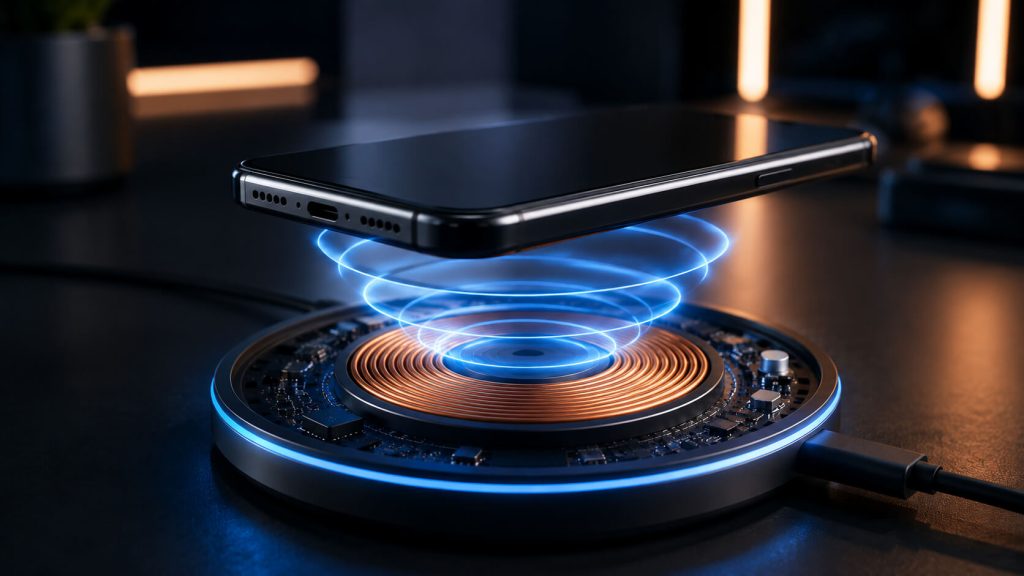
How Qi Wireless Charging Works is a question many smartphone users ask as wireless charging becomes more common in everyday devices. Wireless charging is now a standard feature in modern smartphones, wireless earbuds, smartwatches, and other electronic devices. Most of these products rely on the globally recognized Qi wireless charging standard for safe and efficient power transfer.
If you’ve ever purchased a wireless charger, you’ve probably seen the term Qi Certified on the packaging. But what exactly does Qi mean, and how does Qi wireless charging work?
Qi is more than just a brand name. It is an internationally recognized wireless charging standard that allows compatible chargers and devices to communicate safely while transferring power efficiently.
Unlike basic wireless power transfer, Qi charging includes intelligent communication, automatic power adjustment, safety monitoring, and compatibility testing to ensure reliable charging across devices from different manufacturers.
If you’re new to cable-free charging, start with our complete guide on Wireless Charging Technology to understand the fundamentals before exploring the Qi standard.
In this article, you’ll learn how Qi wireless charging works, how Qi-certified chargers communicate with your phone, why Qi has become the global standard, and what makes it safer than many non-certified wireless charging solutions.
What Is Qi Wireless Charging?
Qi wireless charging is the world’s most widely adopted wireless charging standard for consumer electronics.
Developed by the Wireless Power Consortium (WPC), the Qi standard defines how wireless chargers and compatible devices transfer electrical power safely and efficiently using electromagnetic induction.
Rather than allowing each manufacturer to develop its own charging system, Qi provides a common standard that enables devices from different brands to work together.
For example, a Qi-certified charger can often charge compatible smartphones, wireless earbuds, and other supported devices regardless of the manufacturer.
This universal compatibility has made Qi the preferred wireless charging standard across the industry.
If you’d like to understand the basic concept before learning about Qi, read our guide on What Is Wireless Charging.
What Does “Qi” Mean?
The word Qi is pronounced “chee.”
It comes from a Chinese word that refers to life energy or the natural flow of energy.
The Wireless Power Consortium chose the name to represent the wireless transfer of power between electronic devices.
Today, the name Qi has become almost synonymous with wireless charging because it is supported by most major smartphone manufacturers.
When you see a Qi Certified logo on a charger or smartphone, it means the product has met specific technical and safety requirements established by the Wireless Power Consortium.
Who Developed the Qi Standard?
The Wireless Power Consortium (WPC) is the international organization responsible for creating and maintaining the Qi wireless charging standard.
The organization includes hundreds of technology companies working together to improve wireless charging compatibility, efficiency, and safety.
Instead of allowing different manufacturers to use incompatible charging technologies, the WPC established a universal standard that benefits both consumers and device manufacturers.
As a result, users can purchase a single Qi-certified charger and use it with many compatible devices from different brands.
This universal ecosystem has played a major role in the widespread adoption of wireless charging.
Why Has Qi Become the Global Standard?
Qi became the leading wireless charging standard because it solves one of the biggest challenges in consumer electronics: compatibility.
Before standardized charging systems became common, manufacturers often developed proprietary charging technologies that worked only with their own devices.
Qi changed this by creating a shared wireless charging protocol that allows certified chargers and compatible devices to work together.
Some of the reasons Qi has become the global standard include:
- Universal compatibility across many brands
- Consistent charging performance
- Built-in safety features
- Reliable communication between charger and device
- Support for continuous technology improvements
- Global certification program
Today, millions of smartphones, earbuds, wearables, and accessories support Qi wireless charging, making it the most trusted wireless charging ecosystem in the world.
Why Qi Certification Matters
Not every wireless charger available online meets the same quality standards.
Qi Certification helps ensure that a charger has been tested for compatibility, performance, and safety.
Choosing a Qi-certified charger offers several important advantages:
- Reliable charging performance
- Better compatibility with supported devices
- Temperature monitoring
- Automatic power regulation
- Foreign Object Detection (FOD)
- Reduced risk of charging failures
Although uncertified chargers may appear similar, they may not provide the same level of safety or consistent charging performance.
For this reason, experts generally recommend choosing Qi-certified accessories whenever possible.
How Qi Wireless Charging Works: Step-by-Step
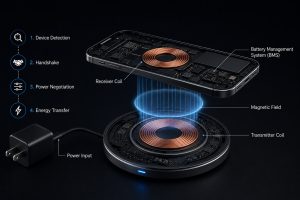
Qi wireless charging follows a carefully designed communication process that allows a charger and a compatible device to exchange power safely and efficiently.
Unlike basic wireless power transfer, a Qi charger doesn’t immediately begin sending maximum power. Instead, both the charger and the device communicate with each other before charging starts.
Let’s look at the process step by step.
Step 1: The Qi Charger Receives Power
The process begins when the Qi charging pad is connected to a power source using a compatible wall adapter.
Electricity enters the charger and is converted into an alternating current (AC).
This alternating current flows through the transmitter coil inside the charging pad, creating an alternating magnetic field above the charger.
At this stage, the charger is in standby mode, waiting for a compatible Qi-enabled device.
Step 2: Device Detection
When you place a smartphone or another Qi-compatible device on the charging pad, the charger first checks whether a compatible receiver is present.
Instead of immediately sending full power, the charger performs an initial detection process.
This helps prevent unnecessary energy transfer and improves charging efficiency.
If no compatible device is detected, the charger remains in standby mode.
Step 3: The Handshake Process
One of the biggest differences between Qi charging and basic wireless charging is the handshake process.
Before charging begins, the charger and the receiving device exchange information.
During this communication, the device tells the charger:
- It supports the Qi standard.
- How much power it can safely receive.
- Whether charging conditions are suitable.
The charger then verifies this information before delivering power.
This intelligent communication helps prevent charging errors and improves compatibility between different manufacturers.
Step 4: Power Negotiation
After the handshake is complete, the charger and device begin power negotiation.
Rather than sending maximum power all the time, the charger adjusts its output according to the device’s requirements.
For example:
- Wireless earbuds may require only a small amount of power.
- Smartphones may request higher charging power.
- Fast-charging compatible devices may negotiate higher power levels if both the charger and device support them.
This dynamic adjustment improves efficiency while reducing unnecessary heat generation.
Step 5: Energy Transfer Through Magnetic Induction
Once communication is complete, electrical energy is transferred using electromagnetic induction.
The transmitter coil inside the charger creates a rapidly changing magnetic field.
The receiver coil inside the smartphone captures that magnetic field and converts it back into electrical current.
The phone’s Battery Management System (BMS) then regulates the incoming power before safely charging the battery.
If you’d like to explore the science behind electromagnetic induction in greater detail, read our complete guide on How Wireless Charging Works.
Intelligent Communication Between the Charger and Device
One reason Qi has become the world’s leading wireless charging standard is its intelligent communication system.
Unlike simple power transfer methods, Qi chargers continuously exchange information with compatible devices throughout the charging process.
This ongoing communication allows the charger to:
- Adjust charging power automatically.
- Monitor charging performance.
- Detect interruptions.
- Prevent overheating.
- Stop charging when necessary.
This real-time communication improves both safety and charging efficiency.
Foreign Object Detection (FOD)
One of Qi’s most important safety features is Foreign Object Detection (FOD).
Sometimes metal objects such as:
- Coins
- Keys
- Rings
- Paper clips
may accidentally be placed on a charging pad.
If power were transferred into these objects, they could become dangerously hot.
Qi-certified chargers continuously monitor the charging surface.
If a foreign metal object is detected, the charger immediately reduces or stops power transfer.
This greatly improves user safety and helps prevent overheating.

Temperature Monitoring and Thermal Protection
Heat management is another major advantage of Qi-certified charging.
Both the charger and the smartphone continuously monitor temperature during charging.
If either device becomes too warm, the system automatically:
- Reduces charging power.
- Slows the charging speed.
- Pauses charging if necessary.
- Resumes normal charging after temperatures return to a safe level.
These intelligent thermal controls help protect battery health while extending the lifespan of both the charger and the device.
Why Qi Charging Is More Reliable Than Basic Wireless Charging
Qi is more than just wireless power transfer.
It combines:
- Standardized communication protocols.
- Automatic power adjustment.
- Intelligent safety monitoring.
- Universal compatibility.
- Certification testing.
Together, these features create a charging experience that is more consistent, reliable, and safer than many non-certified wireless charging solutions.
Qi Wireless Charging vs Non-Qi Wireless Charging
Not all wireless chargers follow the same standards. While Qi-certified chargers are tested for compatibility and safety, non-certified wireless chargers may not provide the same level of performance or reliability.
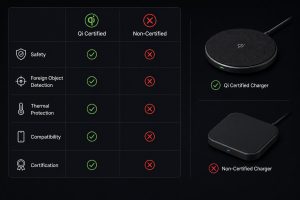
The table below highlights the key differences.
| Feature | Qi Wireless Charging | Non-Qi Wireless Charging |
| Industry Standard | Yes | No |
| Device Compatibility | Excellent | Limited |
| Safety Features | Advanced | Varies by manufacturer |
| Foreign Object Detection | Yes | Not Always |
| Charging Efficiency | Optimized | May Vary |
| Certification | Wireless Power Consortium | None or Proprietary |
For most users, choosing a Qi-certified charger is the safest and most reliable option.
What Is Qi2?
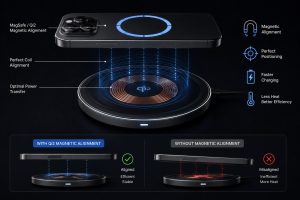
Qi2 is the next generation of the Qi wireless charging standard, introduced to improve charging efficiency, alignment, and compatibility.
One of its biggest improvements is a magnetic alignment system that helps position compatible devices correctly on the charging pad.
Better alignment offers several advantages:
- More efficient power transfer
- Faster and more consistent charging
- Reduced energy loss
- Lower heat generation
- Improved user experience
As more smartphones and accessories adopt Qi2, wireless charging is expected to become even faster and more reliable.
Note: Not all current smartphones support Qi2. Always check your device’s specifications before purchasing a Qi2 charger.
Advantages of Qi Wireless Charging
Qi has become the world’s leading wireless charging standard because it provides a consistent and reliable user experience.
Some of its biggest advantages include:
- Universal compatibility across many brands
- Intelligent communication between charger and device
- Automatic power adjustment
- Foreign Object Detection (FOD)
- Thermal protection
- Safer charging performance
- Better long-term reliability
- Support for continuous technology improvements
These advantages make Qi-certified chargers the preferred choice for most consumers.
Limitations of Qi Wireless Charging
Although Qi technology has improved significantly over the years, it still has some limitations.
These include:
- Charging is generally slower than high-speed wired charging.
- Proper alignment is required for the best performance.
- Slight heat generation during charging is normal.
- Charging distance is limited.
- Qi-certified chargers may cost more than basic wireless chargers.
Understanding these limitations helps users choose the right charging solution for their needs.
If you’re deciding between charging methods, read our comparison guide on Wireless Charging vs Wired Charging.
Frequently Asked Questions (FAQs)
What is Qi wireless charging?
Qi wireless charging is the global standard for wireless power transfer developed by the Wireless Power Consortium. It enables compatible devices and chargers to communicate safely while transferring power through electromagnetic induction.
How does a Qi charger know my phone is compatible?
A Qi charger performs a communication process, often called a handshake, to verify that the device supports the Qi standard before transferring power.
Is Qi wireless charging safe?
Yes. Qi-certified chargers include multiple safety features such as temperature monitoring, automatic power adjustment, and Foreign Object Detection (FOD).
Can I use any Qi charger with my phone?
If your phone supports the Qi standard, you can generally use any Qi-certified charger. However, charging speed may vary depending on your phone’s maximum supported wireless charging wattage.
Is Qi better than other wireless charging standards?
Qi is currently the most widely adopted wireless charging standard because it offers broad compatibility, strong safety features, and reliable performance across devices from different manufacturers.
Conclusion
Qi wireless charging has transformed the way modern electronic devices receive power by providing a universal, safe, and intelligent charging standard. Through features such as device authentication, power negotiation, temperature monitoring, and Foreign Object Detection, Qi delivers a reliable charging experience that goes far beyond basic wireless power transfer.
Whether you’re charging a smartphone, wireless earbuds, or another compatible device, choosing a Qi-certified charger helps ensure better compatibility, improved safety, and consistent performance.
As the technology continues to evolve with innovations like Qi2, wireless charging is expected to become even more efficient, convenient, and widely adopted across the consumer electronics industry.