Every day, over one billion people worldwide listen through headphones or earbuds. However, according to the World Health Organization, 1.1 billion young people face a risk of permanent hearing loss from unsafe listening habits. The question — which headphones are safest for your ears — is no longer just an audiophile concern. It is a genuine public health priority. This guide delivers a complete, evidence-based answer. We cover headphone types, safety ratings, earwax risks, noise cancellation, budget picks, and everything audiologists actually recommend for long-term hearing health.
Featured Snippet Definition:
The safest headphones for your ears are over-ear, closed-back models with active noise cancellation. They sit away from the ear canal, require lower listening volumes in noisy environments, and reduce cumulative acoustic exposure. Over-ear ANC headphones consistently receive the strongest audiologist endorsements for daily hearing health protection.
Which Headphones Are Safest for Your Ears? Understanding the Core Safety Factors
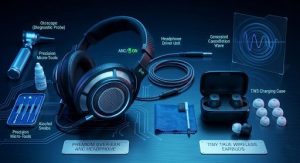
The answer depends on four key variables. Over-ear headphones are safest for your ears because they place the speaker driver furthest from the eardrum, enable the lowest listening volumes, provide strong passive isolation, and avoid ear canal contact entirely.
Here are the four factors that determine headphone hearing safety:
- Driver distance from the eardrum — Greater distance means lower acoustic pressure at the cochlea for any given volume.
- Passive noise isolation — Better physical sound blocking means lower listening volumes needed in noisy environments.
- Active noise cancellation — ANC reduces ambient noise, enabling further volume reduction.
- Listening volume and duration — These behavioral factors outweigh hardware in determining actual hearing damage risk.
Understanding how these four factors interact explains every recommendation in this guide. Furthermore, it helps you evaluate any headphone — regardless of brand or marketing claims — through the lens of genuine hearing science.
How Does Driver Distance Affect Which Headphones Are Safest for Your Ears?
Driver distance matters enormously. Sound pressure follows the inverse square law — doubling the distance from a sound source reduces its intensity by approximately 6 decibels. Over-ear headphones place the driver 25 to 40mm from the ear canal opening. In-ear earbuds place the driver 5 to 10mm from the eardrum itself.
At identical volume settings, in-ear earbuds deliver significantly more acoustic energy to the cochlea than over-ear headphones. This physical reality explains why audiologists consistently recommend over-ear designs as the starting point for hearing-safe listening. Additionally, Houston Methodist audiologists confirm that driver placement is one of the primary factors they consider when recommending headphones to patients with hearing health concerns.
Which Headphone Type Is Safest for Your Ears Based on Design Category?
Here is a direct comparison of the four main headphone design categories ranked by hearing safety:
| Headphone Type | Driver Distance | Canal Contact | Earwax Risk | Safety Ranking |
|---|---|---|---|---|
| Over-ear (circumaural) | 25–40mm | None | Very low | Safest |
| On-ear (supra-aural) | 10–20mm | None | Low | Second safest |
| In-ear (sealed tips) | 5–10mm | Yes — canal entry | Moderate | Third |
| Open-fit earbuds | 3–8mm | Minimal | Low | Variable |
Over-ear headphones rank safest across every hearing health metric. On-ear models rank second — they avoid canal contact but sit closer to the ear canal opening than over-ear designs. Sealed in-ear devices rank third due to canal contact, earwax stimulation, and proximity to the eardrum.
How Does Volume Level Determine Which Headphones Are Safest for Your Ears?
Volume management matters more than headphone type in determining real-world hearing damage risk. The safest headphones for your ears are the ones you naturally use at lower volumes — and that is precisely where over-ear ANC headphones excel.

What Volume Level Is Safe When Using Any Headphones for Your Ears?
The answer is clear and consistent across all major hearing health authorities. The National Institute on Deafness and Other Communication Disorders (NIDCD) states that sustained exposure above 85 decibels causes permanent cochlear hair cell damage. These hair cells do not regenerate. Once destroyed, the hearing loss is irreversible.
The 60/60 rule provides a practical guideline:
- Listen at no more than 60% of maximum volume
- For no longer than 60 minutes without a break
Most smartphone volume scales reach approximately 100 to 110 dB at maximum. Therefore, 60% of maximum volume on a typical device lands around 70 to 75 dB — well within the safe listening range. Furthermore, over-ear ANC headphones make the 60/60 rule easier to follow because they block ambient noise. You do not need to raise volume to hear over background sound.
How Does the Lombard Effect Explain Which Headphones Are Safest for Your Ears in Noisy Environments?
The Lombard effect is a critical concept in hearing safety. It describes the automatic tendency to raise listening volume in response to increased ambient noise — often without conscious awareness.
On a subway producing 85 dB of noise, a listener without noise isolation automatically raises earbud volume to 88 or 90 dB. With quality ANC headphones reducing that ambient noise to 50 dB, the same listener achieves comfortable listening at 60 to 65 dB. That 25 dB reduction in listening volume represents dramatic cumulative hearing protection over months and years of daily use.
According to Soundgate Hearing Clinic’s clinical analysis, the Lombard effect is the primary mechanism through which poor headphone choice contributes to noise-induced hearing loss in otherwise healthy adults. Choosing headphones with strong noise isolation or ANC directly counteracts this effect.
For a complete explanation of how ANC technology reduces ambient noise and protects hearing, read our guide on how active noise cancellation can help you beat noise.
Which Headphones Are Safest for Your Ears? The Complete Type-by-Type Breakdown
Are Over-Ear Headphones the Safest for Your Ears Among All Types?
Yes — over-ear headphones are the safest for your ears among all headphone categories. They combine the greatest driver-to-eardrum distance, the strongest passive isolation from a physical ear cup seal, zero ear canal contact, and the lowest earwax stimulation risk. Every audiologist recommendation we reviewed — including those from Houston Methodist, Soundgate Hearing Clinic, and Widex — consistently places over-ear headphones at the top of the hearing safety hierarchy.
The best over-ear options for hearing safety in 2026 include:
- Sony WH-1000XM6 — Industry-leading ANC, LDAC codec support, 30-hour battery with ANC active, adaptive noise cancellation that adjusts to your environment in real time.
- Bose QuietComfort Ultra — Exceptional ANC depth particularly for low-frequency noise, CustomTune personal calibration, outstanding wearing comfort for extended sessions.
- Apple AirPods Max (USB-C) — Adaptive transparency mode that attenuates sudden loud sounds, computational audio processing, seamless Apple ecosystem integration.
- Jabra Evolve2 85 — Designed specifically for professional all-day use, triple microphone ANC, certified for Microsoft Teams and UC platforms.
Are On-Ear Headphones Safe for Your Ears as a Second Option?
On-ear headphones are reasonably safe for your ears but deliver less hearing protection than over-ear designs. They do not enter the ear canal and avoid direct earwax stimulation. However, their smaller ear cups provide less passive isolation — meaning users in noisy environments need higher volumes to hear clearly.
On-ear headphones suit users who prioritize portability and find over-ear cups physically uncomfortable for extended wear. For daily commuting or travel, however, over-ear models provide better hearing protection meaningfully.
How Safe Are In-Ear Earbuds for Your Ears Compared to Over-Ear Headphones?
In-ear earbuds are less safe for your ears than over-ear headphones — primarily due to driver proximity to the eardrum and ear canal contact. However, responsible in-ear use with proper-fitting silicone tips significantly improves safety. A proper seal with quality tips provides meaningful passive isolation, reducing the Lombard effect and enabling lower listening volumes.
Widex’s audiological guidance on headphone safety notes that earbud safety depends heavily on tip fit — poorly fitted open-style earbuds with no canal seal require the highest volumes and offer the least hearing protection of any headphone category.
For a deep technical dive into how wireless earbud components work and how their design affects your ears, see our complete guide on how wireless earbuds work.
Are Headphones Better for Your Ears Than Earbuds? What the Evidence Shows
The answer is yes — headphones are generally better for your ears than earbuds. The evidence across audiological research, hearing clinic recommendations, and acoustic physics consistently favors over-ear headphone designs for hearing health.
Here is why headphones outperform earbuds for ear safety:
Driver distance advantage: Over-ear headphones place the speaker 25 to 40mm from the eardrum. Earbuds sit 5 to 10mm away. At equal volume settings, earbuds deliver dramatically more acoustic energy to cochlear hair cells — the irreplaceable structures that convert sound to neural signals.
No ear canal obstruction: Over-ear headphones do not enter the ear canal. They sit around the outer ear entirely. This means they do not disrupt the natural earwax migration process, do not create warm and moist canal environments that stimulate excess cerumen production, and do not introduce bacteria into the canal.
Passive isolation without canal sealing: Over-ear cups provide strong passive noise blocking through their physical structure — without sealing the ear canal. This isolation enables lower listening volumes without the earwax and infection risks of sealed in-ear devices.
Natural break reminders: Over-ear headphones become physically uncomfortable after extended wear — a natural built-in reminder to take listening breaks. Earbuds, by contrast, can be worn for hours without physical discomfort, increasing the risk of extended high-volume sessions.
However, headphones are not universally better in every context. For exercise, commuting with small bags, or sleeping, earbuds may be more practical. The key insight is that choosing headphones over earbuds for your primary daily listening represents the single most impactful hardware decision you can make for long-term hearing health.
For a full comparison of how headphone design affects hearing safety across every use case, read our detailed article on whether headphones are better for your ears.
Can Headphones Cause Earwax Buildup? What Every Headphone User Needs to Know
The answer is yes — certain headphones can cause earwax buildup, and the risk varies significantly by headphone type. In-ear earbuds that seal the ear canal are the primary culprits. Over-ear headphones carry minimal earwax risk.
Here is how earwax buildup happens from headphone use:
Blocked airflow: The ear canal relies on airflow to regulate temperature and moisture. Sealed in-ear earbuds block this airflow completely. The resulting warm, moist environment directly stimulates cerumen-producing glands in the canal lining — increasing wax output above normal levels.
Migration disruption: Natural jaw movement during chewing and talking massages earwax outward. Earbuds sitting in the canal physically block this outward migration. Wax accumulates deeper in the canal, eventually forming plugs that muffle hearing and create infection risk.
Heat accumulation: Extended listening sessions increase canal temperature. Studies referenced by Columbia University Medical Center show that sustained heat exposure is a primary driver of increased cerumen production in regular earbud users.
Bacteria introduction: Earbud tips accumulate earwax, skin oils, and bacteria. Reinserting unclean earbuds introduces this bacterial load back into the canal, raising infection risk beyond what the earwax buildup itself causes.
Which headphones are safest for your ears from an earwax perspective? Over-ear models — categorically. They create no canal microenvironment, allow natural wax migration to continue undisturbed, and introduce no bacterial contamination into the ear canal.
If you use in-ear earbuds, clean your tips after every session, take 60-minute listening breaks, and replace foam tips regularly. For the full clinical picture on this topic, read our comprehensive article on whether headphones can cause earwax buildup.
Which Wireless Headphones Under $100 Are Safest for Your Ears?
The best wireless headphones under $100 that are safest for your ears combine over-ear design, decent passive isolation, and responsible volume management features. You do not need to spend $350 on a Sony WH-1000XM6 to protect your hearing. Several genuinely safe options exist at the $50 to $100 price point.
Here are the top picks for safe wireless headphones under $100 in 2026:
Anker Soundcore Q45 (~$60):
Over-ear, closed-back design with hybrid ANC. The ANC reduces ambient noise effectively at this price point. Battery life reaches 50 hours without ANC and 40 hours with ANC active. The over-ear fit provides strong passive isolation that enables comfortable listening below 70 dB in most environments.
Sony WH-CH720N (~$100):
Sony’s entry-level ANC over-ear headphone. It uses the same Dual Noise Sensor Technology found in Sony’s flagship models. At 192g, it is one of the lightest over-ear ANC headphones available. The companion app includes volume limiting and an ambient sound control feature.
JBL Tune 770NC (~$80):
Over-ear design with adaptive ANC, 70-hour battery without ANC, and JBL’s Pure Bass sound profile. The large 40mm drivers produce satisfying bass at low volumes — reducing the temptation to raise volume for frequency fullness.
Edifier W830NB (~$70):
Hybrid ANC over-ear with LDAC support — a rare feature at this price point. LDAC compatibility enables high-bitrate wireless audio that minimizes Bluetooth compression, preserving audio quality at lower volumes.
Key features to prioritize when buying safe wireless headphones under $100:
- Over-ear closed-back design — mandatory for maximum hearing protection
- Active noise cancellation — enables lower listening volumes in noisy environments
- Volume limiting in companion app — allows you to set a maximum volume cap
- Battery life above 30 hours — sufficient for a full work week without daily charging
- Comfort for extended wear — physical comfort encourages listening breaks
Understanding how Bluetooth technology inside these headphones delivers audio without sacrificing quality helps you evaluate specs confidently. For a full technical breakdown, read our guide on how Bluetooth technology works in headphones.
Is Noise-Cancelling Headphones Bad for Your Ears? The Real Answer
The answer is no — noise-cancelling headphones are not bad for your ears. In fact, they are among the most hearing-protective consumer audio products available. This question reflects a widespread misunderstanding of how ANC technology actually works.
Here is what ANC actually does and does not do to your ears:
What ANC does: It uses microphones to detect ambient sound and generates an inverse waveform that cancels the ambient noise through destructive interference. The anti-noise signal carries no harmful acoustic energy. It does not create damaging pressure changes inside the ear cup.
What ANC does not do: It does not expose your cochlea to harmful sound levels. It does not damage the eardrum. It does not cause permanent hearing changes. No peer-reviewed clinical study has demonstrated hearing damage attributable to ANC technology in healthy users.
The pressure sensation is perceptual, not physical: Many new ANC users report a subtle pressure or fullness in their ears when ANC activates. This sensation is the brain interpreting an unusually quiet acoustic environment as a change in air pressure — not an actual barometric change inside the ear cup. This sensation is harmless and typically disappears within days of regular ANC use.
ANC actively protects hearing in noisy environments: By reducing ambient noise by 20 to 35 dB, ANC headphones enable users to listen at dramatically lower volumes. This behavioral benefit — reduced listening volume across thousands of daily listening sessions — provides genuine, cumulative hearing protection that standard headphones cannot match.
Which headphones are safest for your ears therefore include ANC as a positive safety feature, not a risk factor. Understanding the full science behind this technology helps you use it confidently. Read our complete analysis on whether noise-cancelling headphones are bad for your ears for the full clinical picture.
Which Headphones Are Safest for Your Ears in Specific Use Cases?
Which Headphones Are Safest for Your Ears During Exercise?
Exercise headphones present a specific challenge. Over-ear headphones become uncomfortable and sweaty during intense workouts. However, completely open-fit sport earbuds — which do not seal the canal — offer the safest compromise for active use.
The best safe exercise options include:
- Shokz OpenRun Pro 2 — Bone conduction design that bypasses the ear canal entirely. Sound transmits through the skull bones, leaving the ear canal completely open. This design eliminates all canal-related hearing risks and enables full environmental awareness — critical for outdoor runners and cyclists.
- Jabra Elite 8 Active — Sealed in-ear design with ANC, but features a secure wingtip fit that maintains the seal without deep canal insertion. Rated IP68 for water resistance.
- Sony LinkBuds — Open-ring driver design that sits at the canal entrance without sealing it. Minimal earwax stimulation and full ambient sound awareness.
For runners and cyclists, bone conduction headphones offer the unique combination of audio delivery and complete hearing safety — no canal contact whatsoever, full awareness of traffic and surroundings, and zero earwax risk.
Which Headphones Are Safest for Your Ears for Children?
Children require extra protection. Their ear canals are smaller, their auditory systems are still developing, and they cannot reliably report early symptoms of hearing damage. The safest headphones for children combine:
- Over-ear design — Mandatory. No in-ear devices for children under 12.
- Built-in volume limiting at 85 dB or lower — Essential. Do not rely on software limits alone.
- Comfortable, adjustable fit — Ensures the headphone stays on correctly without pressure points.
- Durable construction — Children’s headphones take significant physical abuse.
Top safe children’s headphones in 2026 include the Puro Sound Labs BT2200 (85 dB limit, over-ear, Bluetooth), the LilGadgets Untangled Pro (93 dB limit with volume-sharing cable), and the BuddyPhones Cosmos Plus (75/85/94 dB selectable limits, foldable, ANC).
Which Headphones Are Safest for Your Ears in Professional Work Environments?
Remote workers, call center professionals, and frequent conference call participants need headphones that combine all-day wearing comfort with hearing safety features specifically suited to extended professional use.
Key safety considerations for professional headphone use:
- All-day comfort — Physical comfort prevents the temptation to remove headphones and use speakerphone at higher volume
- Microphone noise cancellation — Reduces the need to speak loudly to be heard, which in turn reduces listening volume during calls
- Volume normalization for call audio — Prevents sudden loud sounds from incoming calls or notifications
- Mono/stereo switching — Mono mode allows one ear to remain open for environmental awareness
Top professional picks: Jabra Evolve2 85, Poly Voyager Focus 2, EPOS ADAPT 660. Each combines enterprise-grade ANC with professional microphone noise cancellation and all-day wearing comfort.
For the technical details on how microphone systems work in professional headsets, our guide on how earbud microphones work covers every component clearly.
How Should You Use Any Headphones Safely for Your Ears? The Practical Rules

What Are the Best Practices for Safe Headphone Use for Your Ears?
The best practices combine hardware choices with behavioral habits. Buying the safest headphones for your ears only protects you if you use them responsibly.
Follow these seven rules for maximum hearing protection:
- Apply the 60/60 rule — Maximum 60% volume for maximum 60 minutes at a stretch, then take a 5-minute break.
- Enable volume limiting in your device settings — iOS, Android, and most Bluetooth companion apps allow you to set a hard volume ceiling.
- Use ANC in noisy environments — Let the technology reduce ambient noise rather than raising your volume to compensate.
- Keep your devices clean — Clean earbud tips after every use. Replace foam tips monthly. Wipe over-ear pads weekly.
- Never use cotton swabs in the ear canal — They push wax deeper rather than removing it. Use a soft cloth at the canal entrance only.
- Monitor for warning signs — Ringing after listening sessions, muffled hearing, or ear fullness are early warning signs of acoustic damage. Reduce volume immediately if any appear.
- Get annual hearing checks — Regular audiological assessments catch noise-induced hearing changes before they become permanent.
How Does Wired vs Wireless Technology Affect Which Headphones Are Safest for Your Ears?
The wired vs wireless distinction matters less for hearing safety than most users assume. The primary hearing safety factor is always listening volume — not the transmission method. A wired headphone used at 90 dB causes more damage than a wireless headphone used at 65 dB, regardless of cable or Bluetooth connection.
However, wireless headphones with high-quality codecs like LDAC and aptX Adaptive deliver excellent audio quality at lower volumes — reducing the temptation to raise volume for perceived clarity. Furthermore, ANC is exclusively a wireless feature in the overwhelming majority of consumer headphones.
For a complete technical comparison of how wired and wireless audio quality differ and what that means for your hearing, read our in-depth analysis of wired vs wireless audio quality.
Frequently Asked Questions: Which Headphones Are Safest for Your Ears?
1. Which headphones are safest for your ears — over-ear or in-ear?
Over-ear headphones are safest for your ears. They place the speaker driver 25 to 40mm from the eardrum — significantly further than in-ear earbuds at 5 to 10mm. They provide strong passive isolation without ear canal contact, require lower listening volumes, and carry no earwax buildup or infection risk. Audiologists consistently recommend over-ear, closed-back designs as the top hearing-safe choice for daily use.
2. Are noise-cancelling headphones safe for your ears to use every day?
Yes — noise-cancelling headphones are safe for daily use and actively protective in noisy environments. ANC technology does not generate harmful acoustic energy or create damaging pressure changes. Daily ANC use reduces cumulative acoustic exposure by enabling lower listening volumes in noisy environments. No peer-reviewed study has demonstrated hearing damage attributable to ANC technology in healthy users.
3. What volume level is safe when using any headphones for your ears?
Keep listening volume at or below 85 decibels — approximately 60% of maximum volume on most smartphones. The 60/60 rule provides a practical guideline: 60% volume maximum for 60-minute sessions with 5-minute breaks in between. Over-ear ANC headphones make this easier to follow by reducing the ambient noise that otherwise drives volume up.
4. Which headphones are safest for your ears for children specifically?
Over-ear headphones with built-in volume limiting at 85 dB or lower are safest for children. Never use in-ear earbuds for children under 12. The Puro Sound Labs BT2200, LilGadgets Untangled Pro, and BuddyPhones Cosmos Plus all include hardware volume limits and comfortable over-ear designs suitable for children’s anatomy.
5. Can headphones cause permanent hearing loss?
Yes — any headphones used at unsafe volumes for extended periods can cause permanent noise-induced hearing loss (NIHL). Cochlear hair cells damaged by excessive acoustic energy do not regenerate. NIHL is cumulative and irreversible. However, headphone-related NIHL is entirely preventable through volume management, regular breaks, and choosing headphones with strong noise isolation that enable lower listening volumes.
6. Are bone conduction headphones safest for your ears?
Bone conduction headphones offer a unique safety profile. They transmit sound through the skull bones rather than through the ear canal, leaving the canal completely open. This eliminates canal contact, earwax risk, and ear canal pressure. However, bone conduction at high volumes can still transmit sufficient energy to the cochlea to cause damage. They are not inherently damage-proof — volume management still matters.
7. How long can you safely wear headphones for your ears each day?
Safe daily listening duration depends on volume level. At 85 dB, the NIDCD recommends a maximum of one hour before mandatory rest. And 80 dB, exposure up to two hours is considered safe. For 70 dB, most hearing authorities consider all-day listening safe. Using over-ear ANC headphones at 60 to 70 dB enables extended daily use without meaningful hearing damage risk for most adults.</p>
8. Which headphones are safest for your ears when sleeping?
Low-profile wireless earbuds with ANC or dedicated sleep headband systems are safest for sleep use. Over-ear headphones create pressure against the head during side sleeping, affecting comfort and circulation in the outer ear. The Bose Sleepbuds II, Kokoon Nightbuds, and ANC-equipped sleep headbands offer the best combination of ANC performance and sleep-position comfort for nighttime use.
9. Do expensive headphones protect your ears better than budget models?
Not automatically — but premium headphones typically deliver superior ANC performance, which enables meaningfully lower listening volumes in noisy environments. A $350 Sony WH-1000XM6 with excellent ANC enables comfortable 60 dB listening on a subway. A $30 earbud with no isolation may require 85 to 90 dB on the same journey. The ANC quality difference translates directly into real hearing protection across thousands of daily listening sessions.
10. Which headphones are safest for your ears if you already have hearing loss?
People with existing hearing loss require guidance from an audiologist before choosing headphones. Generally, over-ear headphones with strong ANC remain the safest choice — they enable clear audio at the lowest possible volumes. Some hearing aid users benefit from headphones with telecoil (T-coil) compatibility or Bluetooth LE Audio, which supports standardized hearing aid integration. Always consult an audiologist for personalized recommendations if you have documented hearing loss.
Conclusion: Which Headphones Are Safest for Your Ears — The Bottom Line
Over-ear, closed-back headphones with active noise cancellation represent the gold standard of hearing-safe audio. They maximize driver-to-eardrum distance, provide strong passive isolation, enable the lowest listening volumes in noisy environments, and eliminate ear canal contact entirely. Volume management — keeping listening below 85 dB with regular breaks — matters more than any single hardware feature. ANC technology actively helps by reducing the ambient noise that drives volume up instinctively. Whether you invest in a premium model or a thoughtful budget pick under $100, the combination of over-ear design, ANC, and responsible listening habits gives your ears the best possible long-term protection.
Ready to protect your hearing with the right pair? Explore our full range of audiologist-recommended headphones and find the perfect match for your lifestyle and budget.