
Introduction
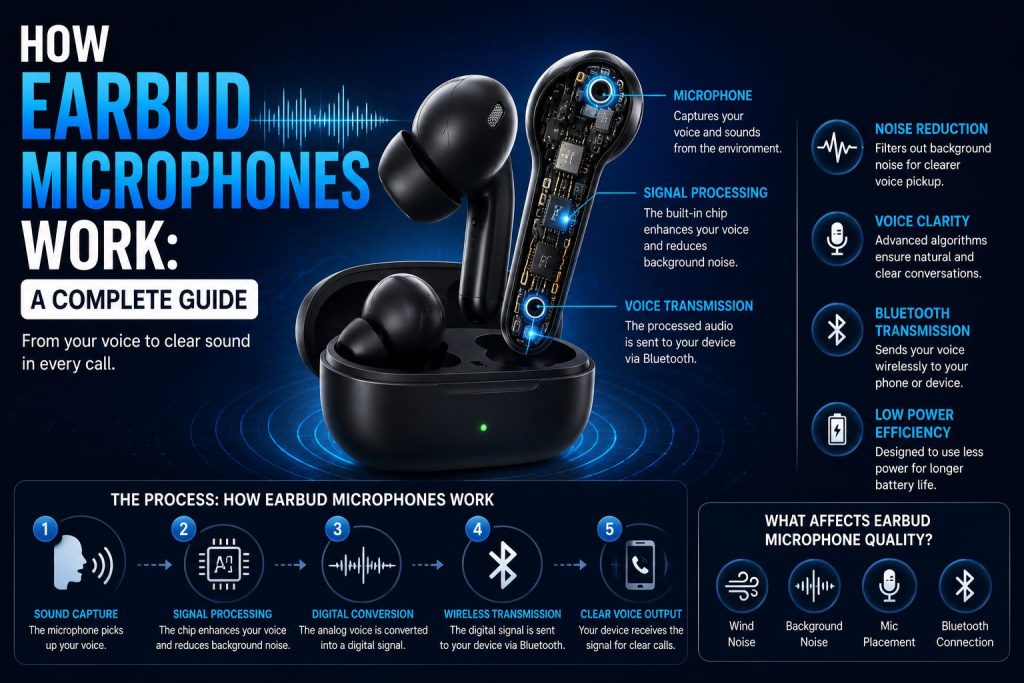
Have you ever wondered how earbud microphones work when you’re talking on a phone call, attending an online meeting, or giving voice commands to your smartphone? Despite their tiny size, modern earbuds contain powerful microphone technology that captures your voice with remarkable clarity-even in noisy environments.
Unlike older wired earphones, today’s wireless earbuds use multiple microphones, advanced Digital Signal Processing (DSP), and artificial intelligence (AI) to reduce background noise while focusing on your speech. Whether you’re walking through a busy street or working in a crowded office, your earbuds are constantly processing sound to deliver the best possible call quality.
In this guide, you’ll learn exactly how earbud microphones work, how do earbud headphones work, how noise cancelling earbuds work, how wireless earbuds work, and how Bluetooth earbuds connect. By the end, you’ll understand why premium earbuds provide much clearer conversations than basic models.
What Is an Earbud Microphone?
An earbud microphone is a miniature microphone built into each earbud that captures your voice during phone calls, video meetings, voice recordings, and interactions with virtual assistants like Siri or Google Assistant.
Although it’s incredibly small, it performs the same basic job as any microphone-it converts sound waves into electrical signals that your phone or computer can process.
The difference is that earbud microphones are specifically designed to work in constantly changing environments, whether you’re sitting in a quiet office or walking beside heavy traffic.
How Earbud Microphones Work
The process may sound complicated, but it actually happens in just a fraction of a second.
Here’s what happens when you start speaking.
Step 1: Your Voice Creates Sound Waves
Every word you speak produces tiny vibrations that travel through the air as sound waves.
These sound waves reach the microphone opening on your earbud almost instantly.
Step 2: The Microphone Captures the Sound
Inside the microphone is an extremely thin diaphragm.
When sound waves hit this diaphragm, it vibrates.
Those vibrations are then converted into electrical signals.
Think of it like translating your voice into a language that electronic devices understand.
Step 3: Digital Signal Processing Takes Over
Once your voice becomes an electrical signal, the earbud’s processor begins analyzing it.
This stage is called Digital Signal Processing (DSP).
DSP helps:
- Remove unwanted noise
- Enhance speech clarity
- Reduce echoes
- Balance voice volume
- Improve overall sound quality
All of this happens so quickly that you never notice it.
Step 4: Your Voice Is Sent to Your Device
After cleaning and processing the audio, your earbuds transmit the signal to your smartphone, tablet, or computer using Bluetooth.
The device then sends your voice to the person you’re talking to.
From speaking to transmission, the entire process usually takes only milliseconds.
Why Modern Earbuds Have Multiple Microphones
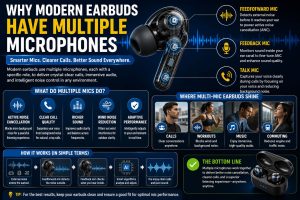
You may have noticed that premium earbuds advertise dual microphones, triple microphones, or even six-microphone systems.
They’re not adding microphones just for marketing.
Each microphone has a different job.
Typically:
- One microphone focuses on capturing your voice.
- Another listens to surrounding environmental noise.
- Sometimes additional microphones improve voice direction and call clarity.
By comparing these sounds, the earbuds can identify which audio belongs to your voice and which sounds should be reduced.
This makes conversations much clearer.
How Noise Cancellation Improves Call Quality
Many people think noise cancellation only affects what you hear.
Actually, it also helps what others hear.
Modern earbuds often use Environmental Noise Cancellation (ENC) during calls.
ENC works by identifying sounds like:
- Traffic
- Wind
- Air conditioners
- Fans
- People talking nearby
The processor reduces these unwanted sounds while keeping your voice as natural as possible.
The result is cleaner conversations-even in noisy environments.
Beamforming Technology Explained
One of the smartest technologies inside premium earbuds is beamforming.
Instead of listening equally in every direction, beamforming allows multiple microphones to focus specifically on where your voice is coming from.
Imagine shining a flashlight in a dark room.
Instead of lighting everything equally, the beam focuses on one area.
Beamforming works similarly-but with sound.
It helps your earbuds prioritize your voice while minimizing surrounding noise.
MEMS Microphones: The Tiny Powerhouse
Most wireless earbuds today use MEMS (Micro-Electro-Mechanical Systems) microphones.
These microphones are incredibly small but highly accurate.
Manufacturers prefer MEMS microphones because they are:
- Compact
- Energy efficient
- Durable
- Resistant to temperature changes
- Consistent in audio quality
Without MEMS technology, today’s lightweight wireless earbuds wouldn’t be nearly as effective.
Can Earbud Microphones Block Wind Noise?
Wind has always been one of the biggest challenges for microphones.
When wind hits the microphone opening, it creates unwanted low-frequency sounds.
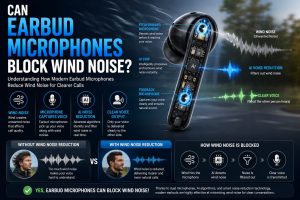
Modern earbuds reduce wind interference using:
- Wind-reduction algorithms
- Protective microphone mesh
- Multiple microphones
- AI-based voice filtering
While strong wind can still affect call quality, today’s earbuds perform much better than older models.
Why Earbud Microphones Sound Better Than They Used To
If you’ve owned earbuds over the last decade, you’ve probably noticed a huge improvement.
Several technologies contribute to better microphone quality:
- Artificial Intelligence
- Better DSP chips
- Multiple microphones
- Beamforming
- ENC
- Higher Bluetooth bandwidth
These improvements allow premium earbuds to produce call quality that rivals dedicated headsets in many situations.
Common Factors That Affect Microphone Quality
Even the best earbuds can’t perform perfectly under every condition.
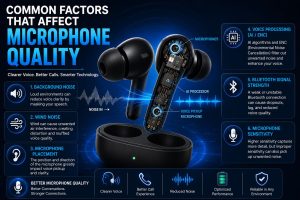
Several factors influence microphone performance:
- Strong wind
- Heavy traffic
- Low battery
- Bluetooth interference
- Dirty microphone openings
- Older Bluetooth versions
Keeping your earbuds clean and updated can noticeably improve call quality.
Tips to Get Better Voice Quality From Your Earbuds
If people often say they can’t hear you clearly, try these simple tips:
- Clean the microphone openings regularly.
- Keep your earbuds charged.
- Wear the correct earbud size for a secure fit.
- Update the firmware through the manufacturer’s app.
- Avoid covering the microphone with your fingers.
- Move away from extremely noisy environments whenever possible.
Small adjustments often make a surprisingly big difference.
Frequently Asked Questions
Do all earbuds have microphones?
Most modern wired and wireless earbuds include at least one built-in microphone for phone calls and voice assistants.
Can one earbud microphone work alone?
Yes. Many true wireless earbuds allow you to use either the left or right earbud independently during calls.
Why do expensive earbuds sound clearer?
Premium models usually include multiple microphones, advanced AI processing, beamforming, and better noise-reduction technology.
Can earbud microphones record audio?
Yes. They can record voice memos, participate in video meetings, create voice notes, and support voice-controlled applications.
Conclusion
Understanding how earbud microphones work reveals just how much advanced technology fits inside these compact devices. Tiny MEMS microphones, Digital Signal Processing, AI-powered noise reduction, and Bluetooth connectivity all work together to capture your voice clearly, even in challenging environments.
Whether you’re learning how do earbud headphones work, how noise cancelling earbuds work, how wireless earbuds work, or how Bluetooth earbuds connect, the goal is the same: delivering crystal-clear communication and an enjoyable listening experience.
As earbud technology continues to evolve, microphones will become even smarter, offering better voice isolation, improved AI processing, and more natural conversations. Choosing quality earbuds with advanced microphone systems ensures you’ll enjoy clearer calls, smoother online meetings, and reliable voice commands wherever you go.