
Quick Answer:
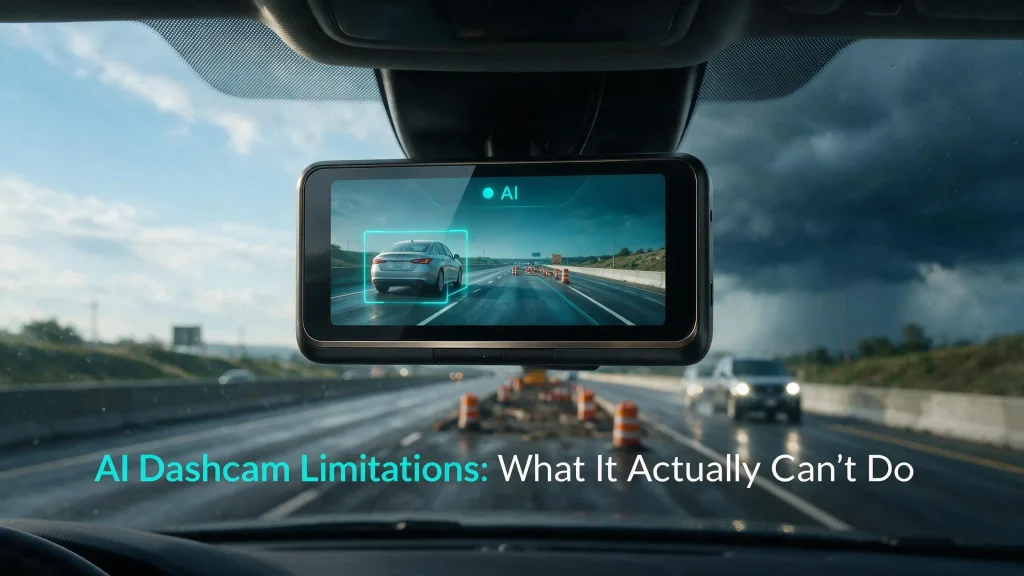
AI dashcam limitations are simple but important: these cameras can warn, record, and monitor alertness, but they cannot brake, steer, see through physical obstructions, identify every driver reliably, or replace your attention. Mount quality, chipset power, weather, glare, and night driving also affect how well they work.
We wrote the case for these devices in a separate article, and stand by most of it. This is the other half of that conversation. It’s the part that doesn’t fit on a product page: what the technology structurally cannot do, where its accuracy genuinely falls apart, and a body of driver-behavior research most manufacturers would rather you not think about too hard.
What an AI Dashcam Fundamentally Cannot Do

Some AI dashcam limitations are not bugs waiting on a firmware update. They’re built into what the device is, and no amount of better tuning changes them.
It can’t act on the car. Every warning covered anywhere on this site, forward collision, lane departure, drowsiness, ends at the beep. Nothing about a dashcam touches the brake pedal or the steering column, and confusing it for something that does, even for a second, is the single most dangerous misunderstanding a new owner can carry into traffic. It can’t predict a genuinely random event either. A tire blowing out on the car ahead. A driver having a medical emergency. A deer stepping out from behind a blind curve. What looks like prediction is really fast recognition of a pattern already visible in the data. Closing speed. Drifting lane position. A lingering glance away from the road. Where there’s no earlier visible pattern, there’s nothing for the system to catch sooner than a human eventually would.
It can’t see past a physical obstruction, obviously. In practice, that means a pedestrian behind a parked van stays invisible. A motorcycle in the camera’s own blind spot stays invisible. A hazard on the passenger side stays invisible when the primary lens faces forward. And despite what “facial recognition” scares suggest, it generally can’t identify a specific individual either.
What driver-facing cameras track is alertness: blink patterns, head angle, gaze direction. Not identity. That’s a meaningfully narrower and less invasive capability than the phrase implies. We cover it in more depth in our driver monitoring guide.
Where Accuracy Actually Breaks Down

Accuracy on any AI dashcam is a spectrum, not a fixed property of the category. It degrades in fairly predictable ways once you know what to look for. A loose or vibrating mount corrupts the motion data every collision and impact detection feature depends on, which is why two identical dashcams can perform completely differently depending on how carefully they you installed them. Heavy rain, fog, and direct low sun all reduce the visual clarity the computer vision model needs. A budget chipset running a lightweight detection model simply drops more frames and misses more edge cases than a properly specced one.
We’ve already covered the specific mechanics behind each failure mode frame preprocessing, sensor fusion, chip-level constraints in our technical breakdown of how AI dashcams work. Our false-alerts guide covers the fixes. We won’t re-walk that ground here. What’s worth adding instead is the buying-decision version of this problem. Accuracy limitations aren’t evenly distributed across price tiers. They also aren’t perfectly correlated with price. A mid-range dashcam with a rigid mount and a dedicated AI chipset often outperforms an expensive one. The expensive one cut corners on the processor to spend the budget on marketing and packaging instead. The honest limitation here isn’t really about the technology. It’s that “accurate” isn’t a claim you can verify from a spec sheet alone. That puts more research burden on the buyer than most product categories do.
Limitations at Night, Specifically
Night driving deserves its own mention because it’s where the gap between a good and mediocre system widens the most dramatically.
Lower light means a noisier image. A noisier image means the object-detection model has less clean signal to work with. Full stop, regardless of how good the underlying software is.
Headlight glare compounds the problem for camera-based systems. Driver-facing cameras relying on infrared illumination also lose effectiveness against certain sunglasses or in a cabin unevenly lit by passing streetlights. None of this means night detection doesn’t work. It means the margin for error shrinks. False negatives—missing something real—become more likely than false positives. A system that felt sharp during the day can feel noticeably less confident after dark on the exact same drive.
Is This Just a Marketing Gimmick?
Fair question, and the honest answer is more complicated than a flat yes or no. The underlying science—computer vision, object detection, PERCLOS-based drowsiness measurement, is real and well-documented. It’s built on decades of research that predates any dashcam company. That part isn’t hype. Where skepticism earns its keep is in how that real science gets deployed and marketed at the consumer level, where “AI-powered” sometimes describes a genuinely capable multi-sensor system and sometimes describes a basic motion sensor with a machine-learning label stapled on for the box.
There’s also a less comfortable data point worth sitting with.
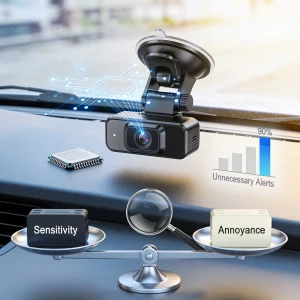
Research into conventional forward collision warning systems—the kind built into new cars, not aftermarket dashcams—has found a striking result. In one study, observers later judged over 90 percent of triggered alerts as unnecessary noise rather than genuine warnings. That doesn’t mean the feature is fake. It means a system tuned to never miss a real threat will, by design, cry wolf constantly. No amount of clever branding changes that trade-off between sensitivity and annoyance. A healthy amount of skepticism toward any specific product’s marketing claims is reasonable. Skepticism toward the entire category tends to fall apart once you look at the research the category is actually built on.
The Overreliance Problem Nobody Warns You About

Here’s the limitation that almost never makes it into a buying guide, including, until now, ours. Safety technology can change behavior in the opposite direction from what it’s designed for. There’s real research documenting exactly that with driver-assistance systems.
The concept is called risk compensation, and it isn’t unique to dashcams or cars. Give a cyclist a helmet and some will ride slightly faster or less cautiously than they would bare-headed, since the perceived safety margin has grown even if the actual risk of a serious head injury per crash hasn’t disappeared.
Researchers studying advanced driver assistance systems have found the same pattern behind the wheel. One large analysis covered roughly 200,000 vehicles, some with ADAS features and some without. The result: warning systems correlated with more hard-braking and speeding events, not fewer. Drivers were paying less active attention because something else was now watching for them. A separate strand of research on adaptive cruise control documents the same pattern. Drivers follow measurably closer than they would unassisted. They assume the system will intervene if they get too close.
This doesn’t mean the safety case falls apart. It means the safety case is a net calculation: real prevented incidents minus some behavior change the technology itself quietly encourages. Manufacturers have essentially no commercial incentive to talk about the subtraction. The most useful thing you can personally do with this information isn’t to distrust your dashcam.
It’s to notice, honestly, whether you’ve started following closer or checking your phone more often since installing one. If the answer is yes, the device is working exactly as the research predicts. The fix is entirely on the human side of the dashboard.
What Real Owners Actually Complain About

Strip away the star ratings and a handful of the same complaints show up across owner reviews and forum threads, brand after brand. That pattern is usually a better signal of a category-wide limitation than any single review. False alerts from mount vibration top the list by a wide margin. We gave the topic its own dedicated troubleshooting guide.
Battery and heat management comes second. It’s a particular problem for units you leave on a dashboard through a hot summer. Thermal throttling can quietly degrade every AI feature at once, with no obvious error message explaining why.
App and companion-software friction shows up constantly too. Laggy Bluetooth pairing. Firmware updates that fail partway. Cloud features that assume a phone connection stronger than what most people actually have in a parking garage. None of these are exotic AI failures. They’re the same categories of complaint any connected consumer electronics product accumulates. That’s either reassuring or unremarkable, depending on how much you expected the word “AI” to change.
Weighing This Against the Case For It
None of the above cancels out what these devices genuinely do well: real-time collision awareness, footage that finds itself, a documented ability to catch staged-accident fraud in the act. We cover all of it honestly in the companion piece. What this article is arguing for isn’t skepticism instead of the advantages. It’s skepticism alongside them, the kind that lets you buy a specific product for the right reasons, install it properly, and use it without quietly outsourcing the attention it was never actually built to replace.
The Short Version
Buy it for what it actually does. Faster detection of hazards already forming. Better evidence after the fact. A second layer of awareness on a long or tired drive. Don’t buy it expecting a system that thinks ahead of you or sees around corners. Don’t buy it expecting permission to pay less attention. The limitations aren’t a reason to skip the technology. They’re the terms and conditions nobody reads before agreeing to trust a camera with part of the job of driving.
Key Takeaways
- Some limitations are structural, not fixable — no AI dashcam can act on the car, predict truly random events, or see past physical obstruction.
- Accuracy varies more by mount quality and chipset than by price alone, which makes it hard to judge from a spec sheet.
- Night performance is where the gap between good and mediocre systems widens most, due to reduced signal quality rather than any single fixable flaw.
- The core science is real, but marketing execution varies wildly — skepticism toward a specific product is more useful than skepticism toward the whole category.
- Overreliance is a documented, research-backed risk, not a hypothetical one — some drivers measurably relax their own attention once a system is watching.
- The most common real complaints are mundane — mounts, battery heat, app friction — not exotic AI failures.
Frequently Asked Questions
What can AI dashcams not do?
They can’t take any physical action on the vehicle, no braking or steering, and they can’t predict genuinely random events like a tire blowout or a medical emergency in another car. They also can’t reliably see past physical obstructions or identify a specific individual by face, only track alertness signals like blink rate and gaze direction.
What are the main disadvantages of an AI dashcam?
Higher cost than a basic dashcam, accuracy that depends heavily on mount quality and chipset rather than price alone, reduced reliability at night and in poor weather, and a documented risk that some drivers become slightly less attentive once they trust the system to watch for them.
Can an AI dashcam make mistakes?
Yes, regularly. False alerts from a loose mount, missed detections in poor lighting, and misclassified events are all documented, well-understood limitations rather than rare edge cases. Research on similar factory-installed systems has found a large share of triggered warnings get judged as unnecessary by outside observers afterward.
Is AI in dashcams just a marketing gimmick?
The underlying science, computer vision and validated metrics like PERCLOS, is real and predates dashcam marketing entirely. The gimmick risk is at the product level, where “AI-powered” can describe anything from a genuinely capable system to a basic sensor with a label on it, not at the level of the technology itself.
What is AI dashcam overreliance, and is it a real problem?
It’s the tendency to pay less active attention because a system is now watching for hazards, and it’s a real, researched phenomenon called risk compensation, documented in studies of similar driver-assistance systems showing increased hard-braking and closer following distances among some users. The safety benefit is real but partially offset by this effect.
Why do AI dashcams struggle at night?
Lower light produces a noisier image with less usable detail for the detection model, and headlight glare compounds the problem. The result isn’t total failure, but a narrower margin for error, meaning missed detections become more likely than false alarms after dark.
A Note on Sources
The overreliance and risk-compensation research cited here comes from published academic studies on driver-assistance systems, not from dashcam manufacturers or their critics. The forward-collision nuisance-alert figure is drawn from a specific research study on conventional FCW systems and is presented as a finding from that study, not a universal statistic for every product on the market.
This guide is for general informational purposes and is not safety or purchasing advice.