

Have you ever wondered how slipping on a pair of headphones can make a roaring jet engine disappear? The answer lies in a clever piece of audio engineering. Understanding how noise-cancelling headphones work reveals one of the most practical applications of physics in everyday consumer technology. This guide breaks down the full science — from sound waves to microchips — so you walk away with a complete, accurate picture of what is actually happening inside those ear cups.
How Do Noise-Cancelling Headphones Work? Starting with Sound
Before diving into the technology itself, you need to understand what noise-cancelling headphones are actually fighting against. Sound is a wave. It travels through air as a series of rapid pressure changes — alternating compressions and expansions that your eardrum detects and your brain interprets.
Every sound wave has three defining properties. First, frequency determines pitch — how high or low a sound is. Second, amplitude determines loudness — how much energy the wave carries. Third, phase describes where in its cycle the wave currently sits.
How Do Noise-Cancelling Headphones Work with Wave Physics?
Here is where the core principle comes in. When two sound waves of identical frequency and amplitude meet in perfect phase opposition — meaning one wave’s peak aligns with the other wave’s trough — they cancel each other out completely. This process is called destructive interference.
Noise-cancelling headphones exploit this principle deliberately. They generate a sound wave that is the mirror image of incoming ambient noise. When these two waves combine inside the ear cup, they neutralize each other. The result is silence — or near silence — where disruptive environmental noise once existed.
This is not a trick or a filter. It is fundamental physics. Furthermore, it works entirely in real time, processing and cancelling ambient sound before it meaningfully reaches your eardrum.
How Do Noise-Cancelling Headphones Work Internally? The Three Core Components
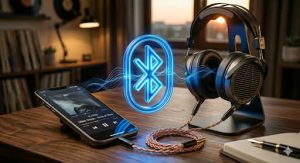
Understanding how noise-cancelling headphones work internally requires looking at three hardware components working together in a continuous loop. Each component plays a non-negotiable role in delivering effective cancellation.
How Do Noise-Cancelling Headphones Work Through Their Microphones?
The first component is the microphone — or more accurately, the set of microphones. Noise-cancelling headphones use one or more small microphones to continuously sample the sound environment around and inside the ear cup.
These microphones listen for ambient noise in real time. They capture everything from the low rumble of an aircraft engine to the steady hum of an office air conditioning unit. Additionally, in more advanced designs, microphones sit both outside and inside the ear cup simultaneously. This dual placement gives the system a fuller, more accurate picture of what the ear is actually experiencing.
The ANC Processor: The Brain Behind How Noise-Cancelling Headphones Work
The microphone feeds its captured audio signal into a dedicated ANC processor chip. This processor performs a mathematically precise operation at extraordinary speed — it analyzes the incoming ambient sound and calculates the exact inverse waveform in real time.
Speed is critical here. Sound travels at approximately 343 meters per second. Therefore, the processor must generate its counter-signal fast enough to reach the ear at the same moment as the ambient sound. Most modern ANC processors complete this calculation in under one millisecond.
This is genuine signal processing engineering. Furthermore, it requires a dedicated chip — not just software — because the computation demands are too high for a general-purpose processor to handle at the necessary speed.
How Do Noise-Cancelling Headphones Work at the Speaker Level?
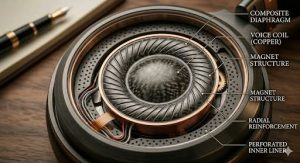
The third component is the speaker driver — the same driver that plays your music or podcasts. It serves a dual function. On one hand, it reproduces your chosen audio content faithfully. On the other hand, it simultaneously plays back the anti-noise signal generated by the ANC processor.
Both signals — your music and the anti-noise — combine acoustically inside the ear cup. The anti-noise cancels the ambient environmental sound. Your audio content passes through unaffected. As a result, you hear your music clearly in a dramatically quieter acoustic environment.
How Do Noise-Cancelling Headphones Work Across Different ANC Designs?
Not all noise-cancelling headphones use the same architecture. Three main design approaches exist, and each one affects performance in meaningful ways. Understanding these differences helps you evaluate which type suits your needs best.
Feedforward ANC: How Noise-Cancelling Headphones Work from the Outside In
In a feedforward system, the microphone sits on the outside of the ear cup, facing the environment directly. It captures ambient sound before that sound physically enters the ear cup space.
This placement gives the processor an early warning. Consequently, the system has slightly more time to generate the anti-noise response before the original sound reaches the ear. Additionally, feedforward ANC can respond to a broader range of frequencies because the external microphone captures a clean, uncolored sound signal.
However, feedforward systems have one significant weakness. Because the microphone sits outside the cup, the system cannot verify whether its anti-noise response has successfully cancelled the ambient sound at the ear. Any error in the calculation reaches the listener uncorrected.
Feedback ANC: How Noise-Cancelling Headphones Work from the Inside Out
Feedback ANC places the microphone inside the ear cup, positioned close to the ear. Instead of sampling ambient sound before it enters the cup, the feedback microphone monitors the acoustic environment right at the listening position.
This placement allows the system to self-correct continuously. If residual ambient noise remains after the initial cancellation, the feedback microphone detects it and the processor adjusts its anti-noise signal accordingly. Therefore, feedback systems deliver more accurate results across individual users with different ear shapes and headphone fits.
On the other hand, feedback microphones are influenced by the acoustic properties of the ear cup itself. This limits the frequency range they can effectively cancel. Furthermore, poorly tuned feedback systems can develop howling or oscillation artifacts if the feedback loop becomes unstable.
Hybrid ANC: How Noise-Cancelling Headphones Work at Their Best
Hybrid ANC combines both feedforward and feedback microphones in a single system. External microphones capture incoming ambient sound and generate a primary anti-noise response. Internal microphones simultaneously monitor the result and apply real-time corrections to any residual noise.
This dual-microphone approach delivers the broadest frequency coverage and the most accurate cancellation currently achievable. Additionally, it compensates automatically for fit variations between users — a factor that significantly affects real-world ANC performance.
Premium headphones from Sony, Bose, and Apple use hybrid ANC systems. The Sony WH-1000XM6, for example, runs an AI-powered adaptive hybrid algorithm that continuously adjusts its cancellation parameters based on the current acoustic environment. For a deep dive into what this technology delivers across top models, read our guide on what headphone noise cancelling really is and how it compares across brands.
How Do Noise-Cancelling Headphones Work Against Different Types of Noise?
A common misconception is that noise-cancelling headphones eliminate all environmental sound equally. In reality, ANC technology performs very differently depending on the nature of the noise. Understanding these strengths and limits helps you set realistic expectations.
How Noise-Cancelling Headphones Work Best Against Low-Frequency Sound
ANC excels at cancelling low-frequency, consistent, and predictable sounds. These include aircraft engine drone, train and subway rumble, highway traffic noise, and HVAC system hum. These sounds have regular, repeating waveforms that the ANC processor can anticipate and counter with high accuracy.
The Bang & Olufsen active noise cancellation explainer confirms that the sweet spot for ANC effectiveness is roughly 20 Hz to 1,000 Hz — the low-frequency range where engine and mechanical noise concentrates. In this range, quality ANC systems achieve reductions of 20 to 35 decibels.
Where ANC Has Limits: How Noise-Cancelling Headphones Work Less Effectively
High-frequency, sudden, and irregular sounds present a much harder challenge for ANC technology. Human speech, barking dogs, keyboard clicks, and sharp unexpected noises change too rapidly and unpredictably for the ANC processor to generate an accurate inverse waveform in time.
For these higher-frequency sounds, the ear cup’s physical structure — its passive noise isolation — does most of the work. Dense ear pad material and a tight seal against the head attenuate high frequencies effectively without any electronics involved. Therefore, the best ANC headphones combine strong active cancellation for low frequencies with excellent passive isolation for high frequencies.
The Bose noise cancelling vs noise masking breakdown makes a similar point — ANC and physical design are complementary, not competing, noise-reduction strategies.
How Do Noise-Cancelling Headphones Work Safely for Your Ears?
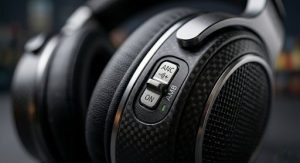
A reasonable concern accompanies any discussion of how noise-cancelling headphones work: is this technology safe? The answer, based on current audiological evidence, is clearly yes — and in many situations, ANC actively protects hearing rather than threatening it.
The Volume Reduction Benefit: How Noise-Cancelling Headphones Work as Hearing Protection
The primary hearing safety benefit of ANC is behavioral. In noisy environments, listeners instinctively raise their audio volume to stay above the ambient noise floor — a well-documented response called the Lombard effect. On a subway producing 82 dB of noise, a listener without noise cancellation might push their headphone volume to 88 or 90 dB just to hear clearly.
With effective ANC reducing that ambient noise to 50 dB, the same listener achieves clear audio at 60 to 65 dB. That 20 to 25 dB reduction in listening volume is significant. Over months and years of daily commuting, it translates into meaningfully lower cumulative acoustic exposure — and a substantially reduced risk of noise-induced hearing loss.
Furthermore, our detailed guide on whether noise-cancelling headphones are bad for your ears covers the full safety evidence in depth, including what the pressure sensation some users experience actually means physiologically.
The Pressure Sensation: Understanding How Noise-Cancelling Headphones Work Perceptually
Some users feel a subtle pressure or fullness in their ears when ANC activates. This sensation is perceptual — not physical. The brain interprets the sudden, unusual quiet inside the ear cup as a change in air pressure, even though no actual barometric change has occurred.
This sensation typically fades with regular use as the brain adapts. However, users with pre-existing conditions such as Eustachian tube dysfunction or heightened auditory sensitivity should consult an audiologist before making ANC headphones a daily habit.
Additionally, if you use in-ear ANC earbuds rather than over-ear headphones, ear canal hygiene becomes relevant. Our article on whether headphones can cause earwax buildup covers this specific concern in detail.
How Do Noise-Cancelling Headphones Work Alongside Transparency Mode?
Modern ANC headphones do not simply toggle between active cancellation and no cancellation. Most premium models include a transparency mode — sometimes called pass-through or ambient sound mode — that represents a sophisticated extension of the same microphone and processing infrastructure that powers ANC.
How Transparency Mode Uses the Same Technology Differently
In transparency mode, the external microphones remain active. However, instead of using the captured ambient sound to generate an anti-noise signal, the processor passes that ambient sound through to the listener’s ears via the speaker driver.
The result is that you hear both your audio content and the outside world simultaneously — as if the headphones were not there at all, or in some implementations, even more clearly than without the headphones. This mode is essential for safe outdoor use, allowing runners and cyclists to remain aware of traffic while still enjoying music.
As the Reddit ELI5 thread on how ANC works illustrates through community discussion, transparency mode is consistently one of the features that surprises users most — because it demonstrates that the same microphones powering noise cancellation can serve the completely opposite purpose with a single button press.
Adaptive Transparency: The Next Evolution
The most advanced implementations — found in Apple’s AirPods Pro and Sony’s XM6 — go further still. Adaptive transparency mode uses real-time audio analysis to pass through ambient sound at natural volume levels while automatically attenuating sudden loud sounds — a jackhammer, a passing siren — before they reach the ear.
This represents a genuinely new safety feature. It keeps the listener aware of their environment while protecting against unexpected acoustic spikes that could damage hearing. In this sense, modern ANC technology has evolved well beyond simple noise reduction into a comprehensive, active hearing management system.
For a full picture of how to choose the safest headphones for your specific situation, explore our complete resource on which headphones are safest for your ears.
Frequently Asked Questions: How Do Noise-Cancelling Headphones Work?
1. How do noise-cancelling headphones work without blocking the ear canal physically?
Noise-cancelling headphones use electronic processing rather than physical blocking to reduce ambient sound. Their microphones capture incoming noise, the ANC processor generates an inverse waveform, and the speaker plays this anti-noise signal. The two waves cancel each other through destructive interference inside the ear cup — no physical ear canal obstruction required.
2. How do noise-cancelling headphones work without affecting music quality?
Modern hybrid ANC systems process the anti-noise signal on a separate path from the audio signal. Therefore, the cancellation circuit does not interfere with the music reproduction chain. Premium models deliver virtually transparent ANC — enabling noise cancellation without any perceptible change in audio fidelity for most listeners.
3. How do noise-cancelling headphones work on an airplane?
Aircraft cabin noise — typically 75 to 85 dB — consists primarily of low-frequency engine and airframe vibration. This is exactly the frequency range where ANC performs best. Quality ANC headphones reduce this noise by 20 to 35 dB on a flight, allowing passengers to listen at safer, lower volumes or to rest in comfortable quiet.
4. How do noise-cancelling headphones work differently from noise-isolating headphones?
Noise-cancelling headphones use active electronic processing to cancel ambient sound waves. Noise-isolating headphones use passive physical design — dense materials and tight seals — to block sound from entering the ear cup. ANC targets low frequencies best; passive isolation handles high frequencies well. Most premium ANC headphones combine both approaches.
5. How do noise-cancelling headphones work when there is no sound playing?
ANC functions independently of whether any audio content is playing. The microphones, processor, and anti-noise signal operate continuously regardless of playback. Therefore, you can activate ANC on a quiet flight or in a noisy office with no music playing and still benefit from the ambient noise reduction.
6. How do noise-cancelling headphones work with different ear shapes?
Individual ear shape and headphone fit significantly affect ANC performance. Hybrid ANC systems with internal feedback microphones compensate for fit variations automatically. However, poorly fitting ear cups reduce passive isolation and allow ambient noise to leak into the ear cups, limiting how effectively the ANC system can cancel it.
7. How do noise-cancelling headphones work in terms of battery use?
ANC requires continuous power for the microphones, processor, and anti-noise signal generation. Consequently, enabling ANC reduces battery life compared to using headphones passively. The typical impact is 20 to 40% reduction in battery life. Premium models achieve 25 to 30 hours with ANC enabled; budget models may deliver only 15 to 20 hours.
8. How do noise-cancelling headphones work against human speech?
Human speech is high-frequency, irregular, and unpredictable — exactly the type of sound ANC handles least effectively. The ANC processor cannot generate an accurate inverse waveform fast enough for rapidly changing speech patterns. Physical passive isolation from the ear cup provides more of the speech attenuation you experience than the electronic ANC circuit.
9. How do noise-cancelling headphones work with the pressure sensation some users feel?
The pressure sensation is perceptual, not physical. When ANC dramatically reduces ambient sound, the brain interprets the sudden quiet as a change in air pressure — even though no actual barometric change has occurred. This sensation is harmless for most users and typically diminishes with regular use as the auditory system adapts.
10. How do noise-cancelling headphones work better in some environments than others?
ANC performance depends on the type of ambient noise present. Low-frequency, consistent sounds like engine noise and HVAC hum are cancelled most effectively — often by 25 to 35 dB. High-frequency, variable sounds like voices and sharp noises are reduced less by ANC and more by passive isolation. Matching your headphone choice to your primary noise environment maximizes performance.
Conclusion: How Do Noise-Cancelling Headphones Work — The Key Takeaways
Noise-cancelling headphones work by using microphones to capture ambient sound, generating an inverse waveform through a dedicated ANC processor, and playing that anti-noise signal through the speaker to cancel unwanted environmental noise via destructive interference. Hybrid systems combining feedforward and feedback microphones deliver the best results. In noisy real-world environments, this technology actively protects hearing by enabling meaningfully lower listening volumes. For anyone who spends time commuting, traveling, or working in noisy spaces, understanding how this technology works empowers smarter, safer listening choices every day.
Ready to find the best noise-cancelling headphones for your needs? Start with our expert guide on which headphones are safest for your ears and make an informed, hearing-safe decision today.