
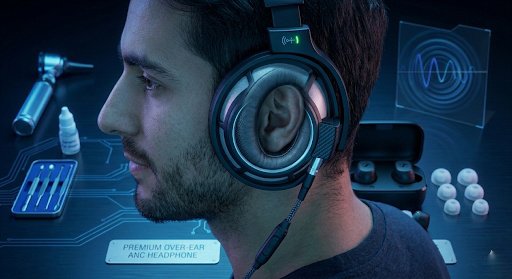
Millions of people reach for earbuds every single day — but is that the right choice for their hearing? Are headphones better for your ears than earbuds? The question matters more than most people realize. According to the World Health Organization, over 1.1 billion young people currently face permanent hearing loss risk from unsafe listening habits. Choosing the right audio device is one of the most impactful decisions you can make for your long-term auditory health. This guide delivers the complete, evidence-based answer.
Featured Snippet Definition:
Headphones are generally better for your ears than earbuds. Over-ear headphones place the speaker driver 25 to 40mm from the eardrum — significantly further than earbuds at 5 to 10mm. This greater distance, combined with stronger passive noise isolation, enables lower listening volumes and reduces cumulative acoustic exposure to cochlear hair cells.
Are Headphones Better for Your Ears? The Core Science Behind the Answer

The answer is yes — headphones are better for your ears than earbuds in most listening scenarios. The primary reason is physics. Sound pressure decreases as distance from the source increases. Over-ear headphones place the speaker driver considerably further from your eardrum than any earbud design achieves.
Here is why that distance matters so profoundly:
- Over-ear headphones: Driver sits 25 to 40mm from the ear canal opening
- On-ear headphones: Driver sits 10 to 20mm from the ear canal opening
- In-ear earbuds: Driver sits 5 to 10mm directly inside the ear canal
- Open-fit earbuds: Driver sits 3 to 8mm at the canal entrance
At equal volume settings, in-ear earbuds deliver dramatically more acoustic pressure to the cochlea than over-ear headphones. This is not a minor difference. Furthermore, cochlear hair cells — the structures that convert sound waves into neural signals — do not regenerate once damaged. The hearing loss that results from excessive acoustic exposure is permanent and cumulative.
How Does Driver Distance Prove That Headphones Are Better for Your Ears?
Driver distance directly reduces the acoustic energy reaching your cochlea. Sound intensity follows the inverse square law. Therefore, doubling the distance from a sound source reduces its intensity by approximately 6 decibels.
An over-ear headphone driver sitting 30mm from your ear canal opening delivers measurably less sound pressure than an earbud sitting 7mm from your eardrum — even when both play the same audio signal at the same device volume setting. As a result, over-ear headphone users experience lower actual sound pressure levels at the cochlea during every listening session.
The Hearing Health Foundation’s comparison of earbuds vs over-ear headphones confirms this physics-based advantage. Their analysis concludes that over-ear designs consistently expose the cochlea to lower pressure levels than in-ear alternatives at comparable perceived listening volumes.
Are Headphones Better for Your Ears Because of Noise Isolation?
Yes — headphones are better for your ears specifically because their superior noise isolation enables lower listening volumes. This behavioral effect is the most practically significant hearing health advantage of headphones over earbuds.
How Does the Lombard Effect Explain Why Headphones Are Better for Your Ears?
The Lombard effect describes the automatic tendency to raise your audio volume in response to increased ambient noise. This response happens instinctively — most people raise their volume without consciously realizing it.
Consider a real-world example. On a subway producing 82 dB of ambient noise, an earbud user with minimal isolation automatically raises their volume to 85 or 88 dB to hear clearly. An over-ear headphone user with strong passive isolation hears the same subway at approximately 55 to 60 dB — and achieves comfortable listening clarity at 65 to 70 dB. That is a 15 to 20 dB reduction in actual listening volume on every single commute.
Additionally, Houston Methodist audiologists confirm that the Lombard effect is the primary mechanism through which poor headphone choice contributes to noise-induced hearing loss in otherwise healthy adults. Choosing headphones with strong isolation directly counteracts this instinctive but damaging behavior.
Why Does Passive Isolation Make Headphones Better for Your Ears Than Earbuds?
Passive noise isolation is the physical sound blocking provided by the ear cup material and seal — no electronics required. Over-ear headphones with quality ear pads and a proper head seal typically provide 15 to 25 dB of passive isolation across most frequency ranges.
In contrast, open-fit earbuds provide essentially zero passive isolation. Even sealed in-ear earbuds — which sit in the canal — provide variable isolation depending on tip fit quality and canal shape. A poor-fitting earbud tip delivers far less isolation than its specifications suggest.
Furthermore, over-ear headphone passive isolation handles the high-frequency sounds that active noise cancellation does not cancel effectively — voices, keyboard noise, and sharp sudden sounds. This complementary effect makes over-ear headphones comprehensively better at blocking all types of noise, not just the low-frequency targets of ANC systems.
For a complete explanation of how ANC technology works alongside passive isolation, read our guide on how noise-cancelling headphones work.
Are Headphones Better for Your Ears When Active Noise Cancellation Is Involved?
Absolutely — headphones with active noise cancellation are the most hearing-protective consumer audio option available. ANC removes another layer of ambient noise on top of passive isolation, enabling even lower listening volumes in challenging environments.

How Does ANC Make Headphones Even Better for Your Ears?
Active noise cancellation uses microphones to detect ambient sound and generates an inverse waveform that cancels it through destructive interference. Premium ANC systems reduce low-frequency ambient noise by 20 to 35 additional decibels beyond what passive isolation achieves.
Combined with passive isolation, the best over-ear ANC headphones can reduce a 90 dB subway environment to an effective perceived level of 50 to 55 dB at the listener’s ear. This allows comfortable audio listening at 60 to 65 dB — a full 25 to 30 dB below the dangerous threshold of 85 dB where cochlear damage begins.
The National Institute on Deafness and Other Communication Disorders (NIDCD) states that exposure above 85 dB for extended periods causes permanent cochlear hair cell damage. ANC headphones consistently enable listening well below this threshold in environments where earbuds would push users dangerously close to or above it.
Are Headphones Better for Your Ears Specifically Because ANC Does Not Damage Hearing?
Yes — ANC technology itself is completely safe. The anti-noise signal carries no harmful acoustic energy. It does not create damaging pressure changes inside the ear cup. No clinical study has demonstrated hearing damage attributable to ANC technology in healthy users.
Some people feel a subtle pressure sensation when ANC activates — particularly during first use. However, this sensation is perceptual rather than physical. The brain interprets an unusually quiet acoustic environment as a pressure change. No actual barometric shift occurs. This sensation is harmless and typically disappears within days of regular use.
Therefore, headphones with ANC are both structurally better for your ears and technologically safe — a combination that earbuds without effective noise isolation cannot match. For a deeper understanding of how ANC can actively protect your hearing in daily environments, see our article on how active noise cancellation helps you beat noise.
Are Headphones Better for Your Ears for Long Listening Sessions?
Yes — headphones are significantly better for your ears during extended listening sessions. They deliver lower acoustic exposure per session and include physical features that encourage healthy listening habits.
How Do Headphones Protect Your Ears Better During All-Day Use?
Over-ear headphones become physically uncomfortable during extended sessions — ear pad warmth and head pressure build gradually. This built-in discomfort serves as a natural reminder to take listening breaks. Audiologists recommend a minimum 5-minute break per hour of listening. Over-ear headphones make this easier to follow because physical comfort prompts users to remove them naturally.
Earbuds, by contrast, sit in the ear canal with minimal physical feedback. Users frequently wear in-ear earbuds for four or five continuous hours without discomfort — far beyond the safe listening duration at any meaningful volume level. Furthermore, prolonged earbud use creates a consistently warm, sealed ear canal environment that stimulates excess earwax production — an additional health concern beyond acoustic damage.
Are Open-Back Headphones Better for Your Ears Than Closed-Back?
Open-back headphones allow ambient sound to pass through the ear cup freely. This design maintains a more natural acoustic environment around the ear and prevents the slight pressure buildup that some users notice with sealed closed-back cups.
For home listening in quiet environments, open-back headphones offer a comfortable, natural-sounding option with no passive isolation side effects. However, their lack of isolation means users need higher volumes in any environment with ambient noise. In quiet rooms, open-back headphones are excellent. In noisy environments, closed-back headphones are better for your ears because they enable dramatically lower listening volumes.
The practical recommendation: use open-back headphones for quiet home listening and closed-back ANC headphones for commuting, travel, and noisy workspaces. Both are better for your ears than earbuds in their respective optimal environments.
Are Headphones Better for Your Ears Than Earbuds for Specific Groups?
Are Headphones Better for Your Ears for Children?
Yes — headphones are substantially better for children’s ears than earbuds. Children’s ear canals are smaller than adults’, which means any in-ear device creates proportionally higher acoustic pressure at the eardrum than the same device would in an adult canal.
Additionally, children cannot reliably report early hearing damage symptoms. They will not recognize tinnitus as a warning sign, or connect muffled hearing after listening sessions to excessive volume exposure. Therefore, children need the built-in hardware protection that volume-limiting over-ear headphones provide — not the responsibility of self-regulating earbud volume.
The best approach for children combines over-ear headphones with hardware volume limits set at 85 dB or below. Never rely solely on software volume limits for children, as these can be overridden. Hardware limits inside the headphone itself provide reliable, non-bypassable protection.
Are Headphones Better for Your Ears for People Who Already Have Hearing Loss?
For people with documented hearing loss, over-ear headphones remain the better choice — but specific features become especially important. Strong ANC enables the user to hear audio content at lower volumes by reducing the competing ambient noise that makes hearing difficult. Wider frequency response at low volumes ensures that audio remains full and clear without requiring dangerous volume levels.
Additionally, people with hearing loss frequently need higher volumes to achieve comfortable listening than people with normal hearing. This makes the passive isolation advantage of over-ear headphones even more critical — every decibel of ambient noise reduction is a decibel they do not need to compensate for with volume.
Always consult an audiologist for personalized headphone recommendations if you have documented hearing loss. For a comprehensive guide to the safest headphone options across all categories and price points, read our complete resource on which headphones are safest for your ears.
Are Headphones Better for Your Ears in Every Situation? When Earbuds Are the Right Choice
Headphones are better for your ears in the majority of listening situations. However, honest analysis requires acknowledging the situations where earbuds are more practical — and how to use them more safely when you do.
When Are Earbuds Acceptable Despite Headphones Being Better for Your Ears?
Earbuds make practical sense in these specific scenarios:
- Intense exercise: Over-ear headphones become sweaty and uncomfortable during vigorous workouts. Sport earbuds with secure wing-tip fits are practical. Use sealed tips with good passive isolation and keep volume below 75 dB.
- Sleeping: Flat-profile sleep earbuds cause less discomfort during side sleeping than any over-ear design. ANC sleep earbuds at low volumes are acceptable for nighttime use.
- Brief, casual use: Answering a quick phone call or listening to five minutes of audio carries minimal risk regardless of device type. Volume and duration together determine risk — not device type alone.
When earbuds are unavoidable, these practices reduce their risk:
- Use properly fitting sealed tips — a good seal reduces the volume needed to hear clearly
- Keep volume at or below 70 dB — lower than the 85 dB safe threshold to compensate for proximity to the eardrum
- Limit continuous sessions to 45 minutes rather than 60 minutes
- Clean tips after every session to prevent bacterial buildup
- Never insert tips deeper than necessary for a comfortable seal
For the technical details behind how Bluetooth audio works in both headphones and earbuds — and what that means for sound quality and hearing safety — read our guide on how Bluetooth technology works in headphones.
Frequently Asked Questions: Are Headphones Better for Your Ears?
1. Are headphones better for your ears than earbuds scientifically?
Yes — scientific evidence consistently supports over-ear headphones as the safer listening choice. The primary reasons are greater driver-to-eardrum distance, stronger passive noise isolation, and the resulting lower listening volumes users naturally choose. The Hearing Health Foundation, Houston Methodist audiologists, and the National Institute on Deafness all favor over-ear designs for hearing health protection.
2. Are wireless headphones better for your ears than wired headphones?
The wired vs wireless distinction does not significantly affect hearing safety. Both wired and wireless headphones can be used at safe or unsafe volumes. Wireless headphones with ANC offer the additional benefit of reducing ambient noise — enabling lower listening volumes. For a complete technical comparison, see our article on wired vs wireless audio quality.
3. Are open-back headphones better for your ears than closed-back?
Open-back headphones are more comfortable for long home listening sessions and maintain a natural acoustic environment. However, closed-back headphones are better for your ears in noisy environments because their passive isolation enables lower listening volumes. Choose open-back for quiet home use and closed-back ANC for commuting or travel.
4. How much better are headphones for your ears compared to earbuds?
The advantage is significant. At equal perceived loudness in a 80 dB ambient environment, over-ear ANC headphone users typically listen 15 to 25 dB lower than earbud users without noise isolation. Over daily commutes, this difference represents dramatically reduced cumulative acoustic exposure — the primary factor in preventing noise-induced hearing loss over time.
5. Are bone conduction headphones better for your ears than traditional headphones?
Bone conduction headphones transmit sound through the skull bones, bypassing the ear canal entirely. They eliminate all canal-related risks — earwax stimulation, infection, and canal pressure. However, at high volumes, bone conduction still transmits acoustic energy to the cochlea and can cause damage. They are not inherently safer than over-ear headphones at responsible volumes, but they suit users who need full environmental awareness during outdoor activity.
6. Are headphones better for your ears if you use them all day for work?
Yes — over-ear headphones with ANC are the best choice for all-day professional use. They enable lower listening volumes by blocking ambient office and HVAC noise. They also become physically uncomfortable before dangerous listening durations accumulate — a natural built-in break prompt. Professional headsets like the Jabra Evolve2 85 and Poly Voyager Focus 2 combine all-day comfort with ANC and volume management features.
7. Do headphones protect your ears better than earbuds in noisy environments like gyms?
In noise-dominated environments like gyms, over-ear headphones provide stronger passive isolation and more effective ANC than earbuds — enabling lower volumes despite surrounding noise. However, many gym users prefer earbuds for physical comfort and stability during exercise. If you choose earbuds for gym use, select a model with sealed silicone tips and keep volume at or below 70 dB to partially compensate for the reduced distance advantage.
8. Are headphones better for your ears for teenagers specifically?
Yes — teenagers face a particularly high noise-induced hearing loss risk because they tend to listen at higher volumes for longer periods and are less aware of long-term consequences. Over-ear headphones are better for teenagers’ ears because they require lower volumes for comfortable listening, provide physical isolation without canal exposure, and many models include volume-limiting companion apps that parents can configure.
9. Can headphones cause hearing loss even if they are better for your ears than earbuds?
Yes. Being better for your ears does not mean headphones are risk-free. Any headphone used at volumes above 85 dB for extended periods causes cumulative cochlear damage. Over-ear headphones reduce the risk compared to earbuds, but irresponsible volume levels override the structural safety advantage. The 60/60 rule — 60% volume maximum for 60-minute sessions — applies to all headphone types.
10. Are headphones better for your ears if they have good sound quality at low volume?
Yes — headphones that deliver full, satisfying audio at 60 to 70 dB are inherently safer for your ears because users do not feel compelled to raise volume to achieve pleasant sound. Premium headphones with wide frequency response, strong bass reproduction at low volumes, and high-quality drivers provide more listening satisfaction at safe volumes than budget options that sound thin unless played loudly.
Conclusion: Are Headphones Better for Your Ears — The Clear Answer
Yes — headphones are better for your ears than earbuds in most listening scenarios. Greater driver distance from the eardrum, stronger passive noise isolation, lower listening volumes driven by the Lombard effect reduction, and zero ear canal contact all combine to make over-ear headphones the audiologist-recommended choice for hearing health. ANC adds an additional layer of protection by further reducing ambient noise and enabling even lower listening volumes. Use headphones as your primary listening device, apply the 60/60 rule consistently, and your ears will benefit from both the immediate comfort and the long-term hearing protection that responsible headphone use delivers.
Ready to find the safest headphones for your specific needs? Explore our complete guide on which headphones are safest for your ears and make an informed, hearing-protective choice today.