
If you’ve been shopping for security cameras, you’ve likely seen “4K” plastered everywhere. But what does it actually mean — and is it worth it?
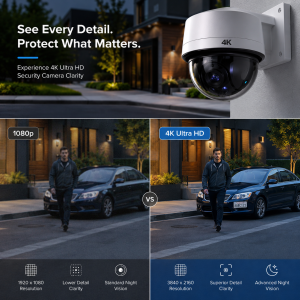
Understanding 4K Resolution
4K refers to a video resolution of approximately 3840 x 2160 pixels — that’s over 8 million pixels per frame. For comparison:
| Resolution | Pixels |
| 1080p (Full HD) | 2,073,600 |
| 2K | 3,686,400 |
| 4K (Ultra HD) | 8,294,400 |
More pixels means more detail — and in security footage, detail is everything.
Why 4K Matters for Security Cameras
The biggest advantage of 4K is digital zoom without losing clarity. With lower-resolution cameras, zooming in on a face or license plate turns the image into a blurry mess. With 4K, you can zoom in significantly and still read a number plate or identify a face clearly.
Other benefits include:
- Wider coverage — Higher resolution lets one camera cover more ground without sacrificing detail.
- Better evidence — Crystal-clear footage holds up better for identification and legal purposes.
- Future-proofing — As storage and streaming technology improves, 4K becomes even more practical.
The Trade-Offs
4K cameras come with a few considerations:
- More storage required — Higher resolution files are significantly larger.
- Higher cost — 4K cameras and compatible NVR systems cost more upfront.
- Stronger network needed — Streaming 4K footage demands more bandwidth.
Is 4K Worth It?
For most homeowners, 4K is an excellent investment — especially for front doors, driveways, and wide open areas where capturing fine detail truly matters.
When image quality counts, 4K delivers.