

Being tired doesn’t feel like a single moment. It builds, one heavier blink and one missed yawn-suppression at a time. Long before a driver would describe themselves as “falling asleep,” that gradual buildup is already underway. It turns out to be exactly what makes drowsiness detectable by a camera. It leaves a trail of small, measurable physical signs well before it becomes dangerous. This guide is about that trail: what it looks like, how software reads it, and how well it actually works.
A quick note on scope: this guide focuses specifically on drowsiness and fatigue: the signals, the science, and the detection methods. For the broader picture of driver monitoring as a feature, see our guide on What Is AI Driver Monitoring? It covers the camera hardware, privacy handling, and how driver monitoring differs from facial recognition.
Two Different Ways Dashcams Detect Drowsiness
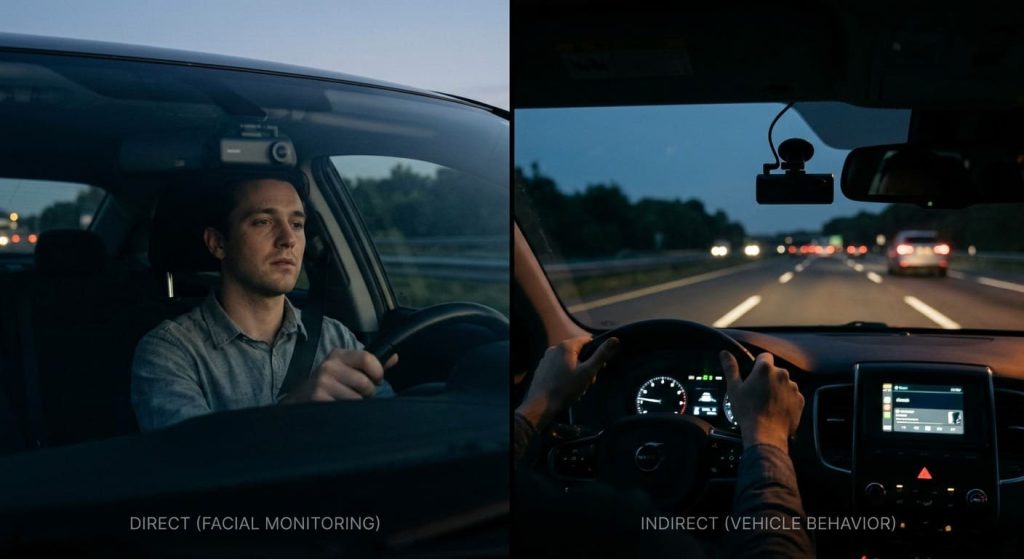
Most people assume “drowsiness detection” always means a camera watching your face. That’s the more common approach today, but it isn’t the only one. Knowing the difference explains a lot about why some systems feel sharper than others.
Direct Detection: Watching the Driver’s Face
A driver-facing camera tracks eye and head movement in real time. This is the approach used by most AI dashcams with a driver monitoring feature. It’s called “direct” because it observes the physical signs of fatigue themselves, rather than inferring them from something else. We cover the hardware and mechanics behind this approach in full in our AI driver monitoring guide. This article picks up from there and focuses on the drowsiness detection signals specifically.
Indirect Detection: Watching How the Car Moves
Before driver-facing cameras became common and affordable, the automotive industry leaned on a different approach. It inferred drowsiness from the way the vehicle moved. Small, involuntary steering corrections change pattern as a driver tires. Lane position also tends to drift and wander in a fairly distinctive way. Early versions of systems like Mercedes-Benz’s Attention Assist worked this way. They learned a driver’s normal steering behavior early in a trip. Then they watched for deviations from it, without needing any camera pointed at the driver at all. Bosch and several other suppliers built similar systems. These combined steering angle sensors with lane-position data from the existing forward-facing camera.
Which One Actually Works Better?
Research on this is fairly consistent: indirect, steering-based methods alone are generally the least reliable of the available approaches. They’re useful as a supplementary signal but not strong enough to stand alone. Direct, camera-based methods perform better because they observe the fatigue itself rather than a downstream side effect of it. One notable finding from comparative research is worth sitting with. Visible fatigue cues like slow eye closure and yawning typically appear before a vehicle starts wandering out of its lane. That means a good camera-based system can catch drowsiness earlier. A steering-pattern system wouldn’t even begin to notice something is wrong yet. The strongest systems today tend to be hybrid, combining both signal types. Each compensates for situations where the other struggles.
| Method | What It Watches | Needs a Driver Camera? | Generally Considered |
|---|---|---|---|
| Indirect (behavioral) | Steering corrections, lane position | No | Useful signal, not reliable alone |
| Direct (camera-based) | Eye closure, blink rate, head position, yawning | Yes | More reliable; industry standard for AI dashcams |
| Hybrid | Both of the above, combined | Yes | Most robust, increasingly common in newer systems |
The Science: Why Blinking and Yawning Reveal Fatigue
Dashcam manufacturers didn’t invent any of these signals. They come from decades of sleep and fatigue research: shift-work safety, aviation fatigue, and clinical sleep studies. That research had nothing to do with cars originally. It happened long before anyone built a camera small enough to fit on a windshield.
The underlying idea is straightforward. As the brain’s drive for sleep increases, the muscles controlling the eyelids are among the first to show it. They produce slower, heavier, more frequent closures. Yawning connects to arousal regulation, the body’s attempt to increase alertness through changes in breathing and blood flow. Its frequency rises measurably as fatigue builds. Head position is the blunter, later-stage signal. By the time the head is genuinely nodding, the driver is often already experiencing brief involuntary lapses. A dashcam’s drowsiness detection is really just automating what a passenger sitting beside a tired driver would eventually notice. It just watches more consistently and reacts faster.
Blink Detection: What Changes When You're Tired
A normal, alert blink is fast, typically a fraction of a second, closing and reopening the eye in one smooth motion. As fatigue builds, two things shift. Individual blinks slow down and linger longer in the closed position. The overall blink rate itself tends to change too. Sometimes it increases, as the eyes work harder to stay lubricated and focused. Sometimes it drops into longer, heavier closures as alertness fades further.
A driver-facing camera picks this up by tracking the distance between the upper and lower eyelid, frame by frame. Researchers sometimes call this measurement the eye aspect ratio. A quick, normal blink barely registers as a blip. A slow, fatigue-driven closure shows up as a sustained dip. That’s exactly the kind of pattern a trained model can easily distinguish from normal blinking, once it’s looking for it.
PERCLOS in Depth: The Threshold Science
PERCLOS, short for PERcentage of eyelid CLOSure, is the specific metric most drowsiness-detection systems build their alerts around. It has an unusually well-documented research history. That’s more than people usually assume for what looks like just another spec-sheet term.
US federal transportation safety agencies established the concept through 1990s driving-simulator research. Researchers tested several candidate drowsiness measures against each other and found PERCLOS the most reliable indicator of the group. The original definition tracks the proportion of time the eyes are at least 80% closed. It measures this within a rolling window, such as a minute, which deliberately captures slow “droops” rather than ordinary blinks.
In practice, a system calculates something like this. Out of several hundred frames captured in the last sixty seconds, it checks what percentage showed the eyes mostly or fully closed. Cross a set threshold, and the system flags drowsiness. That threshold is commonly cited in research around the 20–40% range, depending on how conservatively a given system is tuned. Set the threshold too low, and ordinary blinking triggers false alerts. Set it too high, and real drowsiness slips through before anything fires. That tuning decision matters more than any single hardware spec. It’s a big part of why drowsiness detection can feel sharp on one dashcam and sluggish on another running the same basic idea.
Not a Dashcam Invention
PERCLOS predates AI dashcams by roughly three decades. It’s the same measure used in truck-fleet fatigue-monitoring research and aviation alertness studies. Engineers adapted it into a consumer feature once cameras and processors became small and cheap enough to fit on a windshield mount.
Yawn Detection: How the Camera Spots It
The same landmark-tracking approach used for eyes also applies to the mouth. Software tracks the distance between the upper and lower lip, alongside overall mouth width. Researchers sometimes call this the mouth aspect ratio. The software watches for the specific pattern a yawn creates. That pattern is a wide, sustained opening that lasts noticeably longer than talking, eating, or a normal facial expression.
On its own, a single yawn isn’t a strong signal. Everyone yawns occasionally for reasons that have nothing to do with fatigue. What the system actually tracks is frequency over time. It looks for a rising rate of detected yawns within a given window, combined with the other signals covered here. Used that way, yawning becomes a genuinely useful early-warning contributor rather than a standalone trigger. It can catch a pattern building up well before eye closure alone would flag it.
Microsleep Detection: The Most Dangerous Signal
A microsleep is a brief, involuntary lapse into sleep, often just a few seconds. It happens without the person consciously realizing it occurred. It’s the mechanism behind a specific kind of drowsy-driving crash that involves no braking and no swerving. A driver traveling in a straight line simply stops responding to the road for long enough to drift off it. Federal safety researchers note that a microsleep lasting four or five seconds is enough time to matter. A car traveling at 55 mph covers more than a hundred yards essentially unattended during that gap. That’s plenty of distance for a crash to happen with zero warning from the driver’s side.
This is the scenario where camera-based detection earns its keep most clearly. The signal combines a sudden, sharp head-nod with a PERCLOS spike well past the normal drowsiness threshold, often into fully-closed territory. The head-nod itself comes from neck muscles briefly losing tension and the head physically dropping. Most systems treat this combination as a higher-urgency alert than a gradual PERCLOS climb. That’s precisely because a microsleep is happening in real time rather than building toward something.
What Happens When Drowsiness Is Detected?
Most well-designed systems don’t wait for a single dramatic moment. They escalate, roughly following a pattern like this as measurements climb:
- Early signal
PERCLOS and blink duration creep upward, still below the alert threshold. No warning yet; the system is just tracking a trend.
- Threshold crossed
A gentle audible tone or dashboard icon appears, often a small coffee cup or drooping-eye symbol. It’s a low-key nudge rather than an alarm.
- Pattern continues
Repeated or worsening signals escalate the alert, sometimes to a louder tone or an explicit on-screen suggestion to take a break.
- Microsleep-level event
A sudden head-nod combined with a sharp PERCLOS spike triggers the most urgent response the system has. It’s immediate and hard to ignore.
None of these alerts do anything to the car itself. There’s no automatic braking or lane intervention tied to drowsiness detection on a dashcam. The entire job of the feature is to interrupt the exact mental state that makes a driver unlikely to notice their own decline. It does that loudly and specifically enough to prompt a break, a coffee, or a pull-over. The goal is to act before a microsleep gets the chance to do the deciding instead.
Does AI Dashcam Drowsiness Detection Actually Work?
The underlying science is solid. PERCLOS-based detection has decades of validation behind it, and camera-based systems consistently outperform steering-pattern-only approaches in comparative research. That’s a meaningfully different claim from “every consumer AI dashcam implements it perfectly,” which is worth separating out.
What the Research Supports
- PERCLOS as a validated, reliable drowsiness indicator
- Camera-based detection outperforming steering-pattern-only methods
- Visible fatigue cues often appearing before lane drift does
- Hybrid approaches (camera plus behavioral) as the most robust option
Where Real-World Results Vary
- Threshold tuning differs by manufacturer, affecting sensitivity
- Lighting, glasses, and camera angle still matter, same as any camera-based feature
- Budget hardware may run a lighter, less accurate detection model
- No published, standardized accuracy benchmark exists across all consumer dashcam brands
That last point is worth being direct about. There isn’t a single trustworthy number that says “AI dashcam drowsiness detection is X% accurate” across the whole product category. Any source that states one with confidence is likely citing a specific lab study, not the market as a whole. What the research does support clearly is the underlying approach. Whether any specific product executes it well is a separate question. The best way to answer it is by checking reviews of that exact model, not the feature category in general.
Why This Feature Matters
~91,000
Police-reported crashes involving a drowsy driver, NHTSA estimate, 2017
~800
Deaths from those reported crashes the same year
That last point matters more than the headline numbers. Drowsiness leaves no chemical trace the way alcohol does, and a driver who falls asleep for even a few seconds rarely reports it afterward, whether out of uncertainty or reluctance. Researchers across the traffic-safety field broadly agree official figures represent a floor, not a ceiling. It’s also a risk that’s easy to underestimate personally: fatigue impairs judgment and reaction time gradually enough that most people don’t notice their own decline until it’s already significant, which is precisely the gap this entire feature is built to close.
Beyond the Dashcam: Other Ways to Fight Drowsy Driving
An AI dashcam is a detection tool, not a cure. It works best alongside habits that address fatigue directly rather than just flagging it.
- The coffee-and-nap combination. Caffeine takes roughly 20–30 minutes to take effect. A short nap right after a cup of coffee, rather than instead of one, lets both kick in around the same time.
- Rumble strips. The milled or raised strips along many highway shoulders and centerlines are a low-tech version of the same idea. They trigger a physical alert when a car drifts out of its lane. They’re standard infrastructure in many places, precisely because drowsy drift is such a well-documented crash pattern.
- Trip planning around your body clock. Drowsy-driving crashes cluster heavily in the middle of the night and in the mid-afternoon dip. Both are predictable low points in the body’s natural alertness cycle, worth planning long drives around where possible.
- Actually stopping. It sounds obvious, but it’s the one countermeasure every sleep researcher agrees on without caveats. Opening a window or turning up the radio doesn’t meaningfully counter real drowsiness. Pulling over does.
An AI dashcam’s real value in this list is timing. It’s the one countermeasure that’s actively watching before a driver would consciously reach for any of the others.
Key Takeaways: AI Dashcam Drowsiness Detection
At a Glance
- There are two detection approaches: indirect (steering and lane patterns) and direct (camera-based face tracking). Direct detection is generally more reliable. Hybrid systems combining both are the most robust.
- PERCLOS is the core science, a decades-old, federally-validated metric measuring how much time the eyes spend closed within a rolling window.
- Fatigue signals often appear before lane drift does — eye closure and yawning are frequently earlier warning signs than the vehicle actually wandering.
- Microsleeps are the highest-stakes signal: a few seconds of unintended sleep can cover a hundred-plus yards at highway speed with zero driver awareness.
- Alerts escalate in stages — from a quiet early nudge to an urgent warning — rather than firing identically for every level of fatigue.
- Official crash statistics almost certainly undercount the real scope of drowsy driving, since it leaves no test-able trace the way alcohol does.
How does AI detect driver drowsiness?
Mainly by tracking eye closure duration and blink patterns through a driver-facing camera, comparing them against a research-based metric called PERCLOS. Many systems add yawn frequency and head-position tracking as supporting signals. Some also combine this with indirect steering or lane-position analysis for a more complete picture.
Does an AI dashcam actually detect drowsy driving reliably?
The underlying science, particularly PERCLOS, has decades of transportation safety research behind it. Camera-based detection also outperforms steering-pattern-only methods in comparative studies. Real-world accuracy still varies by manufacturer and threshold tuning. Results can differ between specific products even when they use the same core approach.
How does a dashcam detect fatigue specifically, versus distraction?
Fatigue detection centers on eye closure duration (PERCLOS), blink rate, yawning frequency, and head nodding. Distraction detection, a related but separate function, focuses more on gaze direction and sustained head-angle changes, like looking down at a phone. Many dashcams track both, but they rely on somewhat different measurements.
What is AI dashcam blink detection?
A camera-based measurement of how far apart the eyelids are, tracked frame by frame. A quick, normal blink barely registers. A slow, prolonged closure, the kind associated with fatigue, shows up as a sustained dip in that measurement. That’s how the system tells ordinary blinking apart from a drowsiness signal.
What is microsleep detection in a dashcam?
Detection of a sudden, brief involuntary sleep episode. Systems typically flag it through a sharp head-nod combined with a spike in eye closure well past normal drowsiness thresholds. Most treat it as a higher-urgency alert than gradual fatigue buildup. A microsleep is an active safety event happening in real time.
Does an AI dashcam detect yawning?
On models with driver monitoring, yes. Software tracks mouth shape and width, watching for the wide, sustained opening pattern a yawn creates. It also monitors how often that happens over time. A single yawn doesn’t count as significant on its own. A rising frequency is what actually contributes to a drowsiness alert.
What is a driver fatigue monitoring system?
A general term for any system, camera-based or behavioral, designed to detect signs of driver tiredness and issue a warning. It overlaps heavily with DMS (Driver Monitoring System). Some sources use it more narrowly to mean the fatigue-specific functions, separate from distraction tracking or other monitored behaviors.
Can AI dashcam drowsiness detection replace getting proper sleep?
No, and no manufacturer claims otherwise. It’s a detection and alert tool, not a countermeasure for fatigue itself. The alert is meant to prompt a real response: pulling over, a short nap, or stopping for the night. It’s not meant to make driving while tired feel safer.
How We Verified This
Checked Against Published Research, Not Product Marketing
The core technical claims here come from peer-reviewed and government transportation-safety research, not manufacturer claims. That covers the PERCLOS methodology, the direct-versus-indirect detection distinction, and the comparative reliability findings. We cite crash statistics directly from NHTSA. Where researchers themselves flag a figure as a likely undercount, we mark it that way too. We don’t present it as a precise, settled number.
Final Thoughts
Strip away the branding, and drowsiness detection is really just automated attentiveness. It’s the same thing a good passenger provides on a long drive, built into a camera that never gets tired itself. The science behind it is older and more rigorously tested than most of the features that get louder marketing treatment. It won’t fix a genuine sleep deficit, and it isn’t trying to. What it does is catch the gap between how alert a driver feels and how alert they actually are. That’s exactly the gap where most drowsy-driving crashes happen.
This guide is for general informational purposes and is not medical or safety advice. If you regularly feel drowsy while driving, consider speaking with a healthcare provider — persistent daytime sleepiness can have underlying causes worth checking.