
If you have ever slipped on a pair of headphones and felt the world go quiet around you, you have experienced active noise cancellation firsthand. But most people who enjoy this technology have never stopped to ask: what is headphone noise cancelling, exactly — and how does it actually work? Understanding the science behind noise cancellation helps you choose the right headphones, use them safely, and get the most out of every listening session. This guide covers everything — from the physics of sound waves to the best noise-cancelling headphones of 2026 — in more depth than any single competitor source available today.
What Is Headphone Noise Cancelling? The Core Concept Explained
Active noise cancellation is one of the most significant innovations in consumer audio technology of the past three decades. To understand what headphone noise cancelling is at its most fundamental level, you need to understand one basic principle of physics: sound is a wave, and waves can cancel each other out.
Sound travels through the air as a series of pressure fluctuations — areas of compression and rarefaction that your eardrums detect and your brain interprets as sound. Every sound wave has a specific frequency, amplitude, and phase. When two sound waves of identical frequency and amplitude meet in perfect opposition — that is, when the peak of one wave aligns precisely with the trough of another — they undergo destructive interference. The result is silence, or near-silence. This phenomenon is the physical foundation upon which all active noise cancellation technology is built.
How Headphone Noise Cancelling Uses Destructive Interference
Noise-cancelling headphones implement destructive interference using three core components working in real time:
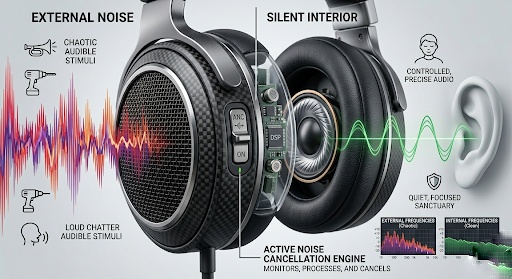
Microphones mounted on the outside of the headphone cups continuously sample the ambient sound environment — traffic noise, engine hum, air conditioning, crowd murmur, and any other low-frequency sound present in the listener’s surroundings.
A processor — a dedicated ANC chip — analyzes the incoming ambient sound signal with remarkable speed, calculating the precise inverse waveform needed to cancel it. This calculation must happen in microseconds to remain effective, since sound travels at approximately 343 meters per second and the headphone must generate its counter-signal before the ambient sound reaches the eardrum.
A speaker driver — the same driver that reproduces your music or podcast audio — simultaneously plays back the anti-noise signal alongside your intended audio content. The two signals combine acoustically inside the ear cup, with the anti-noise cancelling the ambient sound and leaving your chosen audio content intact and audible.
The elegance of this system is that it targets unwanted environmental sound without affecting the audio signal you want to hear. You receive your music at full fidelity while the surrounding world is acoustically filtered out.
What Headphone Noise Cancelling Can and Cannot Do
A common misconception is that noise cancellation eliminates all external sound. In reality, ANC technology has specific strengths and limitations that every buyer should understand.
ANC excels at cancelling: Low-frequency, consistent, predictable sounds — the drone of aircraft engines, train and subway noise, highway traffic, air conditioning units, and office HVAC systems. These sounds have regular waveforms that the ANC processor can anticipate and counter effectively.
ANC struggles with: High-frequency, sudden, or irregular sounds — human speech, barking dogs, keyboard clicks, and unexpected sharp noises. These sounds change too rapidly and unpredictably for the ANC processor to generate an accurate inverse in time. High-frequency sound is also attenuated more effectively by the physical ear cup material itself, so ANC adds less value in this range.
Passive noise isolation — the physical blocking of sound by the ear cup — handles high frequencies. The combination of passive isolation and active cancellation gives premium over-ear ANC headphones their comprehensive noise-reduction capability across the full frequency spectrum.
What Is Headphone Noise Cancelling Technology? A Deep Dive into ANC Types
Not all noise-cancelling headphones use the same approach. As the technology has evolved, engineers have developed multiple ANC architectures, each with its own performance characteristics and trade-offs.
Feedforward Noise Cancelling — What Headphone Noise Cancelling Looked Like First
Feedforward ANC was the original architecture. In a feedforward system, the microphone is placed on the outside of the ear cup, facing the environment. It samples ambient sound before that sound enters the ear cup and sends the signal to the processor, which generates the anti-noise response.
Advantages: The microphone captures ambient sound before it is affected by the ear cup’s acoustic properties, giving the processor a clean input signal. Feedforward systems can respond to a wider range of frequencies.
Disadvantages: Because the microphone is outside the ear cup, it cannot verify whether the anti-noise signal has successfully cancelled the incoming sound. Any error in the inverse waveform calculation passes directly to the listener’s ear without correction.
ass=”text-text-100 mt-2 -mb-1 text-base font-bold”>Feedback Noise Cancelling — Refining What Headphone Noise Cancelling Delivers
Feedback ANC places the microphone inside the ear cup, positioned close to the ear. Instead of sampling sound before it enters the cup, the feedback microphone monitors the sound environment at the ear — including both residual ambient noise and the anti-noise signal — and continuously adjusts the cancellation to correct for any remaining noise.
Advantages: The system self-corrects in real time, producing more accurate cancellation and compensating for fit variations between individual users.
<strong>Disadvantages: Because the microphone sits inside the cup, it is influenced by the acoustic properties of the ear cup itself, limiting the frequency range the system can effectively cancel. Feedback ANC is also more prone to howling or oscillation if the system is not carefully tuned.
Hybrid ANC — The Gold Standard of What Headphone Noise Cancelling Achieves Today
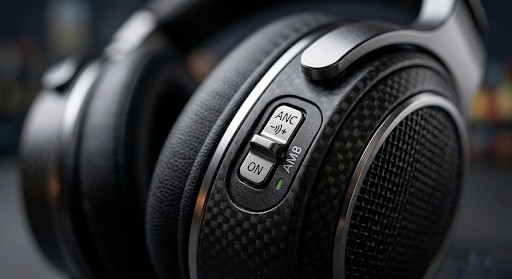
Hybrid ANC combines feedforward and feedback microphones in a single system. External microphones sample incoming ambient sound and generate a primary anti-noise response; internal microphones monitor the result and apply real-time corrections. This dual-microphone architecture delivers the broadest frequency coverage and the most accurate cancellation currently achievable in consumer headphones.
Premium headphones — including Sony’s WH-1000X series, Bose’s QuietComfort Ultra, and Apple’s AirPods Max — use hybrid ANC systems. The computational demands of running two microphone channels simultaneously require dedicated ANC processors with significant processing power, which is one reason why high-quality ANC headphones carry a premium price.</p>
Adaptive ANC — What Headphone Noise Cancelling Becomes with AI
The latest generation of ANC technology introduces adaptive or AI-powered noise cancellation. These systems go beyond fixed anti-noise algorithms, using machine learning models trained on thousands of acoustic environments to predict and cancel ambient sound more accurately than traditional approaches.</p>
> Sony’s Integrated Processor V2 — introduced in the WH-1000XM6 — uses an AI-based adaptive algorithm that continuously monitors the acoustic environment and adjusts both the feedforward and feedback cancellation parameters in real time. The result is noise cancellation that responds dynamically to changes in your environment, rather than applying a fixed cancellation curve.
>This adaptive approach is particularly effective in environments that shift between different noise profiles — a commuter who moves from a quiet platform to a loud train carriage, for example, benefits significantly from a system that adjusts its cancellation parameters automatically rather than applying a one-size-fits-all response.
What Is Headphone Noise Cancelling’s Impact on Sound Quality?
A question closely linked to understanding what noise-cancelling headphones are is understanding how ANC affects the quality of the audio you actually hear. This is an area where competitors and early adopters have historically had strong opinions, and where significant improvements have been made in recent years.
Does Noise Cancelling Affect Audio Fidelity?
lass=”font-claude-response-body break-words whitespace-normal”>In early ANC headphones, enabling noise cancellation noticeably altered the sound signature — often introducing a slight thinning of the bass, a sense of coloration in the midrange, or a faint hiss from the anti-noise generation circuitry. These artifacts were the inevitable result of the ANC system’s anti-noise signal being imperfectly separated from the audio signal in the ear cup.
Modern hybrid ANC systems have largely resolved these issues. In premium headphones, the ANC processor operates on a separate signal path from the audio processing chain, minimizing crosstalk between the anti-noise signal and the music signal. The result is that enabling ANC on a high-quality 2025 or 2026 headphone produces virtually no perceptible change in audio fidelity for most listeners.
That said, audiophiles listening critically at high volumes in quiet rooms may still perceive subtle differences between ANC-on and ANC-off modes. For this reason, many premium headphones include a transparency mode and a full-on passive mode alongside their ANC setting, allowing listeners to choose the acoustic environment that best suits their situation.
The ANC Hiss: What Headphone Noise Cancelling Sometimes Adds
The most consistently reported audio artifact from ANC systems is a faint broadband hiss — sometimes described as white noise or static — that is audible during quiet passages or in silence when no audio is playing. This hiss is produced by the ANC circuitry itself: the anti-noise signal contains a small amount of electronic noise that becomes perceptible when no audio content is masking it.
The intensity of this hiss varies significantly between headphone models and price points. Budget ANC headphones often produce a clearly audible hiss that can be distracting in very quiet environments. Premium models — the Sony WH-1000XM6, Bose QuietComfort Ultra, Apple AirPods Max — have reduced this artifact to a level that most users consider inaudible in normal use.
For users who are particularly sensitive to background noise, reading user reviews specifically addressing the hiss level of any ANC headphone under consideration is worthwhile before purchase.
What Is Headphone Noise Cancelling’s Role in Hearing Health?

Understanding what headphone noise cancellation is also means understanding its relationship to your hearing health. This is an area where significant misinformation exists online, and where a clear, evidence-based answer matters.
How Noise-Cancelling Headphones Protect Your Hearing
The primary hearing health benefit of noise-cancelling headphones is their ability to reduce the listening volumes users choose in noisy environments. This works through a well-documented behavioral mechanism: when ambient noise is louder, listeners instinctively raise their audio volume to maintain perceived clarity — a phenomenon known as the Lombard effect.
In a subway car producing 80 dB of ambient noise, a listener without noise cancellation might raise their audio to 85 or 90 dB to hear their content clearly. With effective ANC reducing that ambient noise to 50–55 dB, the same listener can achieve the same perceived clarity at 60–65 dB. That 20–25 dB reduction in listening volume represents an enormous reduction in acoustic energy reaching the cochlea — translating directly into a lower risk of noise-induced hearing loss over time.
For a comprehensive analysis of how ANC headphones compare to standard headphones from a hearing safety perspective, read our detailed guide: Is Noise-Cancelling Headphones Bad for Your Ears?
The Pressure Sensation and What It Means
<p>lass=”font-claude-response-body break-words whitespace-normal”>Some users experience a sensation of pressure or fullness when using ANC headphones — particularly during initial use. This sensation is perceptual rather than physical: the brain interprets the unusually quiet acoustic environment as a change in air pressure, even though no actual barometric change has occurred.
This sensation is not dangerous for th
e vast majority of users and typically diminishes with regular use. Users who experience persistent discomfort, dizziness, or pain during ANC headphone use should discontinue use and consult an audiologist. For more details on the safety profile of noise-cancelling technology, see: Is Noise-Cancelling Headphones Bad for Your Ears?
What Is Headphone Noise Cancelling’s Connection to Earwax and Ear Health?
While ANC technology itself does not directly affect earwax production, the physical design of noise-cancelling headphones matters significantly for overall ear health. Over-ear ANC headphones — the most common form — sit around the ear without entering the canal, carrying minimal earwax or infection risk. In-ear ANC devices, such as wireless earbuds with active noise cancellation, do interact with the ear canal and can affect earwax production through the same mechanisms as any in-ear device.
For users concerned about earwax buildup from their audio devices, switching from in-ear ANC earbuds to over-ear ANC headphones removes most of the ear canal interaction that drives excess cerumen production. For a detailed explanation of how headphone design affects earwax: Can Headphones Cause Earwax Buildup?
What Is Headphone Noise Cancelling’s Best Use Case? Real-World Applications
Air Travel
Aircraft cabin noise typically registers between 75 and 85 dB — a significant acoustic stressor for frequent flyers. ANC headphones excel in this environment, reducing engine drone and cabin noise by 25–35 dB and allowing passengers to rest, work, or enjoy entertainment at comfortable, hearing-safe volume levels. Frequent flyers report that ANC headphones have transformed long-haul travel from an exhausting acoustic experience into a genuinely comfortable one.
Commuting
Urban commuters face daily exposure to subway, bus, and traffic noise that can reach 80–95 dB in peak conditions. ANC headphones provide meaningful protection in these environments, reducing cumulative daily acoustic exposure for millions of regular commuters. The ability to listen at lower volumes during a daily commute adds up to significant hearing protection over months and years of use.
Open-Plan Offices and Remote Work
The rise of open-plan offices and remote work has created a new and growing use case for noise-cancelling technology: concentration and focus. Office noise — keyboard sounds, telephone conversations, air conditioning, and the general murmur of a busy workspace — is one of the most productivity-damaging acoustic environments for knowledge workers. ANC headphones allow professionals to create a focused listening environment without the need for private offices or soundproofed spaces.
Study and Focus Sessions
Students and professionals who need deep concentration for reading, writing, or complex problem-solving increasingly rely on noise-cancelling headphones to create an acoustic environment conducive to focus. The ability to combine ANC with low-volume background music or study soundscapes gives users fine-grained control over their acoustic environment in a way that was simply unavailable before consumer ANC technology matured.
How Safe Are Wireless Headphones? Understanding Noise Cancelling and Wireless Safety
The question of how safe wireless headphones are appears frequently alongside questions about what headphone noise-cancelling is, and it deserves a direct answer. Wireless headphones — particularly those using Bluetooth — have been subject to safety concerns related to both electromagnetic radiation and hearing health. Here is what the evidence actually shows.
Bluetooth radiation: Wireless headphones communicate via Bluetooth, which operates at extremely low power levels using non-ionizing radiofrequency (RF) radiation — typically 1–3 milliwatts, compared to the 600–3,000 milliwatts produced by a mobile phone in active use. The International Agency for Research on Cancer (IARC) and the World Health Organization classify non-ionizing radiation from Bluetooth devices as a negligible health risk at these exposure levels. No peer-reviewed study has established a causal link between Bluetooth headphone use and adverse health outcomes.
Hearing safety: The hearing safety profile of wireless headphones is determined by listening volume and session duration — not by the wireless transmission. A pair of wireless noise-cancelling headphones used at 65 dB for one hour carries zero meaningful hearing risk. The same headphones used at 95 dB for four hours continuously would carry a significant risk. The wireless technology itself is neutral from a hearing health perspective.
Battery and heat: Some users express concern about heat generated by wireless headphones during charging or extended use. Modern lithium-ion batteries in reputable headphones include thermal management systems that prevent dangerous heat buildup. Normal listening temperatures do not pose a burn or health risk for outer ear tissue.
For a comprehensive look at how different headphone types compare from a hearing health perspective, read: <a class=”yoast-text-mark”>s=”underline underline underline-offset-2 decoration-1 decoration-current/40 hover:decoration-current focus:decoration-current” href=”https://pickerzen.com/are-headphones-better-for-your-ears/”>Are Headphones Better for Your Ears? The short answer is that wireless noise-cancelling headphones are safe when used responsibly — and often actively protective in noisy environments.
Best Headphones for Call Center: Noise Cancelling in Professional Environments
=”font-claude-response-body break-words whitespace-normal”>Call center professionals represent one of the most demanding headphone use cases in any workplace — requiring all-day comfort, reliable microphone performance, clear audio reproduction for incoming calls, and effective noise isolation to maintain focus and call quality in busy, noisy environments. Understanding what headphone noise cancelling contributes to this specific use case helps buyers make better purchasing decisions.
What call center agents need from noise cancellation: In a call center environment, ANC serves two distinct purposes. First, it reduces ambient office noise reaching the agent’s ears, enabling lower listening volumes during long shifts and protecting long-term hearing health. Second — and equally important — the headphone’s microphone noise cancellation (a related but distinct technology from ANC) filters out background office noise from the agent’s outgoing voice signal, ensuring callers hear a clear voice rather than the surrounding workspace.
Key features to prioritize: For call center use, the most important headphone features are microphone clarity and noise rejection, all-day wearing comfort with lightweight construction, durable build quality for daily professional use, compatibility with VOIP platforms like Cisco, Avaya, Jabra, and Microsoft Teams, and a secure, consistent fit that maintains performance throughout an eight-hour shift.
Top considerations for 2026: The Jabra Evolve2 series, Poly Voyager Focus 2, and EPOS ADAPT range are among the most specified headsets for call center environments. Each combines professional-grade ANC with high-quality noise-cancelling microphones, long battery life, and enterprise software integration. Budget-conscious operations may also consider the Mpow HC6 or similar professional-grade wired options with inline controls for high call-volume environments.
Investing in proper call center headphones reduces employee fatigue, improves call quality scores, and protects the long-term hearing health of staff who depend on audio equipment for their livelihood.
Sony WH-1000XM6: What Headphone Noise Cancelling Looks Like at Its Best in 2026
When audiophiles and tech enthusiasts ask what headphone noise cancelling can achieve at its absolute peak, the answer in 2026 consistently points to one model: the Sony WH-1000XM6. Released in 2025, the XM6 represents the most refined iteration of Sony’s flagship ANC platform and has earned near-universal recognition as the best overall noise-cancelling headphone available to consumers.
What makes the XM6’s noise cancellation exceptional
The XM6 uses Sony’s Integrated Processor V2 — a dedicated ANC chip that runs an AI-powered adaptive algorithm, continuously analyzing the acoustic environment and adjusting both feedforward and feedback cancellation parameters in real time. The result is noise cancellation that outperforms its predecessor (the widely acclaimed XM5), particularly in variable noise environments, where the adaptive algorithm dynamically responds to changing conditions rather than applying a fixed cancellation curve.
Sony has also expanded the number of microphones used for ANC in the XM6, improving both the frequency range of effective cancellation and the system’s ability to maintain performance when the fit of the headphones shifts slightly during movement.
Audio quality:
Beyond noise cancellation, the XM6 delivers exceptional audio performance with 30mm drivers, LDAC high-resolution Bluetooth codec support, and Sony’s DSEE Extreme upscaling for compressed audio files. The sound signature is warm and detailed — satisfying for both music enthusiasts and podcast listeners.
ss=”font-claude-response-body break-words whitespace-normal”><strong>Comfort and build: Sony redesigned the XM6’s headband and ear cup attachment mechanism for improved weight distribution, and the ear pads use a higher-density memory foam that provides better passive isolation than the XM5. Battery life reaches 30 hours with ANC enabled — one of the best figures in the category.
The verdict:
For anyone who wants to experience what noise-cancelling headphone technology can achieve at its current peak, the Sony WH-1000XM6 is the definitive answer. It does not just lead its category — it defines it.
For a full breakdown of the safest and best-performing headphones across all categories and budgets, visit: Which Headphones Are Safest for Your Ears?
What Is Headphone Noise Cancelling Versus Noise Masking? A Critical Distinction
Noise masking is a technology that is frequently confused with active noise cancellation, and understanding the difference is important for buyers evaluating their options.
<strong>Noise masking does not cancel ambient sound. Instead, it adds a layer of additional sound — typically a broadband white noise, pink noise, or nature sound — to the audio output, with the goal of making ambient noise less perceptible by blending it into a consistent background. The unwanted noise is not removed; it is buried under the masking signal.
Active noise cancellation physically reduces the amplitude of ambient sound waves through destructive interference. It removes noise from the acoustic environment rather than covering it up.
The practical difference matters significantly:
Noise masking adds to your total acoustic exposure — you are listening to both your content and the masking layer. In environments where ambient noise is already significant, masking can actually increase total sound exposure. ANC reduces your total acoustic exposure by eliminating ambient sound, allowing lower listening volumes.
Noise masking works across all frequencies, including speech, which means it can help in situations where ANC is less effective (blocking nearby conversations, for example). ANC excels at low frequencies but struggles with high-frequency, irregular sounds like speech.
For a detailed scientific overview of the technology and its history, Wikipedia’s noise-cancelling headphones article provides a thorough technical reference. For an evidence-based look at health benefits, Healthline’s analysis of noise-cancelling headphone benefits covers the research comprehensively.
What Is Headphone Noise Cancelling’s Future? Emerging Technologies in 2026
The ANC technology landscape is evolving rapidly, and 2026 has brought several developments worth tracking.
Personalized ANC Profiles
Ear canal shape varies significantly between individuals, which affects how ANC performs in practice. Leading manufacturers are developing systems that use in-ear microphones to map the acoustic characteristics of an individual user’s ear canal and optimize the ANC algorithm accordingly. Apple’s AirPods Pro already include a form of this — the adaptive EQ and ANC personalization feature — and Sony’s XM6 continues to refine the concept.
Transparency Mode Refinement
Transparency mode — which uses external microphones to pass ambient sound through to the listener while ANC is active — has become increasingly important for safe outdoor use. Next-generation transparency modes aim to pass ambient sound with high fidelity while simultaneously allowing partial noise cancellation, giving users granular control over their acoustic environment rather than a binary ANC-on/ANC-off choice.
Spatial Audio Integration
The integration of ANC with spatial audio processing — creating a three-dimensional soundstage that adapts to head movement — represents the next frontier in headphone audio. Sony, Apple, and Bose are all developing systems that combine best-in-class ANC with head-tracked spatial audio, blurring the boundary between headphone listening and speaker listening in physical spaces.
Frequently Asked Questions: What Is Headphone Noise Cancelling?</h2>
1. What is headphone noise cancelling and how does it work?
Headphone noise cancelling uses microphones to detect ambient sound and generates an inverse sound wave — called an anti-noise signal — that cancels the ambient sound through destructive interference. The result is a quieter acoustic environment inside the ear cup. The technology targets low-frequency, consistent sounds like engine noise, traffic, and air conditioning most effectively.
2. What is the difference between active and passive noise cancelling?
Active noise cancelling (ANC) uses electronic processing to generate anti-noise signals that cancel ambient sound. Passive noise cancelling refers to the physical sound blocking provided by the ear cup material and seal — no electronics involved. Most over-ear headphones provide both passive isolation from the physical structure and active cancellation from the ANC circuit.
3. What is headphone noise cancelling’s effect on battery life?
ANC requires continuous power to run the microphones, processor, and anti-noise signal generation. Enabling ANC typically reduces battery life by 20–40% compared to using headphones without ANC active. Premium models like the Sony WH-1000XM6 achieve approximately 30 hours with ANC on, while less powerful headphones may achieve only 15–20 hours.
4. Does noise-cancelling headphone technology work in all environments?
ANC works best in environments with consistent, low-frequency ambient noise — aircraft, trains, traffic, and HVAC systems. It is less effective against high-frequency, irregular sounds like human speech, keyboard noise, and sudden, sharp sounds. In environments dominated by these sounds, passive isolation and noise masking may be more useful.
5. What is the effect of headphone noise cancelling on call quality?
ANC in headphones reduces noise reaching the listener’s ears, which improves the clarity of incoming call audio. Most ANC headphones also include microphone noise cancellation — a related technology that filters ambient noise from the outgoing voice signal. Together, these features significantly improve call quality in noisy environments.
6. Is headphone noise-cancelling safe to use every day?
Yes. ANC technology does not generate harmful sound or create damaging pressure changes inside the ear. Daily use at safe listening volumes — below 85 dB — poses no meaningful hearing risk. In noisy daily environments like commutes, ANC headphones are often actively hearing-protective because they enable lower listening volumes.
7. What is headphone noise cancelling’s impact on music quality?
Modern premium ANC headphones produce virtually no perceptible impact on music quality when noise cancellation is enabled. Early ANC systems introduced coloration and artifacts, but current hybrid ANC architectures process the anti-noise signal on a separate path from the audio signal, preserving fidelity. A faint background hiss may be audible in silence on some models.
<h6 class=”text-text-100 mt-2 -mb-1 text-sm font-semibold”>8. Can children use noise-cancelling headphones safely?
Children can use ANC headphones with appropriate precautions. Volume-limiting headphones that cap output at 85 dB or below are strongly recommended for children. The pressure sensation some users experience with ANC may be unfamiliar or distressing for young children. Over-ear, volume-limited ANC headphones are the safest option for school-age children.
9. What is the best type of noise-cancelling headphone for travel?
Over-ear hybrid ANC headphones are the best choice for travel. They provide the broadest frequency cancellation — essential for aircraft engine drone — along with all-day wearing comfort, high-quality audio for entertainment, and battery life sufficient for long-haul flights. The Sony WH-1000XM6, Bose QuietComfort Ultra, and Apple AirPods Max are the leading options in 2026.
10. What is the difference between headphone noise-cancelling versus noise-isolating headphones?
Noise-cancelling headphones use active electronic processing to cancel ambient sound. Noise-isolating headphones use passive physical design — dense ear cup material, tight seals, or deep-insertion ear tips — to block sound without any electronics. In-ear monitors with foam tips are among the most effective passive noise isolators. ANC and passive isolation are complementary, and the best headphones combine both.</p>
Conclusion: What Is Headphone Noise Cancelling — The Bottom Line
Headphone noise cancellation is a mature, well-understood. And genuinely valuable technology that uses destructive interference to reduce ambient sound and protect hearing in noisy environments. And improve listening comfort across a wide range of daily situations. From the physics of anti-noise waves to the AI-powered adaptive algorithms in 2026’s best headphones. ANC has evolved from a niche aviation tool into an essential feature for anyone who takes their audio experience and hearing health seriously.
Whether you are a daily commuter, a remote worker seeking focus, a frequent traveler, or an audiophile looking for the best sound experience available. Understanding what headphone noise cancelling is, and how it works. And how to use it responsibly puts you in the best possible position to make a smart, hearing-safe choice.
Ready to find the perfect pair? Browse our expert recommendations at Which Headphones Are Safest for Your Ears? — and invest in your hearing health today.