
Quick Answer
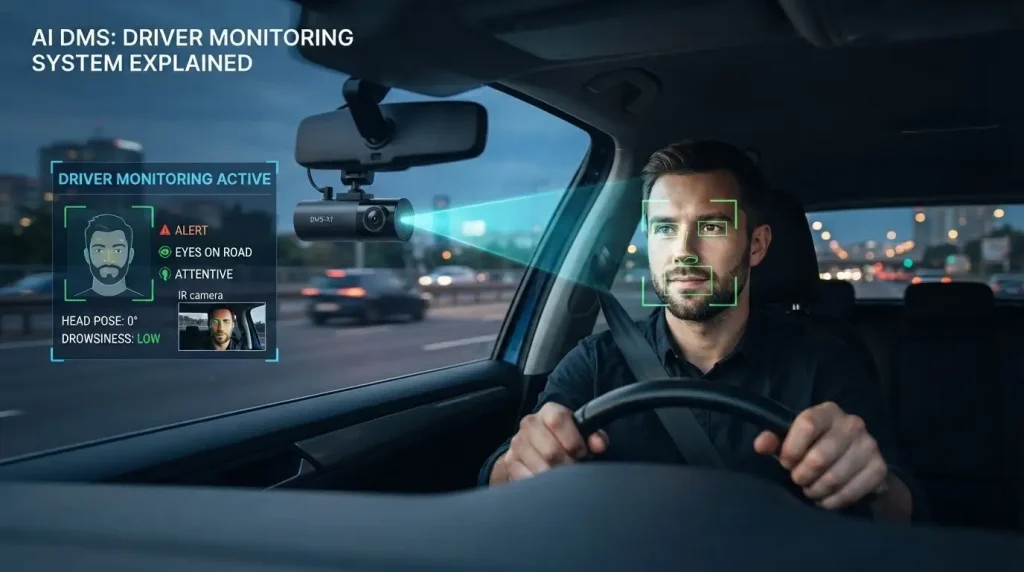
AI driver monitoring, often called a DMS (Driver Monitoring System), is an inward-facing camera and software combination that watches the driver rather than the road. It tracks eye movement, blink patterns, and head position to spot signs of drowsiness or distraction, then issues an alert before either one turns into a mistake. It doesn't identify who's driving. It just watches how alert they are.
Two cameras, two very different jobs. The one facing the windshield watches the road for you. The one facing you is doing something people rarely expect a dashcam to do: keeping an eye on your eyes. That second camera, and the AI behind it, is what this guide is about.
It’s a feature that tends to sound more invasive than it actually is once you understand the mechanics, so that’s where we’ll start. For the fuller feature list this belongs to, see our complete AI dashcam features guide. If you’re brand new to the topic, what an AI dashcam is is the better starting point.
What Is AI Driver Monitoring (DMS), Exactly?
DMS stands for Driver Monitoring System: a camera aimed at the driver instead of the road, paired with software that watches for signs of fatigue or distraction. It’s one of the more quietly clever ideas in modern car safety tech. Every other AI dashcam feature looks outward, trying to catch hazards before they reach you. DMS looks the other way, on the theory that a fair number of those hazards start with the driver, not the road.
The name shows up under a few different labels depending on where you’re shopping: driver monitoring, driver fatigue detection, driver attention monitor, or just “inward-facing camera” buried in the spec sheet. They’re almost always describing the same underlying idea, sometimes with a slightly different mix of what gets tracked.
It sits in an interesting spot, technically. It uses the same face-tracking approach as a phone’s portrait mode or a video call’s auto-framing, pointed at a much narrower question: not “where is the face,” but “how alert is the person behind it, right now.”
How Does AI Driver Monitoring Work?
Four things happen, in sequence, dozens of times a second. Here’s the picture worth having in your head before the technical terms start piling up.
The Camera: Usually Infrared, On Purpose
Most DMS cameras use infrared (IR) illumination rather than visible light. Two reasons: it works in total darkness without shining a distracting light in your face, and it holds up reasonably well through most sunglasses, which block visible light but not the infrared wavelength the camera is actually using. It’s a small hardware choice that solves a problem regular cameras can’t: watching a face in a dim cabin at night without becoming its own distraction.
Facial Landmark Tracking
A trained model identifies specific points on the face, corners of the eyes, edges of the eyebrows, corners of the mouth, and tracks how those points move, frame to frame. This is the same general computer vision approach covered in our breakdown of how AI dashcams process video, applied to a face instead of a road scene. The system isn’t interpreting the face as a whole, the way a person would. It’s tracking a sparse handful of coordinates and measuring how they shift.
PERCLOS: The Actual Science Behind Drowsiness Detection
The core metric most DMS software relies on has a name and a research history: PERCLOS, short for PERcentage of eyelid CLOSure. It measures how much of a given time window a driver’s eyes spend mostly or fully closed, distinguishing a normal blink from the slower, heavier eyelid droop associated with fatigue. The concept isn’t a dashcam-industry invention. It came out of driving-simulator research in the 1990s, backed by US federal transportation safety research, which identified it as the most reliable available measure of driver alertness among several methods tested at the time. When PERCLOS crosses a set threshold over a rolling window, the system flags drowsiness and issues an alert.
Head Pose & Gaze Tracking
A separate calculation handles distraction rather than fatigue: head pose estimation measures the angle of the head (tilted down at a phone, turned toward a passenger), while more advanced systems add gaze tracking, estimating exactly where the eyes are pointed, not just which way the head is facing. That distinction matters. A driver can face forward with a phone in their lap and still be looking down; gaze tracking catches that in a way head-angle alone would miss. We cover this side in full, including phone detection specifically and the kinds of distraction a camera can’t catch, in our dedicated distraction detection guide.
What Does Driver Monitoring Actually Detect?
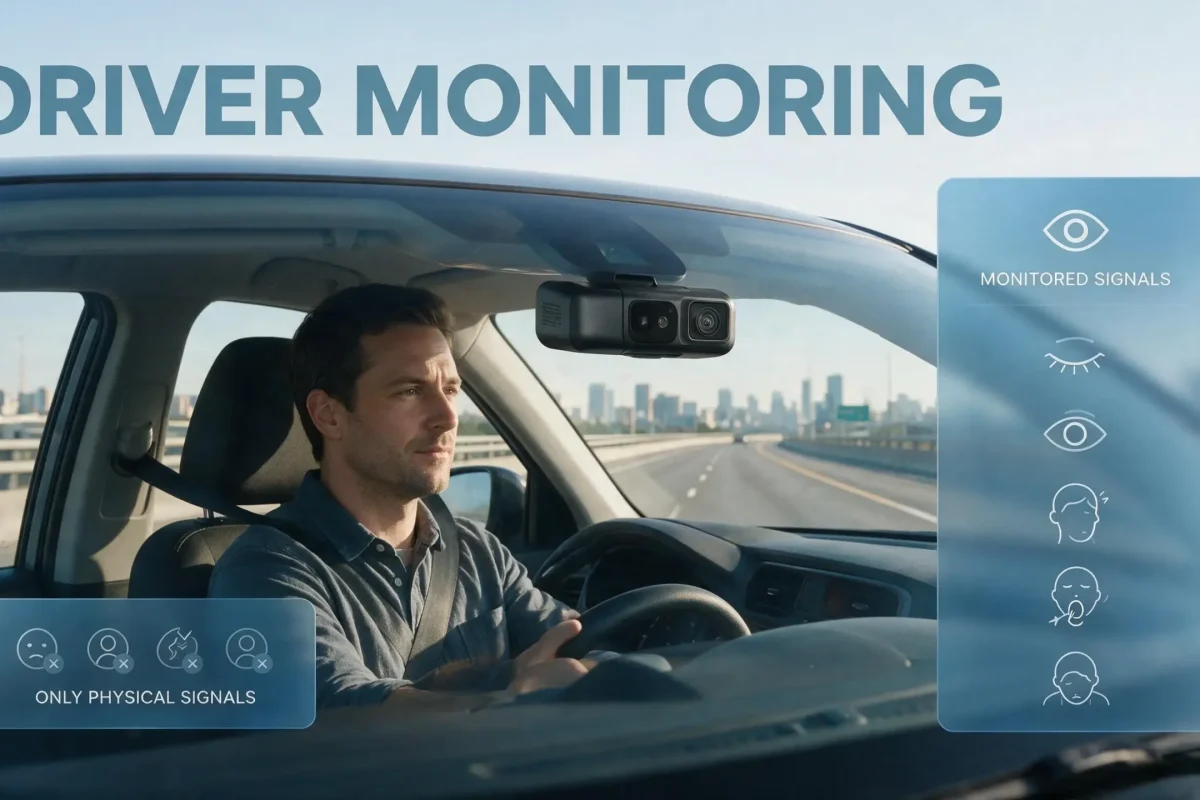
Not a mood, not a thought, nothing that specific. Just a handful of physical patterns that correlate well with reduced alertness.
| Signal | What It Looks Like | What It Suggests |
|---|---|---|
| Slow eyelid closure | Eyes closing for longer than a normal blink, repeatedly | Drowsiness (measured via PERCLOS) |
| Extended eyes-off-road time | Gaze held away from the windshield for several seconds | Visual distraction, often phone use |
| Head tilted down or turned | Head angle deviating from a forward-facing baseline | Distraction or drowsiness |
| Yawning frequency | Mouth-shape tracking picks up repeated wide-open patterns | Fatigue, on models that track it |
| Head nodding or drooping | Sudden downward head movement, then correction | Microsleep, a strong drowsiness signal |
Notice what’s missing from that list: mood, stress, identity, emotion. A handful of premium and research-grade systems experiment with broader “state” estimation, but the mainstream feature you’ll find in a consumer AI dashcam sticks to physical, measurable signals. That’s a feature, not a limitation. Physical signals are what the underlying research actually validated.
Go Deeper
Drowsiness is the bigger of these two categories, and it deserves more room than we can give it here. For the full science, including blink-rate changes, yawn detection, microsleeps, and how it compares to the older steering-pattern-based approach, see AI Dashcam Drowsiness Detection Explained.
Dual-Facing vs Single-Facing: What "Inward-Facing Camera" Means
A single-facing AI dashcam has one lens, pointed through the windshield, handling object detection and road-facing ADAS features alone. A dual-facing model adds a second lens, usually on a small hinge or a separate housing, angled back toward the driver’s seat. That second lens is what makes driver monitoring possible at all; without a camera pointed at the driver, there’s simply nothing for the fatigue-detection software to look at.
Some higher-end setups go further still, sometimes called triple-channel: road-facing, driver-facing, and a third lens covering the rear window or cabin, common on rideshare and delivery vehicles that want full coverage. For a personal car, dual-facing is the meaningful threshold to look for. If a listing advertises driver monitoring but only shows a single lens in the product photos, read the spec sheet closely before assuming it’s included.
Is This the Same as Facial Recognition?
No, and the distinction is worth being precise about. Facial recognition answers “who is this.” Driver monitoring answers “how alert does this person appear to be.” One identifies an individual against a stored reference. The other tracks motion and geometry, blink speed, head angle, without needing to know or store whose face it’s measuring.
This isn’t just a marketing distinction, either. It’s written into regulation. The European Union’s vehicle safety rules, which now require drowsiness and distraction monitoring in new cars, explicitly specify that these systems must operate without using biometric identification, including facial recognition, and must process data locally rather than building any kind of identity profile. Regulators drew the same line this article is drawing, for the same reason: monitoring alertness and identifying a person are genuinely different technologies with genuinely different privacy implications, even though both start with a camera pointed at a face.
We cover this distinction in more depth, including how it applies to consumer dashcams specifically, in our full features guide.
Does It Record and Store Video of You?
Often, less than people assume. A lot of driver monitoring runs as real-time analysis rather than continuous recording: the camera feeds live frames to the on-device processor, the software calculates eye and head measurements, and in many implementations only the resulting alert (or a short clip around a flagged event) gets saved. The raw, continuous video of your face frequently isn’t being written to storage at all, just measured, moment to moment, then discarded.
That varies by model, so it’s worth checking rather than assuming either way. Some dashcams do save continuous cabin footage alongside driver monitoring, particularly dual-purpose setups also meant for cabin/interior recording, covered in our features guide. If keeping that footage off any storage medium matters to you, look specifically for language like “on-device analysis” or “real-time processing only” in the spec sheet, rather than assuming it from the word “AI” alone.
Good to Know
The EU’s regulatory approach for mandated driver monitoring requires exactly this kind of closed-loop, on-device processing, no identity data retained, no biometric matching. It’s a reasonable model of what privacy-conscious driver monitoring looks like, and a useful benchmark to compare any specific product against.
Where It Performs Well
- Consistent lighting, day or night, thanks to IR illumination
- Clear view of the eyes and upper face
- Gradual fatigue buildup, the classic long-drive drowsiness pattern
- Sustained distraction, like an extended glance at a phone
Worth Knowing Before You Rely on It
- Certain sunglasses (particularly some polarized or mirrored lenses) can interfere with IR tracking
- Hats, face coverings, or an unusual seating position can obscure key landmarks
- Naturally narrow or hooded eyes can occasionally affect eye-closure baselines
- Brief glances, checking a mirror, aren’t the same as true distraction, and well-tuned systems account for this, but tuning varies by manufacturer
None of this makes the feature unreliable. It makes it a tool with a known operating range, the same as any sensor. A good system errs toward fewer, more meaningful alerts rather than constant noise; if a specific model seems to be firing constantly on brief, normal glances, that’s more likely a tuning issue with that product than a fundamental flaw in the underlying approach.
Why Regulators Are Starting to Require This
This isn’t just an aftermarket gadget trend. The European Union’s General Safety Regulation (Regulation (EU) 2019/2144) now mandates driver monitoring technology in new vehicles, rolled out in stages: Driver Drowsiness and Attention Warning systems became mandatory for new vehicle types from July 2022 and for all newly sold vehicles from July 2024, with a related Advanced Driver Distraction Warning requirement extending to all new vehicles sold from July 2026.
The reasoning lines up with everything covered above: camera-based monitoring of eyes and head position was assessed as more reliable than indirect methods, like reading steering-wheel movement patterns, which is exactly why the regulation leans on the same DMS approach used in aftermarket AI dashcams. Factory-installed systems and dashcam-based ones are, at the core, the same underlying technology, applied at different points in the vehicle’s life.
For drivers of older cars without a built-in system, that’s really the practical takeaway: an AI dashcam with driver monitoring is a way to add a version of the same protection regulators now consider important enough to require in new vehicles, without needing to buy a new car to get it.
Personal Cars vs Commercial Fleets
The technology is identical either way. The reason for having it tends to differ.
Personal use
Self-protection on long drives, night shifts, or for a newer driver in the family
Fleet use
Liability documentation, insurance requirements, and duty-of-care obligations for professional drivers
Fleet operators were early, heavy adopters of driver monitoring for a straightforward reason: a tired commercial driver represents both a safety risk and a significant liability exposure, and monitoring data can support coaching programs and, when needed, incident review. Personal use is a quieter, more individual value proposition, a second layer of self-awareness on the kind of long, monotonous drive where fatigue creeps in without much warning. Neither use case is more “legitimate” than the other. They’re just solving different versions of the same underlying problem.
Getting the Most Out of It
A few small habits noticeably improve how well driver monitoring actually works for you:
- Mount it at eye level, roughly. A driver-facing camera aimed too high or low struggles to get a clean read on eye position.
- Do the initial calibration if the model asks for one. Many systems build a quick baseline of your neutral head position and eye shape; skipping it usually means less accurate alerts early on.
- Keep the lens clean. A dusty interior-facing lens degrades landmark tracking the same way a smudged windshield hurts the road-facing camera.
- If you wear sunglasses often, check compatibility first. A quick look at reviews for your specific model and lens type saves a returned product later.
- Treat alerts as a nudge, not a verdict. The system is measuring physical signals, not reading your mind. If an alert feels wrong, that’s useful information about the product’s tuning, not a reason to distrust the whole category.
Key Takeaways
- Check the mount before anything else. A loose or vibrating camera causes more false alerts than every other issue on this page combined.
- Each alert type has a different usual suspect: mount for collision warnings, gaze-zone tuning for distraction, calibration and eye shape for drowsiness.
- If everything is misfiring at once, look upstream: firmware, heat, a cracked windshield, or genuinely underpowered hardware.
- Sensitivity settings are a real trade-off, not a free fix — turning them down means slightly later warnings when something real happens.
- Not every unwanted alert is false. Ask whether the flagged behavior actually happened, even briefly, before assuming the camera is wrong.
- Calibration failures are almost always a dirty lens or faded lane markings, not a defective unit.
Frequently Asked Questions
What does DMS mean in a dashcam?
DMS stands for Driver Monitoring System: an inward-facing camera and software combination that watches the driver for signs of fatigue or distraction, rather than watching the road. It’s a standard term across both aftermarket dashcams and factory-installed vehicle safety systems.
How does AI driver monitoring actually work?
An infrared camera tracks landmark points on the driver’s face, eyes, eyebrows, mouth, and measures how they move. Eye-closure patterns are compared against PERCLOS, a validated drowsiness metric, while head angle and gaze direction are tracked separately to catch distraction. When measurements cross a set threshold, the system issues an alert.
What does driver monitoring detect?
Physical, measurable signals: slow or prolonged eyelid closure, extended time with eyes off the road, head tilting or nodding, and sometimes yawning frequency. It does not detect mood, emotion, or who specifically is driving.
What's the difference between a dual-facing and single-facing AI dashcam?
A single-facing dashcam has one lens pointed at the road. A dual-facing model adds a second, inward-facing lens pointed at the driver, which is what makes driver monitoring possible at all. Some fleet-oriented models add a third lens for full cabin or rear coverage.
Is driver monitoring the same as facial recognition?
No. Facial recognition identifies who someone is. Driver monitoring tracks motion and geometry, blink speed, head angle, to estimate alertness, without identifying the person. EU vehicle safety regulation explicitly requires mandated driver monitoring systems to function without biometric identification.
Does an in-cabin AI camera record and store video?
Often not continuously. Many systems analyze the live camera feed in real time and discard the raw video, saving only alerts or short clips tied to a flagged event. This varies by model, so check for terms like “on-device analysis” in the specific product’s documentation if it matters to you.
Is AI driver monitoring accurate?
Generally reliable in normal conditions with a clear view of the driver’s face. Accuracy can dip with certain sunglasses, hats, or unusual seating positions. A well-tuned system distinguishes brief normal glances from genuine distraction; frequent false alerts usually point to a specific product’s tuning rather than a flaw in the underlying technology.
Do I need driver monitoring in a personal car, or is it just for fleets?
Both use it, for different reasons. Fleets adopted it early for liability and duty-of-care purposes. For personal use, it’s a self-awareness tool, especially valuable on long highway drives, night shifts, or for a newer driver in the household. Neither use case is more valid than the other.
How We Verified This
Checked Against Research and Regulation, Not Marketing Copy
The technical claims in this guide are grounded in two verifiable, publicly available sources rather than manufacturer marketing language: the PERCLOS drowsiness metric, which comes from published US transportation safety research, and the European Union’s General Safety Regulation (EU 2019/2144), the official legal text governing mandated driver monitoring in new vehicles. Where this guide describes what these systems do and don’t do, that description is checked against how the regulation and the underlying research actually define the technology, not how any single product markets it.
Final Thoughts
Once you know what’s actually being measured, driver monitoring stops sounding like surveillance and starts looking like what it is: a fairly narrow, well-studied safety check, watching for the same physical fatigue signals that safety researchers have been measuring since long before AI dashcams existed. It’s not reading your mind, and it’s not identifying you. It’s just asking, continuously and quietly, whether your eyes are doing what alert eyes do. For a feature with that job description, that’s a genuinely reasonable amount of watching.
This guide is for general informational purposes. Feature implementation varies by manufacturer and model — always confirm specific privacy and data-handling details against the current documentation for the product you’re considering.