
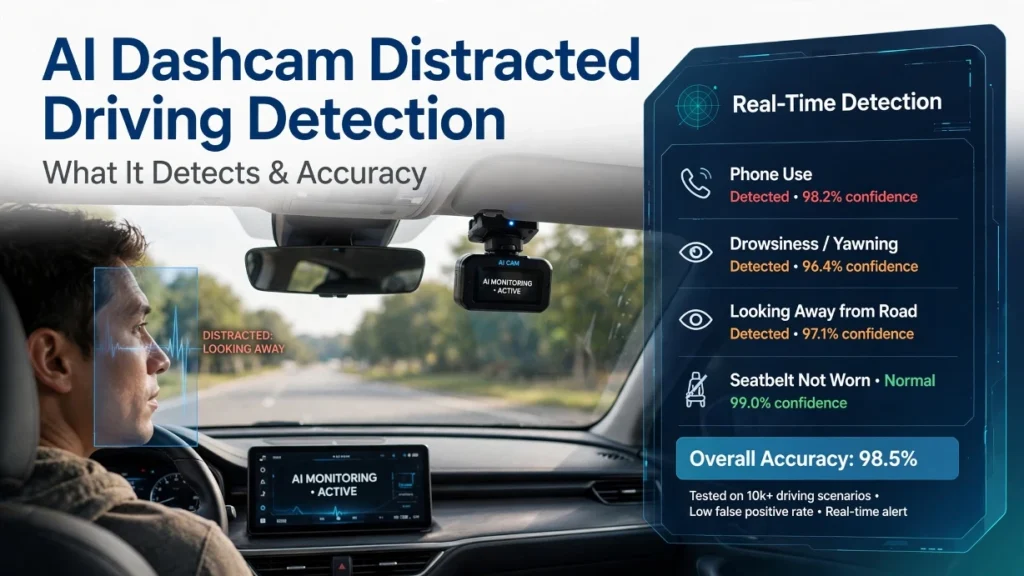
Five seconds. That’s roughly how long an average text message pulls a driver’s eyes off the road, according to federal crash research, and at highway speed that’s long enough to cover the length of a football field without looking up once. Nobody plans to drive blind for a hundred yards. It just happens, in pieces too small to notice until a dashcam starts counting them.
That counting is what this article is about. Not distraction in general, but specifically how a camera figures out that it’s happening, and, just as importantly, the kinds of distraction no camera will ever catch.
Where this fits in: for the full driver-monitoring picture, hardware and privacy included, see What Is AI Driver Monitoring? For the fatigue side of things, blinking, yawning, microsleeps, that’s covered separately in our drowsiness detection guide. This one stays on distraction.
What Counts as Distraction in AI Dashcam Detection?
Federal traffic safety research splits distraction into three categories. That split matters here because AI dashcam distracted driving detection can only ever catch two of them. Visual distraction means eyes off the road. Manual distraction means hands off the wheel. Cognitive distraction means the mind is elsewhere even while the eyes and hands are technically doing their jobs. The classic example is a phone conversation on speaker: hands-free and eyes-forward, yet somehow half the attention disappears anyway.
Texting is the one behavior researchers point to again and again, for a simple reason. It’s the rare case that manages to hit all three categories simultaneously: eyes down, hand off the wheel, mind on the message. That combination is a large part of why it consistently ranks among the more dangerous things a driver can do. It’s also why texting is the easiest of the three to actually detect with a camera, since it leaves visible evidence in two of the three categories at once.
| Category | What It Looks Like | Can a Camera See It? |
|---|---|---|
| Visual | Eyes off the road | Yes, directly |
| Manual | Hands off the wheel | Yes, directly |
| Cognitive | Mind elsewhere, eyes and hands still “normal” | No, not directly |
AI Dashcam Phone Detection: Can It Really Tell You're Texting?
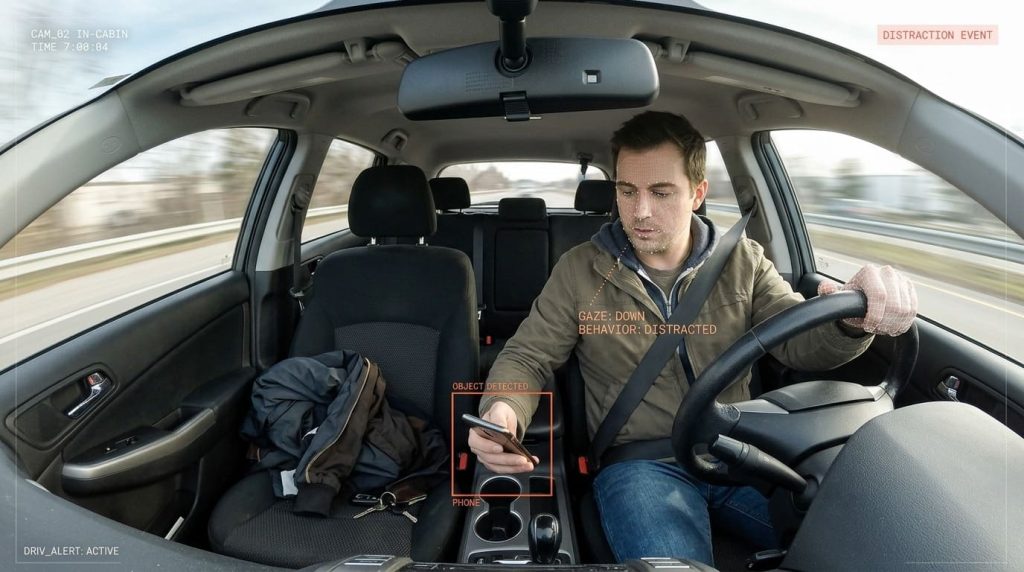
Mostly through indirect signals, though a growing number of systems are starting to look for the phone itself. The more established method tracks where your eyes and head point. Picture your gaze dropping toward your lap or the console. If it stays there past a set duration, the system flags it as visual distraction. That’s true regardless of whether there’s actually a phone in your hand. The system isn’t looking for a phone. It’s looking for the behavior a phone usually causes.
Newer setups add a second layer: object detection trained to recognize a phone-shaped rectangle near the hand or ear. This uses the same underlying computer vision approach used for spotting cars and pedestrians in the road-facing camera. It’s simply repurposed and retrained on a much narrower target. Combine that with hand position tracking, whether a hand is near the wheel or off it. Together, the system can distinguish “glanced at the phone sitting in the cupholder” from “picked it up and started typing.” That combination provides meaningfully more confidence than gaze tracking alone.
Neither approach is foolproof. It’s worth saying plainly: no consumer AI dashcam is reading your screen or knows what app you’re in. It knows where your eyes went and, on more advanced models, whether something phone-shaped left your hand or ear. That’s a real signal. It’s not surveillance of what you were actually doing with the device.
Smoking, Eating, and Other Behaviors AI Dashcam Detection Watches For
Phone use gets most of the attention, understandably. But that same hand-tracking and object-recognition approach extends to other behaviors on higher-end systems too. None of these are universal across every AI dashcam with driver monitoring. Think of this as the outer edge of what the technology currently attempts, not a baseline feature set.
- Smoking. Detected through a combination of hand-to-mouth motion patterns. On some systems, it also uses visual recognition of smoke itself in the cabin.
- Eating or drinking. Similar hand-to-mouth tracking. This one produces more false positives than phone detection, since the motion overlaps with plenty of harmless gestures.
- Talking on a handheld phone. Caught through the combination of a hand near the ear and head tilt. That’s distinct from the pattern a hands-free call produces.
- Extended hands-off-wheel time. Tracked independently of what caused it, useful as a catch-all for distraction the system can’t otherwise classify.
Worth noting: these secondary behaviors are markedly less standardized across manufacturers than core features like collision warning. If any of them matter to your buying decision, check the specific product’s documentation. Don’t assume “driver monitoring” on the box covers all of it.
Does AI Dashcam Distraction Detection Check Your Seatbelt Too?
On some models, yes, and it’s a genuinely different kind of detection than everything else in this article. Seatbelt detection isn’t watching for a behavior or a pattern over time. It’s a single-frame classification question: is there a diagonal strap crossing the chest, yes or no. That simplicity makes it one of the more reliable detections a driver-facing camera performs. It also requires far less of the timing and threshold-tuning complexity that gaze and hand tracking need. Usually it’s bundled quietly into the broader driver monitoring package rather than marketed on its own. It’s a small feature, but worth knowing it’s there.
What It Can't See: The Cognitive Blind Spot
Here’s the honest limit of all of this. Picture a driver deep in thought about a work problem, replaying an argument, or mentally rehearsing a route. That driver can sit with perfect posture: eyes locked on the road, hands correctly at the wheel. Yet they can still be significantly less attentive than the camera has any way of knowing. Cognitive distraction produces no visual signature. There’s nothing for a lens to catch, because nothing about the body has changed, only what’s happening behind it.
This shows up in an interesting way in the research itself. Studies on driver distraction have found something notable. Hands-free phone conversations and talking with a passenger carry meaningfully lower measured crash risk than visual-manual tasks like texting. That’s likely because the eyes stay on the road and the hands stay on the wheel, even while cognitive load rises. That’s a real, evidence-based distinction, not a technicality. But it also means something important. A hands-free call is arguably the single most cognitively demanding thing many drivers do behind the wheel. Yet it’s close to invisible to a camera built to watch eyes and hands. The feature is genuinely good at what it does.
What it does is simply narrower than “detect distraction” as a whole, and it’s worth knowing exactly where that line sits rather than assuming the camera is watching everything that matters.
How Accurate Is Distraction Detection?
Good for the categories it’s built to catch, weaker at the edges. Most of the complaints about this feature actually come from those edges. A quick, necessary mirror check can occasionally register as a gaze-zone violation on an aggressively tuned system. A sip from a water bottle can look enough like the start of a hand-to-mouth phone gesture. That’s often enough to trip a false flag on less refined hardware. None of that reflects a broken concept. It reflects the genuine difficulty of drawing a clean line around “distracted” using nothing but a camera and a set of thresholds.
Phone-specific detection tends to be the most mature of the group. That’s largely because texting produces such a distinctive, sustained pattern across both gaze and hand position at once. Smoking and eating detection lag behind, both technically newer and inherently harder. That’s because the underlying gestures overlap more with ordinary, harmless driving behavior. Product pages that lean heavily on secondary behaviors, like eating or smoking detection, deserve a bit more skepticism. A straightforward phone-use claim is usually more trustworthy by comparison.
Why AI Dashcam Distracted Driving Detection Matters
3,208
People killed in US crashes involving a distracted driver, NHTSA’s most recent annual figure
Those numbers describe a risk that’s almost entirely invisible to the driver taking it. Nobody merges into oncoming traffic on purpose to read a text. The gap between “I’ll just glance down for a second” and an actual five-second lapse is a classic self-misjudgment. A camera simply doesn’t make that mistake. That’s the real case for AI dashcam distracted driving detection. It’s not that the camera is smarter than a careful driver. It’s that the camera doesn’t drift the way attention does.
Key Takeaways
- Distraction splits into three types — visual, manual, and cognitive — and a camera can only directly observe the first two.
- Phone detection works through gaze and hand tracking, with newer systems adding object detection for the phone itself.
- Texting is uniquely easy to catch because it hits visual and manual distraction simultaneously.
- Smoking, eating, and seatbelt checks exist on some models but aren’t standardized, so verify before assuming a specific product includes them.
- Cognitive distraction, like a hands-free call, is largely invisible to a camera — the single biggest honest limitation of this entire feature category.
- Five seconds of texting covers roughly a football field at highway speed, which is the core reason this feature exists at all.
Can an AI dashcam detect phone use while driving?
Yes, mainly by tracking eye and head position for the downward, sustained glance that texting typically causes. On more advanced systems, it also works by recognizing the phone itself near the driver’s hand or ear. It’s not reading the screen, just the behavior around it.
How does AI detect distracted driving?
A driver-facing camera tracks gaze direction, head angle, and hand position. It compares how long attention stays away from the road against set thresholds. Visual and manual distraction, eyes and hands, are what the technology can actually observe.
Can a dashcam tell if the driver is using their phone specifically, versus just looking away?
Increasingly, yes. Basic systems only track where the gaze goes, without knowing why. Newer ones add object detection trained to recognize a phone shape near the hand, plus hand-position tracking. Together, these produce a more specific signal than gaze alone.
Does an AI dashcam detect smoking or eating while driving?
On some higher-end models, yes, through hand-to-mouth motion tracking. It’s less standardized and less mature than phone detection. Eating in particular produces more false positives, since the motion resembles other harmless gestures.
Does an AI dashcam check if you're wearing a seatbelt?
Some models do. It’s a simpler detection than most driver-monitoring features. Essentially, it checks a single frame for a diagonal strap across the chest. That simplicity makes it one of the more reliable checks the camera performs.
What is a distracted driver monitoring system?
A driver-facing camera and software system, usually part of a broader DMS, specifically designed to detect visual and manual distraction: eyes off the road, hands off the wheel, or phone use, and issue an alert when detected patterns cross a set threshold.
Can an AI dashcam detect cognitive distraction, like daydreaming?
No, not directly, and this is the technology’s clearest limitation. Cognitive distraction produces no visible change in eye position, head angle, or hand placement, so a driver can appear fully attentive to a camera while genuinely being mentally elsewhere.
How accurate is AI dashcam distraction detection?
Strong for phone-specific detection, since texting produces a distinctive combined gaze-and-hand pattern. Weaker at the edges, occasional false positives from mirror checks or drinking water are the most common complaints, and secondary behaviors like smoking or eating detection are generally less mature.
How We Verified This
Checked Against Federal Research, Not Product Claims
This AI dashcam distracted driving detection guide draws its numbers from NHTSA and independent research, not dashcam marketing. That covers the distraction taxonomy, crash statistics, and glance-duration findings referenced throughout. Where this guide describes what a camera can and can’t detect, that line comes from research. It’s drawn from the physical signals each distraction category produces, not any single product’s advertised capabilities.
Final Thoughts
A camera watching for distraction is really just formalizing something drivers already half-know about themselves: that attention drifts in ways too small to self-monitor reliably. It’s good at the physical half of that problem, eyes and hands, and honest about not touching the mental half. That’s not a small feature pretending to be a complete solution. Call it a narrow, well-aimed one instead, which is arguably the more useful kind.
This guide is for general informational purposes and is not safety or legal advice. Distracted driving laws vary by location — check local regulations regarding phone use while driving.