
Wooden kitchen gadgets bring quiet power to daily cooking. They protect nonstick and enamel surfaces, feel comfortable in your hand, and add natural warmth to your workspace. Unlike metal, wood won’t clang or overheat; unlike plastic, it won’t warp near heat or hold stubborn odors when you care for it properly. The result is control, comfort, and longevity—meal after meal.
In this easy, in-depth guide, you’ll learn exactly which wooden gadgets to choose and why. I’ll cover spoons, spatulas, ladles, cutting boards, rolling pins, bowls, mortars, pasta tools, muddlers, tongs, and more. You’ll see how different woods—maple, beech, cherry, walnut, acacia, teak, olive, and bamboo—affect strength, feel, and moisture resistance. I’ll also show you how to pick sizes and shapes that match your cookware, how to recognize quality sanding and safe finishes, and how to clean, dry, and oil your tools so they last for years. Along the way, you’ll get practical tips to fix common issues like fuzzing grain, stains, and warping.
By the end, you’ll know how to build a tight, sustainable kit of wooden tools that works hard, looks great, and ages beautifully.
Why choose wooden kitchen gadgets?
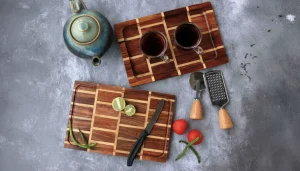
Wood has earned its place beside stainless steel and silicone for good reasons. It’s gentle on cookware, quiet to use, comfortable to grip, and—with the right species and finish—tough enough for daily cooking. It won’t scratch nonstick or enamel, it keeps its cool in hot pans, and it brings a warm, natural look to your space. With simple care, wooden tools can last for years and even look better as they age.
At a Glance: The Benefits
Wooden tools stay gentle on any cookware. So your nonstick, stainless steel, and cast iron stay scratch-free. They handle heat well and don’t get scorching hot like metal. Plus, you get a softer, quieter feel when you stir or mix.
Hardwoods and bamboo are also more eco-friendly when responsibly sourced. Even better, you can sand and re-oil wooden utensils to refresh them instead of buying new ones.
And the Trade-Offs
Wood needs a little care. Hand-wash, dry right away, and oil the surface when it starts looking dull. Otherwise, it can stain or hold onto smells. Also, avoid soaking or using the dishwasher, because too much moisture can cause warping or cracking.
Wood basics: species, grain, and finish
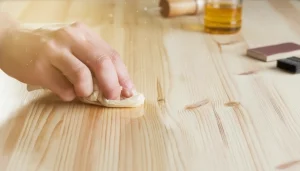
Best Woods for Kitchen Tools
Maple (hard/soft), Beech, Cherry:
These woods have a tight grain, stay strong, and work great for spoons, boards, and rolling pins.
Walnut:
It’s dense, dark, and classy. People love it for cutting boards and serving pieces.
Acacia, Teak, Olive:
These woods are naturally oily. So they resist moisture well. They’re popular for boards, bowls, and serving utensils.
Bamboo:
It isn’t a wood, but a grass. It’s lightweight, hard, and usually laminated with food-safe glue.
Grain Orientation for Cutting Boards
End-grain:
The fibers stand upright, making the surface “self-healing.” It’s gentle on knives, heavy, and usually the premium option.
Edge-grain:
Strips stand on their sides. It’s durable, stable, and sits in a mid-price range.
Face-grain:
Wide planks show off beautiful grain patterns. Great for serving, but softer for daily chopping.
Food-Safe Finishes
Mineral oil & beeswax:
A classic combo with a neutral smell that’s easy to reapply anytime.
Fractionated coconut oil:
It stays stable and doesn’t go rancid like regular cooking oils.
Pure tung oil (fully cured):
Creates a harder, protective finish. Just allow it to fully cure as the maker recommends.
Avoid regular vegetable oils because they can oxidize and develop bad odors.
A Quick Tour of Wooden Kitchen Gadgets
Below is a simple look at the most useful wooden tools—what they do best, what to look for, and how to care for them.
Wooden Spoons: The Kitchen Workhorse
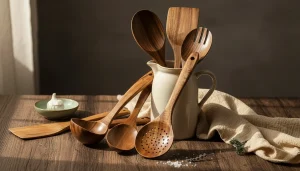
Wooden Spoons: Simple but Essential
Wooden spoons are true kitchen staples. You can use them to stir sauces, saute veggies, scrape up fond, or even taste as you cook. They feel natural in the hand and work with almost any pan.
Types of Wooden Spoons
Round-bowl:
Great for soups, broths, and smooth sauces.
Oval:
Perfect for mixing, folding, and everyday cooking.
Slotted:
Lets extra liquid drain while you stir.
Corner/angled:
Reaches the edges of your pan without missing a spot.
Risotto spoon (with a center hole):
Helps stir rice evenly and release starch.
How to Choose the Right Spoon
Pick a tight-grained hardwood—it lasts longer and resists cracks.
Check that the bowl edge is smooth so food doesn’t cling.
Make sure the handle feels comfortable, especially if you cook for long periods.
Care Tips
-
Wash and dry right after use.
-
Oil it now and then to keep the wood from drying out.
-
If the surface feels rough, lightly sand it and re-oil.
Wooden Spatulas, Turners, and Scrapers
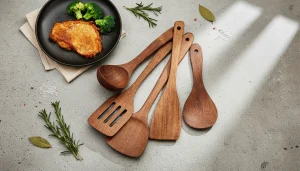
Wooden Spatulas & Scrapers: Small Tools, Big Help
Wooden spatulas and scrapers make flipping, folding, and scraping feel easy. They’re gentle on all cookware and give you great control while cooking.
Best Uses
-
Fold batters without deflating them.
-
Stir stews or thick mixtures.
-
Flip delicate foods in nonstick or enameled pans.
Types to Know
Flat scraper:
Perfect for lifting and cleaning out mixing bowls.
Beveled turner:
Slides under food effortlessly.
Fish-style spatula:
Has a wider head that supports fragile fillets.
Jar spatula:
Narrow shape reaches into jars and scoops sticky spreads.
How to Choose the Right One
Look for thin but sturdy edges so you can lift food cleanly.
Choose rounded corners to keep your pans safe.
Keep separate tools for baking and savory dishes to avoid mixing flavors.
Wooden Ladles and Serving Utensils
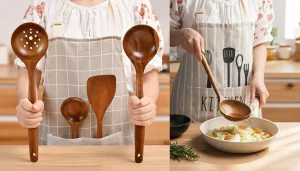
Wooden ladles and serving utensils are excellent for soups, stews, grains, and sauces.
Choosing Tips:
-
Deep bowl to hold liquids effectively.
-
Drip-stop notch helps prevent spills.
-
Long handle works well for stockpots.
Extras:
-
A matching set with slotted and solid spoons makes family meals easy.
-
They are durable, gentle on cookware, and add a rustic charm to your table.
Wooden Cutting Boards: Prep and Carving
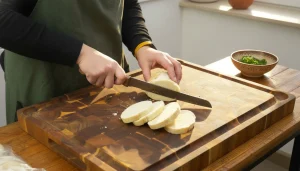
Wooden Cutting Boards: Your Everyday Prep Partner
Wooden cutting boards make prep work easy and look great on the counter. You can use one board for daily chopping, slicing bread, carving roasts, or even serving snacks.
Best Uses
-
Everyday chopping and slicing.
-
Cutting bread cleanly.
-
Carving roasted meats.
-
Serving cheese, fruits, or appetizers.
How to Choose
Pick a size that fits your sink so cleaning feels simple.
Go for an end-grain board if you do a lot of heavy knife work.
A juice groove helps when carving juicy roasts.
And for safety, choose a board with rubber feet or place a damp towel under it to stop slipping.
Care Tips
Wash the board and stand it upright to dry.
Apply oil or wax regularly to keep the wood healthy.
If the surface feels rough, light sanding brings it back to smooth.
Bread Boards & Cheese Boards

Bread & Cheese Boards: Simple, Stylish, and Useful
Bread and cheese boards do double duty—they help you serve beautifully while still staying practical.
How to Choose
Pick face-grain or edge-grain boards for a smooth, flat surface.
These styles work great for serving bread, cheese, and charcuterie.
Care Tips
Give the board a light coat of oil now and then to protect the wood.
Avoid using it for raw meat, so you keep things clean and safe.
Rolling Pins
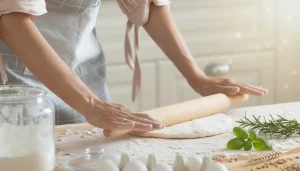
Rolling Pins: Simple Tools That Make Baking Better
A good rolling pin makes pies, cookies, laminated doughs, and flatbreads so much easier.
Popular Styles
-
French (tapered): Easy to pivot and gives great control.
-
Straight dowel: Helps you roll dough to an even thickness.
-
Handled pin: Rolls smoothly with less effort.
-
Embossed pin: Adds fun patterns to cookies or fondant.
How to Choose
Look for a smooth finish and straight grain.
Pick a pin with balanced weight, so it feels steady in your hands.
Care Tips
Wipe after use and avoid soaking.
Apply a light coat of oil occasionally, but don’t overdo it.
Why It Helps
A solid rolling pin keeps your dough consistent and gives your baking a clean, professional touch—without much effort.
How to Choose Quality Wooden Gadgets
Here’s an easy checklist:
-
Pick pieces with tight grain and smooth sanding—no rough patches.
-
Check the balance; the tool should feel steady, not heavy on one side.
-
For boards, look at the joinery. Glue lines should be clean with no gaps.
-
Choose food-safe finishes like oil or wax. Skip heavy lacquer on surfaces that touch food.
-
Match the size to your pots and pans—long handles for deep pots, smaller tools for nonstick pans.
-
And finally, consider sustainability. FSC-certified wood or responsibly sourced materials are always a better choice.
Rolling Pins: Simple Tools That Make Baking Better
A good rolling pin makes pies, cookies, laminated doughs, and flatbreads so much easier.
Popular Styles
-
French (tapered): Easy to pivot and gives great control.
-
Straight dowel: Helps you roll dough to an even thickness.
-
Handled pin: Rolls smoothly with less effort.
-
Embossed pin: Adds fun patterns to cookies or fondant.
How to Choose
Look for a smooth finish and straight grain.
Pick a pin with balanced weight, so it feels steady in your hands.Care Tips
Wipe after use and avoid soaking.
Apply a light coat of oil occasionally, but don’t overdo it.Why It Helps
A solid rolling pin keeps your dough consistent and gives your baking a clean, professional touch—without much effort.
How to Choose Quality Wooden Gadgets
Here’s an easy checklist:
-
Pick pieces with tight grain and smooth sanding—no rough patches.
-
Check the balance; the tool should feel steady, not heavy on one side.
-
For boards, look at the joinery. Glue lines should be clean with no gaps.
-
Choose food-safe finishes like oil or wax. Skip heavy lacquer on surfaces that touch food.
-
Match the size to your pots and pans—long handles for deep pots, smaller tools for nonstick pans.
-
And finally, consider sustainability. FSC-certified wood or responsibly sourced materials are always a better choice.
-
Care, cleaning, and maintenance (step-by-step)
Daily cleaning
- Wash promptly with warm water and mild soap.
- Rinse and dry immediately with a towel.
- Stand boards on edge so both faces dry evenly.
Monthly oiling (or when wood looks dry)
- Apply food-safe mineral oil with a lint-free cloth.
- Let it soak for 20–30 minutes.
- Wipe excess; buff with a beeswax/mineral oil board cream for extra protection.
Deodorizing and stain help
- Baking soda paste lifts odors (garlic/onion) from boards and spoons.
- Lemon + coarse salt gently scrubs stains on cutting boards.
- Sunlight (briefly) can freshen odors; avoid long exposure that can warp or bleach.
What to avoid
- Dishwashers, soaking, or boiling water.
- Harsh bleach or strong detergents that dry and crack wood.
- Vegetable oils (they can oxidize and smell).
When to retire a tool
- Deep cracks you can’t sand out, black mold spots that return, or loose parts on mallets and mills.
Wooden vs. bamboo vs. other materials
- Hardwood: classic, repairable, excellent feel.
- Bamboo: hard and budget-friendly, often a bit more brittle; great for boards and servers.
- Silicone: flexible, fully dishwasher-safe; great heat resistance.
- Metal: ultra-durable, thin edges; can scratch coatings and clangs loudly.
Smart strategy: mix and match—use wood for daily stirring and boards, silicone for high-heat spatulas, metal for searing and scraping steel pans.
Sustainability & end-of-life
Choose responsibly sourced wood, maintain it well, and you’ll keep tools in service for years. At end-of-life, repurpose (garden markers, trivets, craft projects) or compost small, finish-free pieces. Avoid tossing large, oiled blocks in green waste unless your local program accepts them.
Troubleshooting: quick fixes
- Fuzzy grain after washing: when dry, hand-sand with 400-grit, then oil.
- Warped cutting board: store flat with light weight on top in a dry, shaded spot; oil evenly after.
- Persistent smell: baking soda + lemon scrub; if it lingers, sand lightly and re-finish.
- Sticky surface after oiling: you used too much or a curing oil; wipe with a clean cloth and buff in a small amount of mineral oil.
Buying checklist (printable mental note)
- Tight grain hardwood or quality bamboo
- Smooth finish, no splinters, no rough glue lines
- Comfortable, balanced handle
- Size and shape fit your pots, pans, and jars
- Food-safe oil/wax finish (not heavy lacquer)
- Reputable brand with sustainable sourcing
- Care instructions included
Why Wooden Kitchen Gadgets Are a Must-Have
-
Durable: Can last for years with proper care.
-
Eco-friendly: Biodegradable and natural.
-
Safe: Non-toxic, food-grade wood is gentle on your hands and cookware.
-
Versatile: Perfect for prep, cooking, baking, and serving.
-
Aesthetic: Adds warmth and charm to your kitchen.
Wooden kitchen gadgets combine practicality, style, and sustainability.
Final Thoughts
Wooden kitchen gadgets are timeless, durable, and versatile. From stirring sauces with wooden spoons to rolling out dough with a balanced pin, these tools make cooking enjoyable and effortless. They’re eco-friendly, gentle on cookware, and add a rustic charm to your kitchen.
Investing in quality wooden spoons, spatulas, cutting boards, and rolling pins is not just practical — it’s a way to bring craftsmanship, durability, and style into your cooking every day.
FAQs About Wooden Kitchen Gadgets
1. Are wooden kitchen gadgets safe for non-stick cookware?
Yes, they won’t scratch or damage non-stick surfaces.
2. How do I clean them properly?
Wash with mild soap and warm water. Dry immediately. Avoid soaking.
3. How often should I oil wooden utensils?
Once every few weeks or when the wood starts looking dry.
4. Can I put wooden boards or utensils in the dishwasher?
No, dishwashers can warp and crack wood. Always hand wash.
5. How do I prevent wooden boards from slipping?
Place a damp towel or rubber feet under the board for stability.