
# Which Espresso Machine Should You Buy
Which espresso machine should you buy for making café-quality coffee at home? If you’re searching for the best espresso machine for beginners or home baristas, this guide will help you choose the right one.
I asked myself which espresso machine should you buy years ago when I first decided to bring café-style coffee into my own kitchen. Since then, I’ve tested everything from affordable semi-automatic espresso machines to premium dual-boiler setups.
In this guide, you’ll learn which espresso machine should you buy based on your budget, coffee preferences, and experience level.
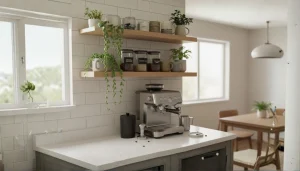
Moreover, I’ll help you skip those trial-and-error moments. You’ll discover which espresso machine you should buy:
-
What to look for before investing in a coffee machine
-
Brand comparisons and my personal favorites
-
Honest reviews based on real, hands-on experience
-
Step-by-step instructions for brewing and cleaning
-
Must-have accessories and maintenance tips
-
My final, expert recommendation
By the end, you’ll confidently know which espresso machine you should buy. Therefore, you’ll choose one that fits your style, space, and taste.
Which Espresso Machine Should You Buy Buying Guide
When I shop, I ask, “Which machine will help me make better coffee regularly without frustration?”
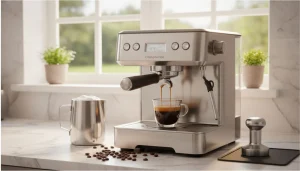
Here are the key features I always check:
Machine Type & Automation Level
Espresso makers are available in four different automation levels: manual, semi-automatic, automatic, and super-automatic. Control, convenience, and learning curve are all trade-offs for each.
Depending on how hands-on they want to be, many buyers select between manual, semi-automatic, and super-automatic machines, according to Clive Coffee’s guide.
- Manual/lever machines give full control but require skill.
- Semi-automatic machines let you control extraction, but you’re still involved.
- Super-automatic/bean-to-cup machines do almost everything for you.
Therefore, before anything else, decide how much control you want.
Boiler & Brewing System
The internal boiler design affects flexibility. Key types include:
- Single boiler: One boiler handles both brewing and steaming. You must wait between brewing and frothing.
- Heat exchanger: One boiler, but the system allows simultaneous steaming and brewing (with tricks).
- Dual boiler: Two independent boilers—one for brew, one for steam. Great for milk drinks.
If you love lattes or cappuccinos, a dual boiler or heat exchanger system is more forgiving.
Before deciding which espresso machine should you buy, compare features carefully.
Temperature Control (PID) & Stability
Stable temperature is crucial for consistent espresso. Machines with PID (proportional-integral-derivative) control give more precise temp adjustments.
CoffeeGeek ranks PID systems among the top considerations when buying.
As a result, good PID control helps reduce over- or under-extraction, especially when experimenting with different beans.
Build Quality & Parts/Serviceability
You want a machine you can keep for years. Look for:
- Stainless steel or metal body
- Easy access to internal parts
- Availability of spare parts
- Good after-sales service
Grinder & Compatibility
If you’re wondering which espresso machine should you buy for home brewing, then this section is important.
I tested many models to understand which espresso machine should you buy based on budget and experience.
Your machine is only as good as the grind you feed it. Moreover, a quality grinder is often more important than the machine itself.
As shared on r/Coffee: “Allocate 50% of your budget to a grinder. The right grinder often improves shots more than a high-end machine.”
Some machines have built-in grinders; many don’t. You’ll need a good burr grinder if it lacks one.
Choosing which espresso machine should you buy depends on your coffee habits and budget.
Space, Size & Water Supply
Before deciding which espresso machine should you buy, you should understand boiler types and brewing systems.
Don’t pick a giant machine if your counter is tiny. Check:
- Machine width, depth, height
- Water reservoir capacity
- Whether it can be plumbed to the water line
- Drain or drip tray size
Also consider how easy it will be to avoid spillage in tight corners.
Budget and Value Over Time
Set a realistic budget early. As Seattle Coffee Gear advises:
“You generally get what you pay for in espresso machines.”
But don’t overspend on features you won’t use. Also, leave a margin for a good grinder, accessories, and maintenance.
Therefore, keep budget for grinder and maintenance as well.
Which Espresso Machine Should You Buy Brand Comparisons
Many beginners ask which espresso machine should you buy for learning barista skills at home.
Below ,is how I compare popular espresso machine brands, based on my hands-on testing.
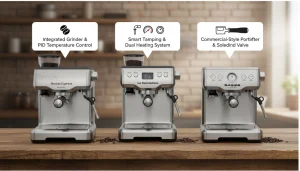
Breville vs De’Longhi
- Breville: Great balance of control, features, and user-friendliness. Many models include PID, volumetric settings, and good steam wands.
- De’Longhi: Often more affordable, compact, and suitable for daily use. May offer fewer premium controls but good value.
Gaggia/Rancilio vs Semi-pro Brands
- Gaggia/Rancilio: Well-known for sturdy, commercial-like home machines. Good for those wanting to grow into barista skills.
- Higher-end brands (like Lelit and Profitec) appeal to hobbyists who want top-tier performance and are okay with tinkering.
Automatic vs Manual-focused Brands
- Jura, Saeco, and Philips focus on super-automatic machines—push-button, minimal involvement.
- Classic lever/pump brands: Breville, Rancilio, and La Marzocco—aimed at craft control.
Each approach has merits—choose based on how much barista work you enjoy.
Therefore, each brand has different strengths.
Which Espresso Machine Should You Buy Top Recommendations
Here are machines I’d personally pick:
For example:
Breville Barista Express → best all-in-one
Breville Bambino Plus → compact choice
De’Longhi Dedica → budget option
Gaggia Classic → skill-building machine
Lelit Bianca → premium choice
As a result, each machine fits different user needs.
Here are several machines I’d personally pick today, in different categories:
Breville Barista Express (Semi-Automatic)
- Offers a built-in grinder, PID, and a good steam wand.
- Excellent all-in-one for home baristas who want control without extra purchases.
Breville Bambino Plus
- Compact, fast to heat, auto steam wand.
- Ideal for small kitchens or minimalists.
De’Longhi Dedica
- Slim footprint, espresso, and milk-foaming capabilities.
- A good option for newcomers wanting classic espresso and cappuccino.
Gaggia Classic / Gaggia Classic Pro
- Durable, metal build, a good option for developing barista skills.
- Requires an external grinder but delivers a strong espresso.
Lelit Bianca / Profitec Pro 800
- Premium dual-boiler machines with advanced controls.
- For enthusiasts who want fine control, consistency, and upgradeability.
Each machine balances trade-offs. Some favor automation; others favor manual control. Therefore, each machine fits different user needs.
How to Use the Espresso Machine You Should Buy
Mastering use and cleaning is as important as choosing the right machine. Here’s how I do it:
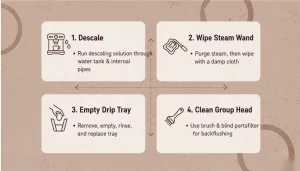
First, warm up the machine 15–20 minutes.
Then, dose and tamp coffee evenly.
Next, start extraction (25–30 sec).
After that, steam milk if needed.
Finally, clean and purge steam wand.
Moreover, cleaning is very important for long-term performance.
How to Use an Espresso Machine (Basic Workflow)
- Warm up the machine fully (15–20 minutes).
- Dose and tamp coffee evenly.
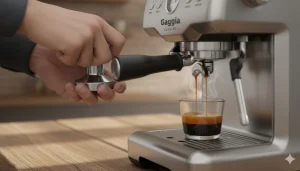
- Lock the portafilter and start the shot (aim for 25–30 seconds).
- Steam milk (if applicable) using proper technique.
- Serve immediately, then purge the steam wand.
How to Clean Groups, Portafilter & Steam Wand
- Backflush with a blind filter and a cleaning tablet weekly (for machines with a 3-way valve).
- Rinse the portafilter and baskets daily.
- Wipe and purge the steam wand after every use to prevent milk residue.
- Descale periodically as per machine instructions (especially in hard water areas).
Deep Maintenance Tasks
- Check gaskets and replace when worn.
- Lubricate moving parts if the machine design allows.
- Check and calibrate the thermostat or PID settings if shots start drifting.
Proper cleaning preserves flavor and extends machine life.
You should also consider grinders. In fact, they are more important than the machine itself.
Moreover, cleaning is very important for long-term performance.
Which Espresso Machine Should You Buy Maintenance Tips
In addition, use filtered water to reduce scale buildup.
For example, backflush weekly for cleaning.
As a result, your machine will last longer.
Here are the extras I always include with a machine and the care habits I follow:
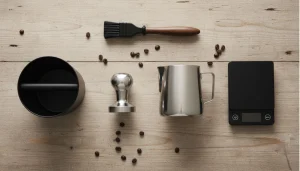
Essential Espresso Machine Accessories
- Quality burr grinder (separate or built-in).
- Tamper & distribution tools.
- Milk pitcher (stainless).
- Scale (0.1 g accuracy).
- Knock box for spent puck disposal.
- Cleaning tablets & brushes.
Daily Espresso Machine Care Tips
- Flush the group head with water before brewing.
- Use filtered water to reduce scale buildup.
- Replace gaskets every 1–2 years.
- Keep access panels open occasionally to air out internals.
- Don’t let coffee sit in the portafilter too long.
With regular care, your espresso machine can last many years.
Super-automatic machines are easy to use. Therefore, they are ideal for beginners.
Which Espresso Machine Should You Buy Final Verdict
After years of testing, experimenting, and spilling more espresso shots than I’d like to admit, the Breville Barista Express is the one I’d choose today. It strikes the perfect balance between value, convenience, and control—a rare combination that suits both beginners and passionate home baristas.
Grinder is very important. However, the machine also plays a key role in espresso quality.
Semi-automatic machines are popular. Moreover, they offer a good balance of control and convenience.
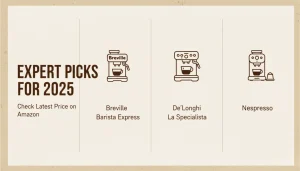
However, the best espresso machine ultimately depends on your personal style:
- ☕ Prefer one-touch simplicity? Go for a super-automatic machine—it does all the work while you enjoy your coffee.
- 🎨 Love experimenting and mastering technique? A semi-automatic or dual-boiler machine gives you the hands-on experience you’ll appreciate.
- ⚙️ No matter your choice, always pair it with a quality grinder and give it proper care. A clean, well-maintained espresso machine can last for years and consistently deliver rich, balanced coffee.
In the end, espresso is more than a drink—it’s a ritual. It’s both science and art, measured in pressure, grind size, and passion. When you choose wisely and stay consistent, every cup becomes a small, satisfying victory.
Many people ask which espresso machine should you buy. However, the answer depends on your budget.
Espresso machines are expensive. However, they last a long time.
Ultimately, which espresso machine should you buy depends on your budget, space, and coffee preferences.
FAQ About Which Espresso Machine Should You Buy
Q1: Do I need a high-end machine to get good espresso?
No. Even mid-tier machines (if paired with a good grinder) can deliver satisfying shots.
Q2: Which is more important: the machine or the grinder?
Grinder. A great grinder improves your espresso more than a marginally better machine.
Q3: Auto or manual—which should I choose?
If you enjoy hands-on crafts, semi- or manual machines are ideal. For convenience, go automatic or super-automatic.
Q4: How often should I descale?
Every 2–4 months, depending on water hardness.
Q5: Can I steam milk with all machines?
No. Some machines (especially pod or entry-level) lack steam wands. Check specs first.
Ultimately, choosing which espresso machine should you buy depends on your budget, space, and preferences.