
Table of Contents
ToggleIntroduction
Electronics is one of the most important fields of modern science and technology. Nearly every device we use today—from smartphones and laptops to televisions, cars, and smart home systems—relies on electronic components. If you’re new to this subject, learning electronics for beginners is an excellent way to understand how these devices work and build practical technical skills.
The good news is that you don’t need an engineering degree to start learning electronics. By understanding a few basic concepts such as electricity, voltage, current, resistance, circuits, and common components, anyone can begin exploring this fascinating field.
This comprehensive guide explains the fundamentals of electronics, introduces essential components, and provides practical tips for beginners who want to learn and build simple electronic projects.
What Is Electronics?
Electronics is the branch of science and engineering that studies the controlled movement of electricity through electronic components to process information or perform useful tasks.
Electronics is used in:
- Smartphones
- Computers
- Televisions
- Medical equipment
- Robots
- Smart home devices
- Automobiles
Without electronics, modern technology would not exist.
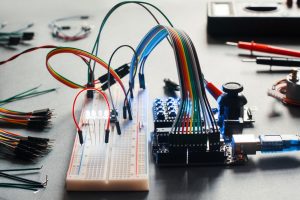
Why Learn Electronics?
Learning electronics offers many benefits:
- Understand how devices work
- Develop problem-solving skills
- Build DIY projects
- Prepare for engineering careers
- Improve technical knowledge
- Support robotics and programming projects
Electronics is valuable for students, hobbyists, and professionals alike.
Basic Concepts Every Beginner Should Know
1. Electricity
Electricity is the flow of electrons through a conductor.
It powers electronic devices and allows circuits to operate.
2. Voltage
Voltage is the electrical pressure that pushes electrons through a circuit.
It is measured in volts (V).
Example:
- AA battery: approximately 1.5V
- USB power: 5V
3. Current
Current is the flow of electrical charge.
It is measured in amperes (A).
Higher current means more electrical flow.
4. Resistance
Resistance limits the flow of current.
It is measured in ohms (Ω).
Resistors are commonly used to protect electronic components.
5. Power
Power represents the rate at which electrical energy is used.
It is measured in watts (W).
Examples:
- LED bulb
- Laptop charger
- Television
What Is an Electronic Circuit?
A circuit is a complete path through which electricity flows.
A basic circuit includes:
- Power source
- Conductive wires
- Electronic components
- Load
If the circuit is complete, electricity flows and the device operates.
Essential Electronic Components
Resistor
A resistor limits electrical current.
Uses:
- Protect LEDs
- Control voltage
- Divide signals
Capacitor
A capacitor stores electrical energy temporarily.
Applications:
- Power filtering
- Timing circuits
- Energy storage
Diode
A diode allows electricity to flow primarily in one direction.
Common uses:
- Rectification
- Protection
- Signal control
LED (Light Emitting Diode)
LEDs produce light when current passes through them.
Advantages:
- Low power consumption
- Long lifespan
- High efficiency
Transistor
A transistor acts as an electronic switch or amplifier.
Modern processors contain billions of transistors.
Integrated Circuit (IC)
An IC combines many electronic components into a single chip.
Examples:
- Microcontrollers
- Memory chips
- Processors
Common Tools for Beginners
Useful tools include:
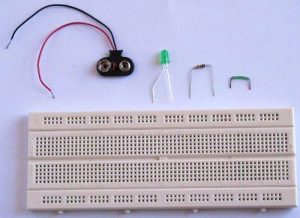
- Breadboard
- Jumper wires
- Multimeter
- Screwdriver set
- Wire cutter
- Soldering iron (for advanced projects)
These tools help assemble and test circuits.
What Is a Breadboard?
A breadboard allows you to build circuits without soldering.
Benefits:
- Easy experimentation
- Reusable
- Beginner-friendly
- Safe for learning
Many educational projects start on a breadboard.
Power Sources Used in Electronics
Common power sources include:
- AA batteries
- Rechargeable batteries
- USB power supplies
- DC adapters
- Solar panels
Always use the correct voltage for your project.
Understanding Series and Parallel Circuits
Series Circuit
Components are connected one after another.
Characteristics:
- Single path for current
- Failure of one component may stop the circuit
Parallel Circuit
Components operate on separate branches.
Characteristics:
- Multiple current paths
- One failure may not stop the others
Most household electrical systems use parallel connections.
Simple Beginner Projects
Start with easy projects such as:
- LED blinking circuit
- Battery-powered flashlight
- Simple alarm
- Light sensor
- Electronic dice
- Mini fan controller
These projects help reinforce basic concepts.
Safety Tips for Beginners
Always follow good safety practices:
- Disconnect power before modifying circuits.
- Use components with appropriate ratings.
- Keep liquids away from electronics.
- Work in a clean, dry area.
- Avoid damaged wires.
- Read instructions before powering a project.
Safety should always be a priority.
Common Mistakes Beginners Make
Avoid these common errors:
- Reversing polarity
- Using incorrect voltage
- Short-circuiting components
- Forgetting resistors for LEDs
- Loose wire connections
- Ignoring safety precautions
Learning from mistakes is part of the process, but careful planning helps prevent damage.
Benefits of Learning Electronics
Studying electronics can lead to skills in:
- Robotics
- Automation
- Programming
- Home projects
- Product design
- Engineering
It also encourages creativity and logical thinking.
Future Opportunities
Knowledge of electronics is valuable in fields such as:
- Artificial Intelligence
- Internet of Things (IoT)
- Smart home technology
- Renewable energy
- Automotive systems
- Medical technology
As technology advances, electronics skills remain highly relevant.
Tips for Learning Faster
To improve your understanding:
- Learn basic theory first.
- Practice with simple circuits.
- Read component datasheets when needed.
- Keep a notebook of experiments.
- Build projects regularly.
- Be patient and curious.
Consistent practice is one of the best ways to develop electronics skills.
Frequently Asked Questions
Is electronics difficult for beginners?
No. Starting with basic concepts and simple projects makes electronics accessible to most learners.
What should I learn first?
Begin with electricity, voltage, current, resistance, circuits, and basic components such as resistors and LEDs.
Do I need programming to learn electronics?
Not necessarily. Many basic electronics projects require no programming, although programming becomes useful for microcontrollers and automation projects.
What is the best tool for beginners?
A breadboard and a multimeter are among the most useful tools because they allow easy circuit building and testing.
Can I learn electronics at home?
Yes. With online resources, beginner kits, and regular practice, many people successfully learn electronics at home.
Conclusion
Learning electronics for beginners is the first step toward understanding the technology that powers the modern world. By mastering concepts such as electricity, circuits, voltage, current, and electronic components, you can build practical skills that apply to everyday devices and future innovations.
Whether your goal is to create DIY projects, pursue an engineering career, or simply understand how electronic devices work, starting with the basics provides a strong foundation. With curiosity, practice, and patience, anyone can begin an exciting journey into the world of electronics.